Magnitude 7.1 earthquake hits Japan's Kyushu region: JMA
A 7.1 magnitude earthquake struck Japan's Kumamoto prefecture on Kyushu island, registering the highest level on the Shindo scale. A tsunami warning for waves up to 1m was issued.
Intelligence analysis by Gemini 2.5 Flash Lite
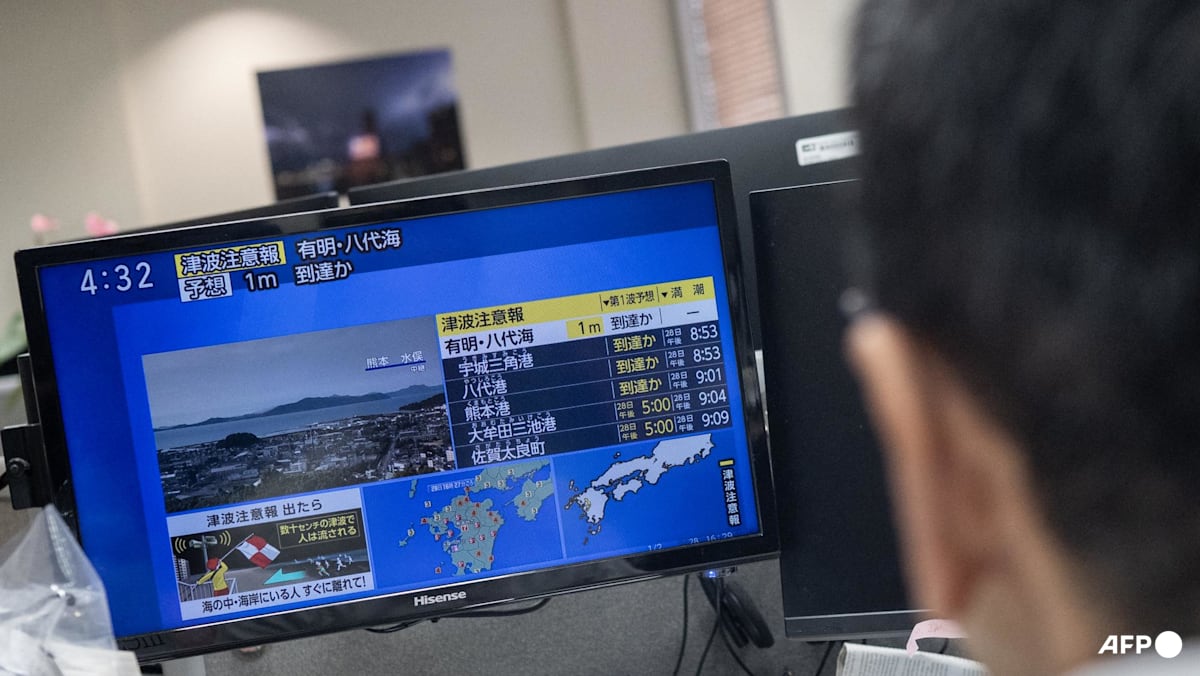
Japan's Kyushu island was hit by a powerful 7.1 magnitude earthquake, triggering a tsunami warning for waves up to 1 meter. The tremor registered the maximum level on Japan's seismic scale, leading to the suspension of train services and emergency warnings across several prefectures.
Imagine the Earth is like a giant puzzle with many pieces. Sometimes, these pieces shift and bump into each other, causing the ground to shake. This happened in Japan, and the shaking was so strong it was like a level seven on a special shaking scale! Because it happened near the ocean, there was a warning that a small wave, about as tall as a big dog, might come ashore.
Analysis
Seismic Activity in a Volatile Region
Japan, situated on the Pacific Ring of Fire, is no stranger to seismic events, experiencing tremors with remarkable frequency. This particular earthquake, registering a preliminary magnitude of 7.1 and a shallow depth of 10km, struck the Kumamoto prefecture on Kyushu island. Its intensity was such that it measured at the highest possible level, seven, on Japan's own Shindo scale, indicating severe shaking. The Japan Meteorological Agency (JMA) promptly issued a tsunami warning, anticipating waves of up to 1 meter, with the possibility that such waves might have already arrived. This immediate alert underscores the sophisticated early warning systems Japan has in place to mitigate the impact of such natural disasters.
Infrastructure and Nuclear Safety
The earthquake's impact extended to critical infrastructure, with train operator JR Kyushu announcing the suspension of all services, including the high-speed Shinkansen. This disruption is a common consequence of significant seismic activity in Japan, affecting both passenger and freight transport, and highlighting the resilience challenges faced by the nation's advanced transportation networks. Crucially, Kyushu Electric Power reported no irregularities at its Sendai and Genkai nuclear power stations. This is a significant point, given the historical concerns surrounding nuclear safety in earthquake-prone regions, particularly in the wake of the Fukushima disaster. The lack of reported issues at these facilities suggests that safety protocols and infrastructure held firm under the stress of the tremor.
Regional Impact and Preparedness
The Japanese government issued emergency earthquake warnings across seven prefectures on Kyushu island: Kumamoto, Nagasaki, Kagoshima, Fukuoka, Saga, Oita, and Miyazaki. This broad alert signifies the widespread potential impact of the earthquake and the need for coordinated emergency response across a significant geographical area. Japan's location along the Ring of Fire means it accounts for approximately 20 percent of the world's earthquakes of magnitude 6.0 or greater. This constant threat necessitates a high level of preparedness, from building codes to public education and emergency services, making the nation a global benchmark for earthquake resilience and disaster management.
Key points
- A 7.1 magnitude earthquake struck Japan's Kyushu island, registering the highest level on the Shindo scale.
- A tsunami warning for waves up to 1 meter was issued for the region.
- Train services, including Shinkansen, were suspended following the tremor.
- No irregularities were reported at nuclear power stations in the affected area.
- Emergency warnings were issued across seven prefectures on Kyushu island.
The swift issuance of tsunami warnings and emergency alerts demonstrates Japan's advanced disaster preparedness. The absence of reported irregularities at nuclear power stations suggests that critical infrastructure remains resilient, minimizing the risk of secondary disasters.
Despite robust systems, the magnitude of the earthquake and the potential for tsunami waves pose significant risks to infrastructure and public safety. Disruptions to transportation networks, like the suspension of train services, can have cascading economic and social impacts.