Marquetry Work Inspired by Ashura Donated to Museum
Marquetry artist Hamed Asgarian donates his Ashura-inspired work to the Shah Abdol-Azim Museum in Rey, Iran.
tehrantimes.com1 min read
Intelligence analysis by Qwen 2.5 (3B)
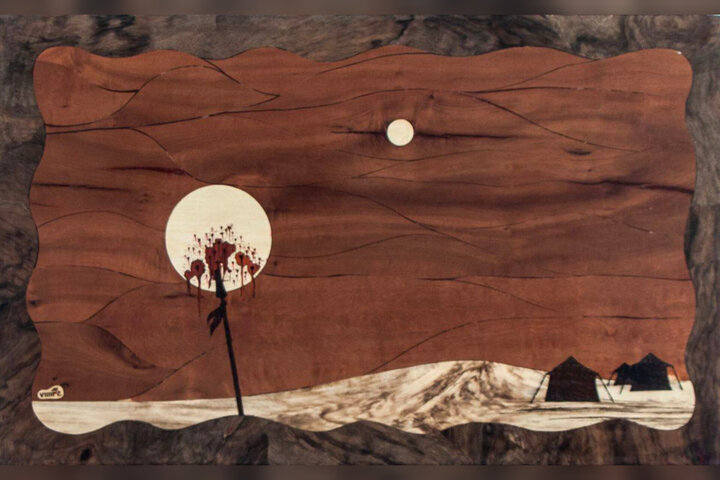
Iranian marquetry artist Hamed Asgarian donates his Ashura-inspired marquetry work to the Shah Abdol-Azim Museum in Rey, Iran.
An artist made a special wooden picture inspired by a sad event in history. He gave it to a museum where people can see it and learn about it.
Analysis
{"
Marquetry and Its Evolution in Iran":"Hamed Asgarian, a marquetry artist with a background in engineering, has developed a unique style known as 'Chiltechini.' This style combines geometric precision with the organic qualities of nature, creating a distinctive visual balance. The exhibition 'Marquetry... A Different Kind' showcased Asgarian's works, moving marquetry beyond its conventional association with handicrafts and traditional decoration.","
The Ashura-Inspired Work":"Asgarian's Ashura-inspired marquetry work, titled 'Blood of God,' is a 74 by 53 centimeter piece weighing 4.75 kilograms. It features contrasting areas of light and darkness, elements representing earth and sky, and two luminous circles evoking the symbolic imagery of Karbala. The work is made of natural, dried wood, untreated and free of additional ornamentation.","
The Museum and Its Collection":"The Shah Abdol-Azim Museum in Rey houses a permanent collection of contemporary artistic interpretations of Ashura. The donation of 'Blood of God' places this work within the institution's visual record, preserving its significance for future generations."}
Key points
- Hamed Asgarian donates his Ashura-inspired marquetry work to the Shah Abdol-Azim Museum in Rey, Iran.
- The work, titled 'Blood of God,' is a 74 by 53 centimeter piece weighing 4.75 kilograms.
- The museum houses a permanent collection of contemporary artistic interpretations of Ashura.
The Upside
The donation of 'Blood of God' to the museum will help preserve and promote the intersection of art and religious symbolism in Iran.
The Downside
If the museum does not properly preserve the artwork, it could lose its significance and impact.