Mecca Pact: What does Ankara want from defense agreements with Pakistan and Saudi Arabia?
Trump has welcomed a new defense pact between Pakistan, Saudi Arabia, and Turkey, under which an attack on any of the three will be treated as an attack on all. The agreement has drawn varied analysis, with some calling it a 'Muslim NATO' while Turkey insists it is open t…
Intelligence analysis by Llama
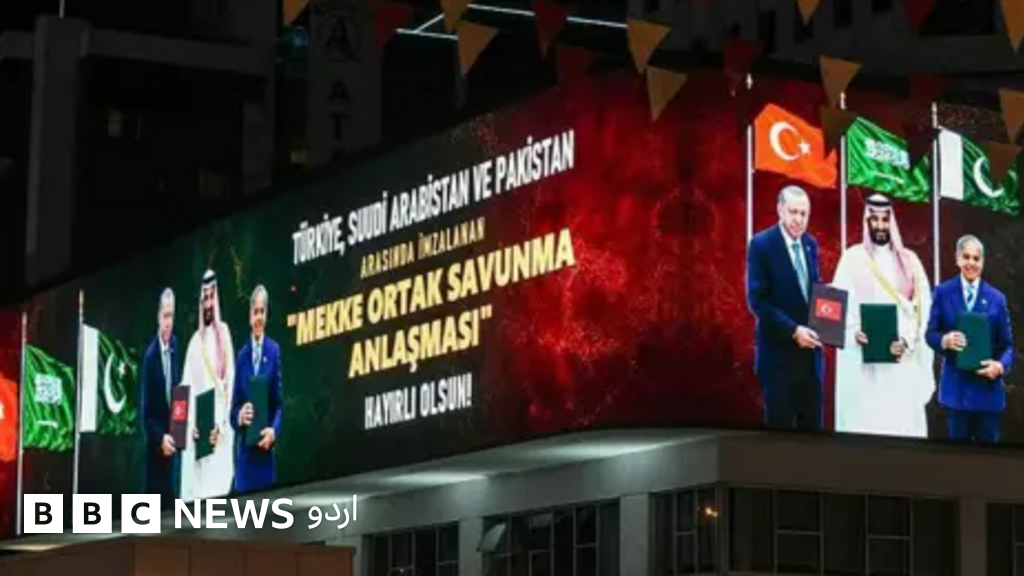
Trump's endorsement of the Mecca Pact between Pakistan, Saudi Arabia, and Turkey frames it as a sign of Middle East unity, though analysts remain divided on whether the alliance targets Iran or Israel. Erdogan has invited Egypt to join, while the written text remains undisclosed.
Three big Muslim countries, Pakistan, Saudi Arabia, and Turkey, agreed to treat an attack on any one of them as an attack on all three, kind of like best friends promising to stick together on the playground. Some people think the deal is meant to keep the region safe, while others wonder if it is really aimed at Iran.
Analysis
Strait of Hormuz
President Erdogan, in a recent interview, stated that the three nations believe "joint security will improve stability in the region, including the Strait of Hormuz," and that "security and economic progress cannot be separated." The explicit mention of the Strait of Hormuz, through which roughly a fifth of global oil shipments pass, signals that the pact is not a purely ceremonial document. Turkey's inclusion in a Gulf-centered security architecture is unusual; Ankara has historically positioned itself as a NATO-anchored power with a Mediterranean and Black Sea focus. By tying itself to the Strait, Turkey is signaling a long-term interest in energy security and freedom of navigation in a chokepoint it does not geographically border. For Pakistan, whose naval assets and Gwadar port sit near the approaches to the Strait, the pact creates a connective tissue between the Arabian Sea and the wider defense framework, raising the question of how a mutual-defense clause would be operationalized far from South Asia.
December 2024
On August 8, Turkey's defense minister announced that negotiations on the Mecca Pact had been running since December 2024, a timeline officials have cited to argue that the agreement predates recent regional flare-ups. This dating matters because it undermines the framing, common in some commentary, that the pact is a direct reaction to a single crisis. The negotiations appear to have matured across more than 18 months, during which Pakistan signed a separate bilateral defense agreement with Saudi Arabia in September 2025, also without publishing its text. The opacity of these texts has become a defining feature of the new alignment. Analysts note that the absence of a written, public document has fueled speculation about whether the pact is a binding mutual-defense treaty, a framework for cooperation, or a political signal. Until the text is released, observers are reading between the lines of presidential speeches and social media posts, including Trump's Truth Social message calling the pact a "great, brave, and important first step."
Gönül Tol
Gönül Tol, director of the Turkey Program at the Middle East Institute in Washington, argues that Turkey's central objective is to secure funding for its defense industry and expand defense exports. Her reading frames the pact as an economic play, leveraging Pakistan's and Saudi Arabia's financial weight to underwrite Turkish defense production. Professor Serhat Guvenc takes a different view, treating the agreement as a new shape for Turkey's security relationships with the United States and Europe, particularly in light of Iran's ballistic missile attacks on Turkey and other regional states, which he notes were intercepted by US warships. The two interpretations are not mutually exclusive, but they point to different futures: a Turkey that becomes a defense supplier to a Sunni security bloc, or a Turkey that uses the pact to recalibrate its transatlantic ties while diversifying its security partnerships. For Pakistan, the strategic calculus turns on which Turkish model prevails, and how its own nuclear deterrent fits into a framework whose contents remain largely unstated.
Key points
- Trump praised the Mecca Pact on Truth Social as a 'great, brave, and important first step' toward Middle East unity
- Under the pact, an external attack on any of Pakistan, Saudi Arabia, or Turkey would be treated as an attack on all three
- Erdogan told Al Jazeera that Egypt could join, and that any country seeking regional stability is welcome
- Turkey's defense minister said negotiations began in December 2024, predating recent regional conflict
- Iran's foreign ministry said there is no reason for concern, but analysts note Tehran-internal debate about encirclement persists
- Analysts are divided on whether Turkey's main goal is defense industry funding and exports or a recalibration of its transatlantic security ties
If implemented transparently and expanded to include countries like Egypt, the pact could anchor a broader framework for regional stability and joint maritime security, including in the Strait of Hormuz. Economic integration among the three signatories, from Saudi capital to Turkish defense industry capacity to Pakistani manpower, could unlock new trade and investment flows.
The pact's text remains unpublished, leaving mutual-defense obligations legally ambiguous and susceptible to conflicting interpretations. If framed as an anti-Iran bloc, it could entangle Pakistan in Middle East confrontations far from its borders and harden sectarian divisions across the Muslim world, while skepticism from voices inside Tehran about encirclement suggests the diplomatic messaging has not fully landed.