Meet He Tingbo: Huawei’s ‘chip queen’ trying to rewrite China’s semiconductor playbook
Huawei is pitching a new chip framework to work around tighter US sanctions and slowing transistor shrinkage. The company says He Tingbo’s Tau Scaling Law could guide performance gains without relying only on smaller chips.
Intelligence analysis by GPT-5.4 Mini
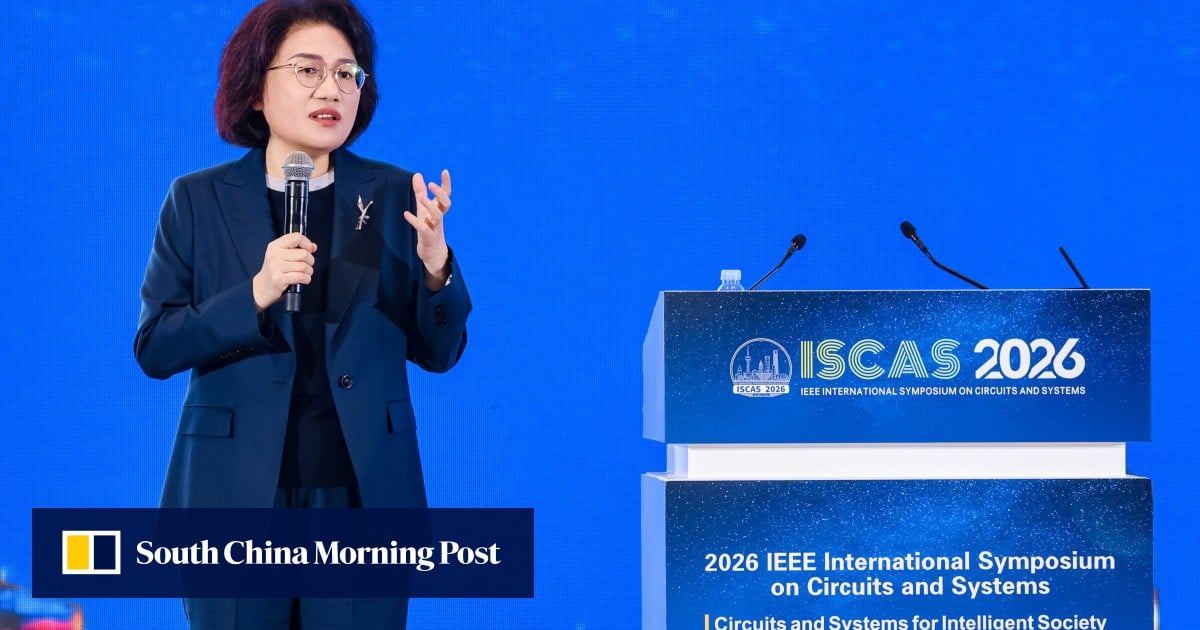
At a Shanghai presentation, Huawei used He Tingbo to frame semiconductors as an engineering problem under constraint, not just a supply problem. The company is trying to shift attention from what it cannot buy to what it says it can still build.
Huawei is trying to make faster computer chips even though it cannot always get the best tools from other countries. Instead of only making tiny parts smaller, it wants to make the whole chip system work more smoothly.
That is a bit like building a race car. If the engine cannot get any bigger, the team can still make the car faster by improving the wheels, the body, and how all the parts fit together.
He Tingbo is the person leading that effort at Huawei. The story matters because faster chips help power AI, and countries want to stay strong in that race.
Analysis
Huawei’s new pitch
He Tingbo, who leads Huawei’s semiconductor business and has been dubbed China’s “chip queen,” used a Shanghai appearance to present Huawei’s Tau (τ) Scaling Law. The company says the framework is meant to guide chip development at a time when Moore’s Law is weakening and the industry can no longer count on the simple march of shrinking transistors.
From restriction to strategy
The article frames Huawei’s message as a response to sanctions and supply limits. He said there was a period after US sanctions when she felt there was “no way out,” but later drew inspiration from Dujiangyan, an ancient irrigation system in Sichuan built without modern machinery. In Huawei’s telling, sanctions became engineering constraints to solve rather than dead ends.
What the framework claims to do
Instead of relying only on geometric scaling, Huawei says performance can also improve by reducing delays across devices, circuits, chips, and computing systems. That is a significant strategic shift: it suggests Huawei is trying to keep advancing chip capability even as access to the world’s most advanced chipmaking tools stays restricted. For AI observers, the story matters because the race for better chips is also the race for more compute, and compute remains the bottleneck behind many AI systems. Huawei is signaling that China’s path may depend not just on smaller transistors, but on redesigning the whole stack around them.
Key points
- Huawei introduced the Tau (τ) Scaling Law in Shanghai as a new chip development framework.
- The company says the approach is meant to work even as Moore’s Law weakens.
- He Tingbo linked Huawei’s response to US sanctions with engineering under constraint.
- Huawei says performance gains can come from reducing delays across the whole computing stack.
- The story is important for AI because chip supply and compute capacity shape how far AI systems can go.