More students can take mother tongue language elective programme from 2027
Education Minister Desmond Lee announced that the Language Elective Programme will expand from 2027, allowing more students to learn advanced mother tongue languages and gain cultural exposure. The programme will add schools for Chinese and Tamil languages, and expand the…
Intelligence analysis by Llama
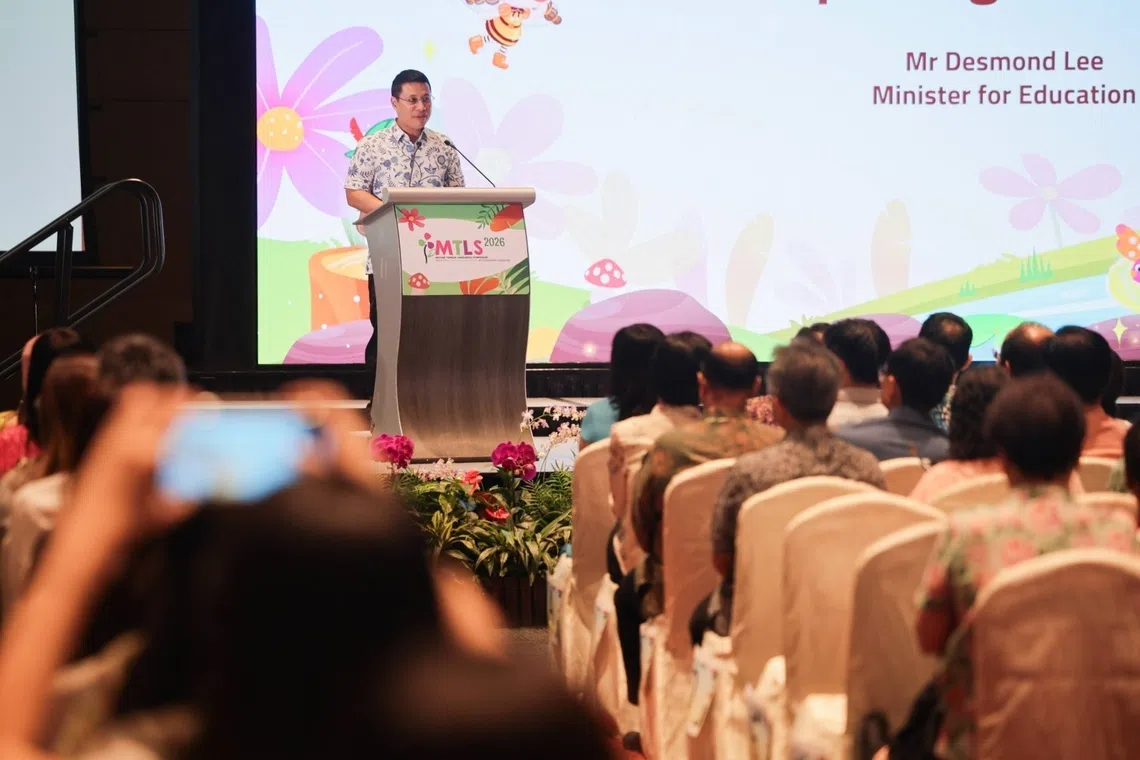
The Education Ministry is expanding the Language Elective Programme to allow more students to learn advanced mother tongue languages and gain cultural exposure. The programme will add schools for Chinese and Tamil languages, and expand the Malay (Special Programme) to a fifth centre at National Junior College.
Imagine you're a kid, and you want to learn a new language. The government is making it easier for you to do that by adding more schools where you can learn Chinese, Tamil, and Malay. They're also using computers to help teachers grade your essays, so they can focus on helping you get better.
Analysis
Expanding the Language Elective Programme
The Education Ministry has announced that the Language Elective Programme will expand from 2027, allowing more students to learn advanced mother tongue languages and gain cultural exposure. This programme was introduced in 1990 at pre-university level to nurture students with a high level of proficiency in their mother tongue languages and enhance their appreciation of literature and culture.
Adding Schools for Chinese and Tamil Languages
The programme will add schools for Chinese and Tamil languages, providing more students with the opportunity to learn these languages. The Chinese Language Elective Programme at junior college level will be expanded to a sixth school, Anderson Serangoon JC. The Tamil Language Elective Programme at both secondary and junior college levels will be expanded to the Umar Pulavar Tamil Language Centre.
Expanding the Malay (Special Programme)
The Malay (Special Programme) will be expanded to a fifth centre at National Junior College. This programme is currently offered at 12 secondary schools and four ‘centres’ – the MOE Language Centre (Bishan), Bukit Batok Secondary School, Tampines Secondary School, and Zhonghua Secondary School. Students whose schools do not offer the programme will attend lessons at the centre nearest to their school.
Launching the AI Essay Marking System
In September, MOE will launch the new AI Essay Marking System (AIMS) in secondary schools to help Chinese language teachers handle routine marking – such as grammar, spelling and sentence structure – for both handwritten and typewritten essays. This will allow teachers to focus on providing feedback on students’ creativity, depth of expression, and the quality of their ideas.
Key points
- The Language Elective Programme will expand from 2027, allowing more students to learn advanced mother tongue languages and gain cultural exposure.
- The programme will add schools for Chinese and Tamil languages, and expand the Malay (Special Programme) to a fifth centre at National Junior College.
- MOE will launch the AI Essay Marking System in September to help Chinese language teachers handle routine marking.
- The programme aims to develop a sustainable pipeline of bilingual and bicultural talents who can forge meaningful connections with the region and contribute to Singapore's cultural fabric.
This development has the potential to increase the number of bilingual and bicultural talents in Singapore, who can forge meaningful connections with the region and contribute to the country's cultural fabric. It may also lead to a greater appreciation of mother tongue languages and cultures among Singaporeans.
However, there may be challenges in implementing the AI Essay Marking System, such as ensuring that the system is accurate and fair. Additionally, there may be concerns about the impact of technology on the teaching and learning process.