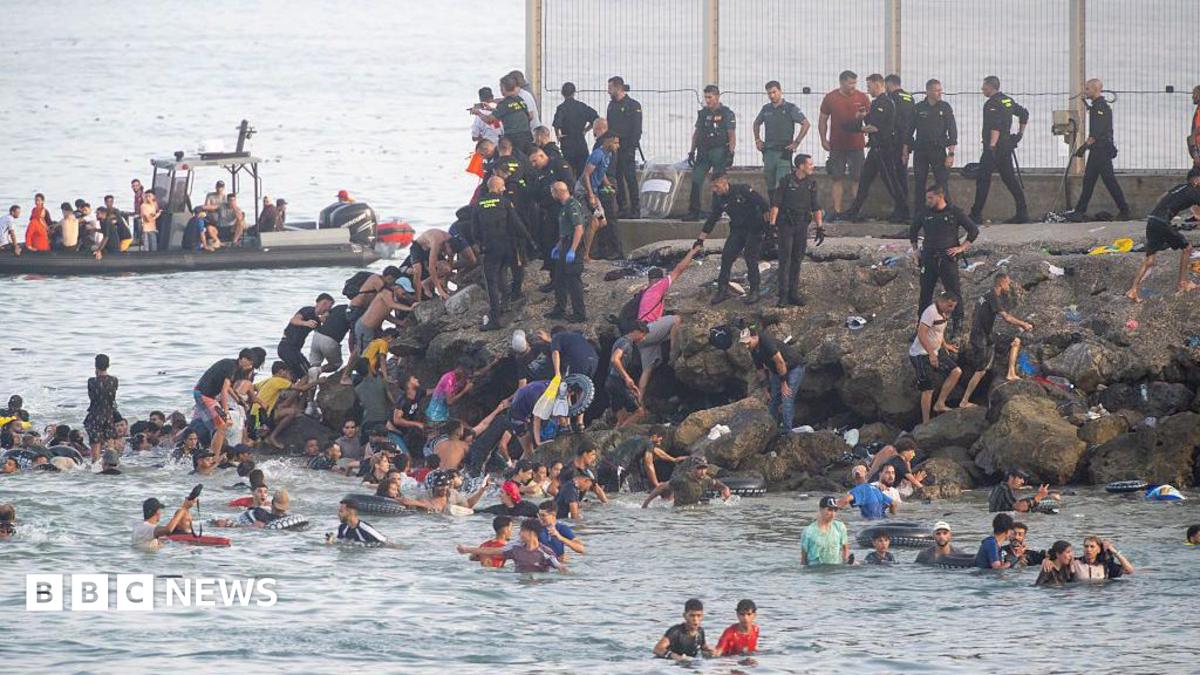
Morocco Denies 'Pressures and Blackmail' in Ceuta Crisis and Blames Spanish Supreme Court Ruling
Morocco denies exerting 'pressures or blackmail' in the Ceuta crisis and blames the Spanish Supreme Court ruling for the surge in migrant arrivals. Rabat claims it has acted as a 'reliable ally' to Spain and has been warning of the consequences of the court's decision.
Intelligence analysis by Llama
Morocco has denied exerting 'pressures or blackmail' in the Ceuta crisis and has blamed the Spanish Supreme Court ruling for the surge in migrant arrivals. The country's foreign minister has stated that Morocco has acted as a 'reliable ally' to Spain and has been warning of the consequences of the court's decision. Morocco has also accused Spanish politicians of 'instrumentalizing the…
Imagine you're trying to get into a country without permission. If the country has a rule that says you can't be sent back right away, you might try to get in. That's what's happening in Ceuta, a city in Spain. Morocco, the country next door, is saying that Spain's rule is causing the problem, and that they're not doing enough to stop it.
Analysis
A Crisis in the Making: The Ceuta Conundrum
The recent surge in migrant arrivals in Ceuta has sparked a heated debate between Morocco and Spain. Morocco's foreign minister has denied exerting 'pressures or blackmail' in the crisis, instead blaming the Spanish Supreme Court ruling for the surge in arrivals. The ruling, which limited the expulsions of irregular migrants, has created a power vacuum in the management of migrant flows, and Morocco's response highlights the need for a coordinated approach to address the crisis.
The Role of the Spanish Supreme Court
The Spanish Supreme Court's ruling has been a game-changer in the management of migrant flows. By limiting the expulsions of irregular migrants, the court has created a situation where migrants can enter Ceuta without fear of being deported. Morocco's foreign minister has stated that this has led to a surge in arrivals, with thousands of migrants taking advantage of the situation. The minister has also accused Spanish politicians of 'instrumentalizing the crisis for electoral purposes', highlighting the need for a more nuanced approach to addressing the crisis.
Morocco's Response: A Reliable Ally?
Morocco's response to the crisis has been to deny any involvement in the surge in arrivals. The foreign minister has stated that Morocco has acted as a 'reliable ally' to Spain and has been warning of the consequences of the court's decision. However, the minister has also accused Spain of not doing enough to address the crisis, highlighting the need for a more coordinated approach to managing migrant flows. The minister has also stated that Morocco has been working closely with Spain to address the crisis, but that more needs to be done to prevent further arrivals.
Key points
- Morocco denies exerting 'pressures or blackmail' in the Ceuta crisis
- Spanish Supreme Court ruling has created a power vacuum in the management of migrant flows
- Morocco has acted as a 'reliable ally' to Spain and has been warning of the consequences of the court's decision
- Spain accused of not doing enough to address the crisis
- Morocco has been working closely with Spain to address the crisis
If the situation in Ceuta is addressed through a coordinated approach between Morocco and Spain, it's possible that the number of migrant arrivals will decrease. This could lead to a more stable and secure situation for both countries.
If the situation in Ceuta continues to deteriorate, it could lead to a humanitarian crisis and further strain on the relationship between Morocco and Spain. This could also lead to a surge in migrant arrivals in other parts of Europe.