Mutiny in Niger: 5 questions to understand why the AES left Tiani alone
The Alliance of Sahel States' (AES) Unified Force failed to act during a mutiny in Niger, exposing the bloc's struggle to operationalize its common defense ambitions despite its headquarters being repeatedly attacked.
Intelligence analysis by Gemini 2.5 Flash
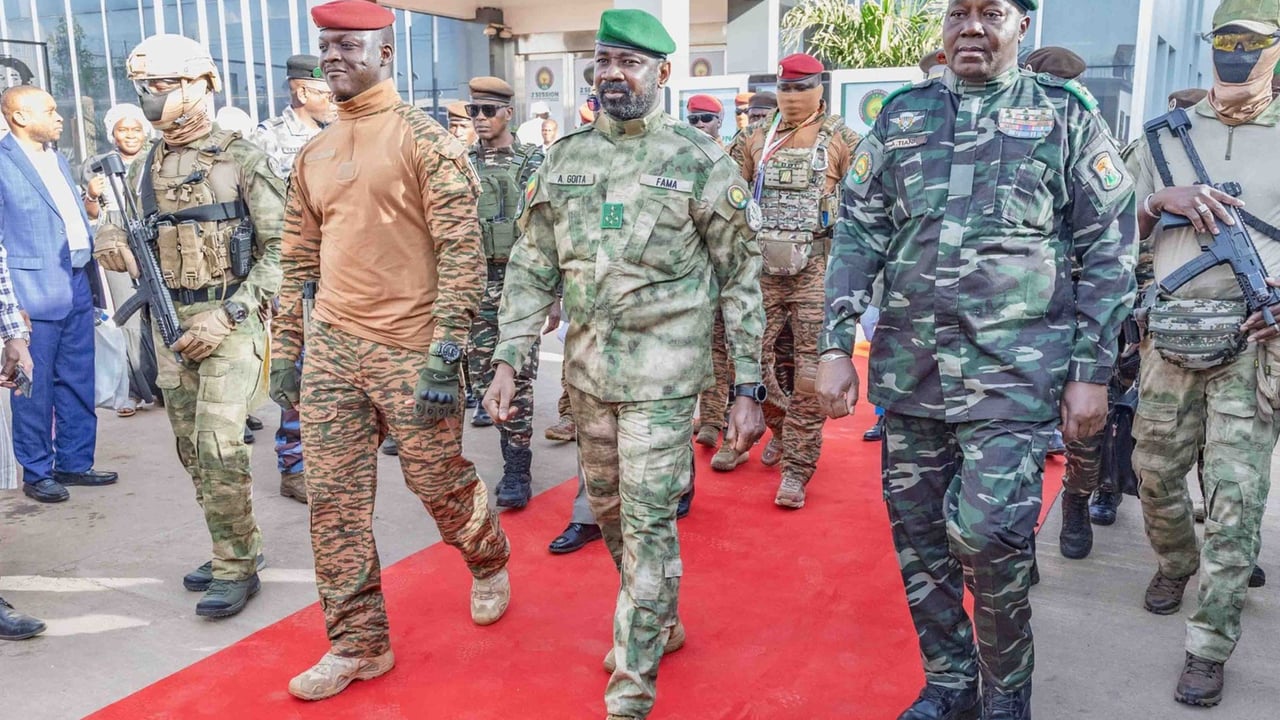
A recent mutiny attempt at Niamey's military air base highlighted the ineffectiveness of the Alliance of Sahel States' (AES) Unified Force. Despite being established for common defense, the force remained inactive during multiple attacks on its own headquarters, raising questions about the practical implementation of the AES's security commitments and leaving Niger's leader, Abdouraha…
Imagine a club of three friends who promised to help each other if one got into trouble. But when one friend's house was attacked, the other two just watched, even though their clubhouse was right next door! This story is about why that club, called the AES, didn't help its friend, Tiani, when his military base in Niger was attacked, making everyone wonder if their promise means anything.
Analysis
Alliance des États du Sahel
The Alliance of Sahel States (AES) was formed with the ambitious goal of establishing a common defense mechanism, embodied by its Unified Force (FU-AES). This force was intended to serve as the armed wing of the organization, providing collective security to its member states—Mali, Burkina Faso, and Niger—in a region plagued by instability and extremist violence. The Liptako-Gourma Charter underpins this commitment, outlining the principles of mutual assistance and defense among the allied nations.
However, the recent events in Niger have cast a significant shadow over the operational viability of the FU-AES. Its repeated failure to mobilize in response to direct threats, even those targeting its own infrastructure, suggests a profound disconnect between the alliance's stated objectives and its practical capabilities. This inaction raises critical questions about the level of military integration and political will among the member states to transform their defense ambitions into a tangible, responsive force.
Abdourahamane Tiani
The mutiny attempt that unfolded in Niger on August 28 and 29 directly challenged the authority of Abdourahamane Tiani's regime. This internal security crisis exposed significant vulnerabilities within the Nigerien army and Tiani's leadership, forcing him to confront the threat largely on his own. Despite the theoretical backing of the AES Unified Force, Tiani found himself without the anticipated support from his regional allies.
Reports indicate that Tiani had to rely on external partners, notably Russia's Africa Corps, to help quell the mutiny. This reliance on non-AES entities underscores the alliance's failure to provide timely and effective assistance to a member state in crisis. Such a situation not only weakens Tiani's position domestically but also highlights the limitations of the AES as a credible security guarantor, potentially pushing member states to seek alternative security arrangements.
Niamey
The 101 military air base in Niamey, Niger's capital, holds particular significance as it houses the headquarters of the Unified Force of the Alliance of Sahel States (FU-AES). This strategic location should, in principle, ensure a rapid and robust response to any security threats within its vicinity. Yet, the article reveals that this very base has been attacked three times since the beginning of the year, including during the recent mutiny, without the FU-AES mobilizing to defend itself or its host nation.
This repeated inaction at the heart of the FU-AES's operational command is highly symbolic and deeply problematic. It not only demonstrates a critical operational deficiency but also sends a clear message of vulnerability to both internal dissidents and external adversaries. The inability of the force to protect its own headquarters in Niamey undermines its deterrent capability and raises serious doubts about its capacity to fulfill its broader mandate of regional security.
Key points
- The AES Unified Force failed to intervene during the August 28-29 mutiny in Niger.
- This inaction contradicts the stated purpose of the Alliance of Sahel States (AES) and its Liptako-Gourma Charter.
- The Niamey military air base, housing the FU-AES headquarters, has been attacked three times this year without a response from the force.
- The incident highlights the difficulties for AES member states (Mali, Burkina Faso, Niger) in translating common defense ambitions into operational reality.
- Niger's leader, Abdourahamane Tiani, reportedly relied on external partners like Russia's Africa Corps to counter the mutiny.
The continued inaction of the AES Unified Force could embolden internal opposition and external threats, further destabilizing Niger and potentially leading to a wider security crisis across the Sahel region. This failure also suggests a lack of genuine military integration among member states, making them individually more vulnerable.