NDA before retrenchment payout: What to do
Employees who are asked to sign a non-disclosure agreement before receiving a retrenchment payout should first ask for more time if the deadline is too tight, said Amarjit Kaur, head of employment practice at Withers KhattarWong. They should also request a breakdown of th…
Intelligence analysis by Llama
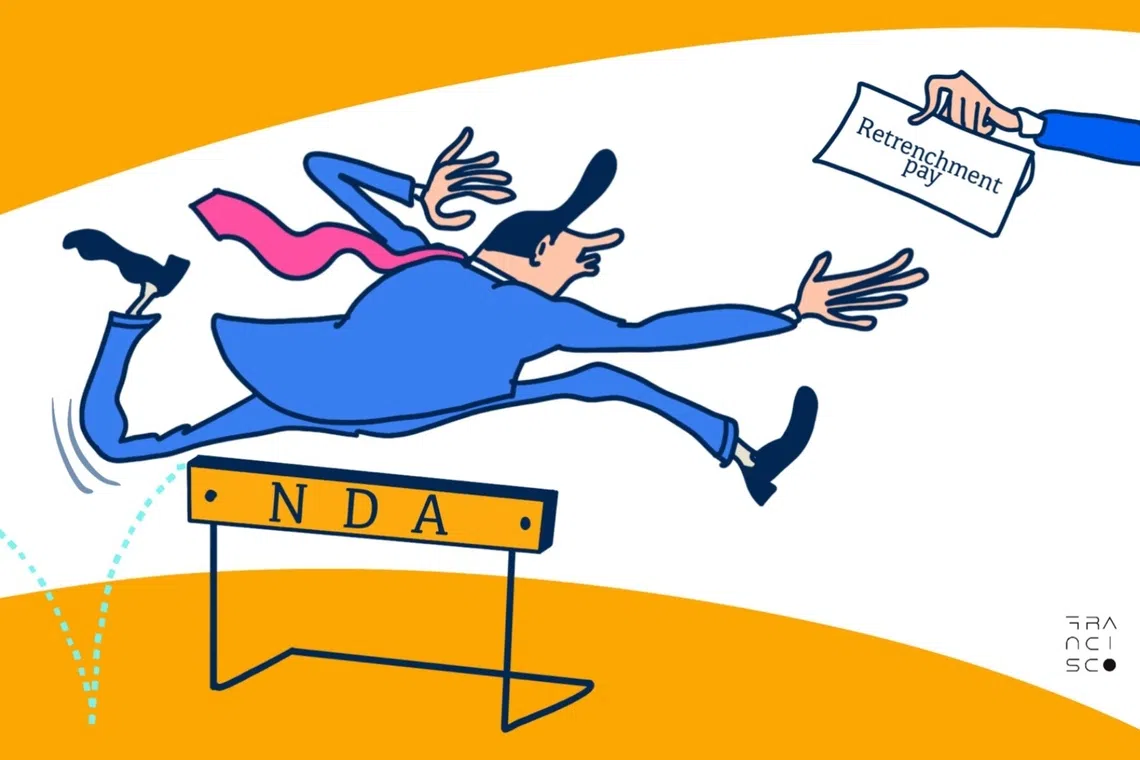
Employees who are asked to sign a non-disclosure agreement before receiving a retrenchment payout should first ask for more time if the deadline is too tight, said Amarjit Kaur, head of employment practice at Withers KhattarWong. They should also request a breakdown of the payout to distinguish between sums that are contractually or statutorily owed and any discretionary payments.
When you get retrenched, your employer might ask you to sign a secret agreement before giving you your payout. This is to keep the amount of your payout a secret. But you should ask for more time to think about it, and also ask for a breakdown of the payout so you know what you're getting.
Analysis
What to Do When Asked to Sign an NDA Before Retrenchment Payout
Employees who are asked to sign a non-disclosure agreement (NDA) before receiving a retrenchment payout should first ask for more time if the deadline is too tight, said Amarjit Kaur, head of employment practice at Withers KhattarWong. They should also request a breakdown of the payout to distinguish between sums that are contractually or statutorily owed and any discretionary payments.
Contractual or statutory entitlements typically include notice pay or salary in lieu of notice, salary up to the termination date, and payment for unused annual leave. Such payments should not be contingent on an employee signing an NDA, said Kaur. Retrenchment benefits, however, are discretionary payments that are not mandatory under Singapore law.
Before signing, employees should carefully review the NDA to understand their obligations and the rights they may be giving up. In exchange for discretionary payments or non-monetary benefits, such as a waiver of non-compete obligations, employers often require employees to agree to obligations under the NDA. These may include confidentiality and non-disparagement obligations, post-termination obligations, clawback provisions if the NDA is breached, and a waiver and release of legal claims.
Employees should compare these against their existing employment contract, paying particular attention to non-compete clauses and other post-termination obligations. “The employee should only sign the NDA if they are prepared to abide by any such revised obligations, failing which the employee could be at risk of legal liability for breach of contract,” she said.
Employees should also check whether the NDA prevents them from making legitimate disclosures, including to their lawyer, immediate family members and the authorities, or where disclosure is required by law. Employees should also consider whether there is room to negotiate better terms before signing. “If the NDA contains onerous or ambiguous terms, the employee should obtain independent legal advice before signing,” said Kaur.
NTUC assistant secretary-general Patrick Tay said such NDAs are to ensure that the retrenchment payout is not disclosed to third parties, including colleagues. It is intended to avoid prejudicing the employer’s position, especially where further retrenchments or restructuring may be planned.
However, these agreements are usually signed after the employee has been informed of the retrenchment package and has had the opportunity to negotiate and agree to its terms. “If an employer requires an employee to sign an NDA or confidentiality obligations before the employee has been informed of the retrenchment package, the employee should not sign the agreement immediately,” said Tay.
“Doing so may prevent the employee from seeking union or legal advice on the employer’s offer, and consulting on their rights and obligations.” Tay added that employees should be given reasonable time to consult their union, if they are union members, as well as their lawyers or the Tripartite Alliance for Dispute Management.
“NDA or confidentiality obligations should not deny employees the right to seek union or legal advice, or silence employees from alerting unions or the authorities to an ongoing retrenchment exercise,” he said.
Key points
- Employees who are asked to sign a non-disclosure agreement before receiving a retrenchment payout should first ask for more time if the deadline is too tight.
- They should also request a breakdown of the payout to distinguish between sums that are contractually or statutorily owed and any discretionary payments.
- Employees should carefully review the NDA to understand their obligations and the rights they may be giving up.
- Employees should compare the NDA against their existing employment contract, paying particular attention to non-compete clauses and other post-termination obligations.
- Employees should check whether the NDA prevents them from making legitimate disclosures, including to their lawyer, immediate family members and the authorities, or where disclosure is required by law.
If employees are aware of their rights and obligations, and seek independent legal advice before signing an NDA, they can negotiate better terms and avoid potential legal liability.
If employees sign an NDA without understanding their obligations and the rights they may be giving up, they may be at risk of legal liability for breach of contract, and may also be prevented from making legitimate disclosures.