NUS researchers brandish light beams for biotechnology breakthrough
Researchers from the National University of Singapore (NUS) have developed a red light-responsive protein called y-iLight that controls gene activity in yeast without extra chemicals. This breakthrough makes biomanufacturing more reliable and eco-friendly.
Intelligence analysis by Llama
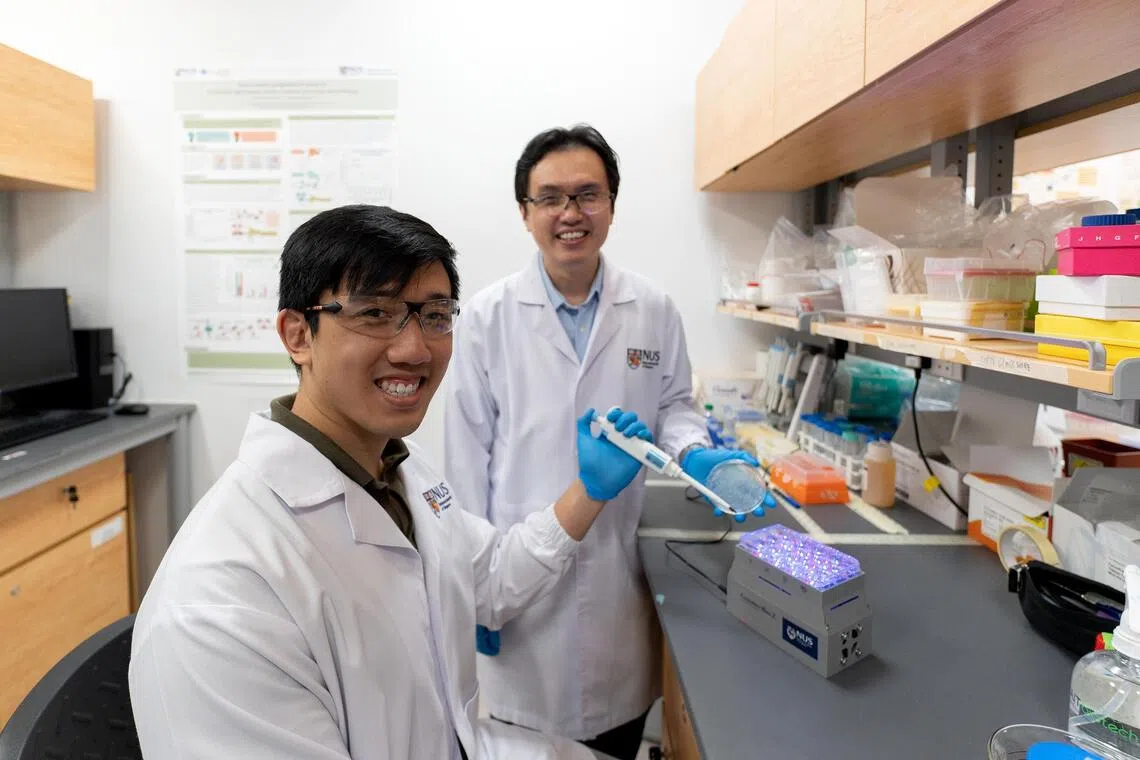
NUS researchers have employed optogenetics to control yeast activity using light. They developed a red light-responsive protein called y-iLight that controls gene activity in yeast without extra chemicals, making biomanufacturing more reliable and eco-friendly.
Imagine you have a special kind of yeast that can be controlled by light. Researchers at NUS have developed a way to make this yeast respond to red light, which can be used to make medicines and other products. This breakthrough makes biomanufacturing more reliable and eco-friendly.
Analysis
Optogenetics: A New Frontier in Biotechnology
Optogenetics is a rapidly evolving field that uses light to control cell activity. This technology has the potential to revolutionize biomanufacturing by making it more predictable and programmable. In this study, researchers from the National University of Singapore (NUS) employed optogenetics to control yeast activity using light.
The Challenge of Red Light Responsiveness
One of the key challenges in optogenetics is making yeast respond reliably to red light. Red light is often used in optogenetics as it is able to penetrate deep into biological tissues without significant cellular damage. However, existing red light-responsive optogenetic systems in yeast require several introduced genes, additional cofactors, or careful handling to avoid unintended activation. These limitations made it difficult to combine them with other light-controlled systems.
Developing y-iLight
To overcome this challenge, the researchers adapted iLight, a light-sensitive genetic tool that had previously been used to control gene expression in bacteria and mammalian cells. This was used to develop a protein for yeast which responds to red light, which they dubbed y-iLight. When exposed to red light, y-iLight attaches to certain DNA sequences in the yeast, activating specific genes. The protein also works without the need for additional chemicals beyond those naturally found in yeast.
Multiplexed Optogenetics
The researchers combined y-iLight with an established blue light-responsive system called EL222, a light-sensitive protein derived from marine bacteria. This was a major step towards multiplexed optogenetics in yeast, where different coloured lights can be used to control multiple biological processes. The researchers were able to show that the yeast could produce luteolin under blue light and then clump together under red light, demonstrating how light could control production and separation.
Future Directions
The team is now working on boosting the strength and sensitivity of y-iLight, as well as exploring the use of different coloured lights to control multiple biological processes. They aim to improve protein sensitivity and add more light colours for greater control, with plans to commercialise the technology.
Key points
- Researchers from NUS have developed a red light-responsive protein called y-iLight that controls gene activity in yeast without extra chemicals.
- This breakthrough makes biomanufacturing more reliable and eco-friendly.
- The researchers combined y-iLight with an established blue light-responsive system to create a multiplexed optogenetics system in yeast.
- The team is now working on boosting the strength and sensitivity of y-iLight and exploring the use of different coloured lights to control multiple biological processes.
This breakthrough has the potential to revolutionize biomanufacturing, making it more predictable and programmable. With further research and development, we can expect to see more efficient and sustainable biomanufacturing methods emerge.
However, there are still challenges to be overcome before this technology can be widely adopted. The researchers will need to continue to improve the strength and sensitivity of y-iLight, as well as explore the use of different coloured lights to control multiple biological processes.