Omi Desktop: An Open-Source AI Companion for Mac
Omi Desktop is a new open-source AI companion for Mac that acts as a "second brain," capturing screen activity and conversations to provide real-time summaries, action items, and proactive assistance. It integrates with virtual meetings and ambient desktop context, offeri…
Intelligence analysis by Gemini 2.5 Flash
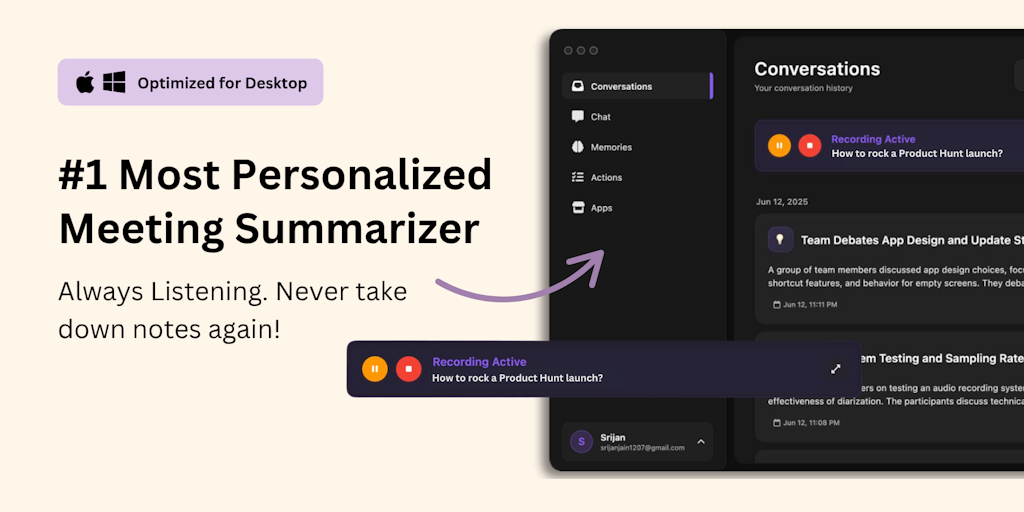
Omi, initially an AI necklace, has launched its Mac desktop application, Omi Desktop, designed to be a comprehensive AI companion. It records meetings, monitors screen activity, and generates tasks, offering searchable summaries and contextual nudges to enhance productivity and memory, all while being local-first and open source.
Imagine a super-smart friend living in your computer. It watches your screen and listens to your meetings, remembering everything important. If you forget what was said or need help, you just ask it. It's like having a perfect memory for your whole day, always ready to remind you or help with tasks.
Analysis
Omi Desktop represents a significant evolution in personal AI assistants, moving beyond simple conversational interfaces to a deeply integrated "second brain" for Mac users. This new application extends the capabilities of the original Omi wearable, which focused on capturing spoken conversations, by now incorporating ambient desktop context. It actively monitors screen activity and virtual meetings, providing real-time summaries, identifying action items, and offering proactive nudges to enhance user productivity and memory. The system's ability to discern "who said what" in meetings and cite sources for its answers adds a layer of reliability and accountability often missing in general-purpose AI tools.
Omi Desktop
The core functionality of Omi Desktop revolves around its ability to capture and process a user's digital and auditory environment. By integrating with the Mac operating system, it can "see" the user's screen and "hear" their meetings, whether in-person or via platforms like Zoom, Meet, and Slack huddles. This comprehensive data capture allows Omi to generate highly contextualized insights, such as summarizing past discussions, providing feedback on design work, or assisting with writing tasks based on recent activity. The application aims to make notifications useful rather than annoying, delivering timely information derived directly from the user's workflow.
A key differentiator for Omi Desktop is its claim to understand ambient desktop context, setting it apart from more isolated AI models like ChatGPT or Claude. This contextual awareness enables it to proactively assist users, anticipating needs based on their current tasks and past interactions. The system is also designed for speed, boasting a 10x improvement in answer and search capabilities. Furthermore, its local-first processing and open-source architecture address growing concerns about data privacy and user control, allowing for greater transparency and community-driven development.
Nik Shevchenko's Vision
The founder, Nik Shevchenko, articulated the driving force behind Omi's evolution, stemming directly from user feedback. Initially, Omi was conceived as a small pendant designed to remember conversations, fulfilling a basic need for memory augmentation. However, users expressed a desire for the AI to have a broader understanding of their lives, prompting the development of a computer-integrated solution. This shift reflects a strategic move to make Omi a more pervasive and indispensable personal assistant.
Shevchenko's vision is to create "the best way to ask AI about your own life," emphasizing a personalized and trustworthy AI experience. The commitment to providing citations for every answer, linking back to specific meetings, times, or screen captures, is central to building this trust. This approach ensures that users can verify the AI's information, fostering a sense of reliability that is crucial for a tool positioned as a "second brain." The iterative development, with Omi Desktop being the fifth major launch, underscores a continuous effort to refine and expand the product's utility based on real-world user needs and feedback.
Open-Source Development
A foundational aspect of Omi's strategy is its commitment to being local-first and open source, with its code hosted on github.com/BasedHardware/omi. This model fosters a collaborative environment, as evidenced by the "1,600+ pull requests" merged by the open-source community within the past year. This level of community engagement not only accelerates development but also enhances the transparency and security of the platform. Users can inspect the code, contribute to its improvement, and potentially customize it to their specific needs, which is a significant advantage over proprietary AI solutions.
The open-source nature also contributes to the "trust" factor that Omi aims to cultivate. By making the underlying technology accessible, Omi addresses concerns about how personal data is handled and processed, especially given its deep integration with a user's digital life. This approach aligns with a growing demand for more ethical and transparent AI systems, positioning Omi as a potentially more secure and user-centric alternative in the crowded AI assistant market. The community-driven development model also suggests a robust and adaptable future for the platform, capable of evolving rapidly with user contributions.
Key points
- Omi Desktop is a new open-source AI companion for Mac, evolving from an AI necklace.
- It captures screen activity and conversations in real-time, providing searchable summaries and action items.
- The AI understands ambient desktop context and offers proactive nudges, distinguishing it from other AI models.
- It operates local-first and is open source, with its code available on GitHub, fostering community contributions.
- The system aims to be a "second brain," offering verifiable answers with citations from user's own data.
Omi Desktop's deep integration with a user's digital environment and its open-source, local-first approach could revolutionize personal productivity and memory retention. By providing contextual, verifiable insights and proactive assistance, it has the potential to significantly reduce cognitive load and enhance decision-making, fostering a new era of trustworthy AI companionship.
Despite its promise, Omi Desktop faces challenges in achieving perfect transcription accuracy and seamless quality-of-life features, as noted in early reviews. Over-reliance on such a system could also lead to a decline in natural memory skills, and potential privacy concerns, even with local processing, might arise from the sheer volume of personal data it captures.