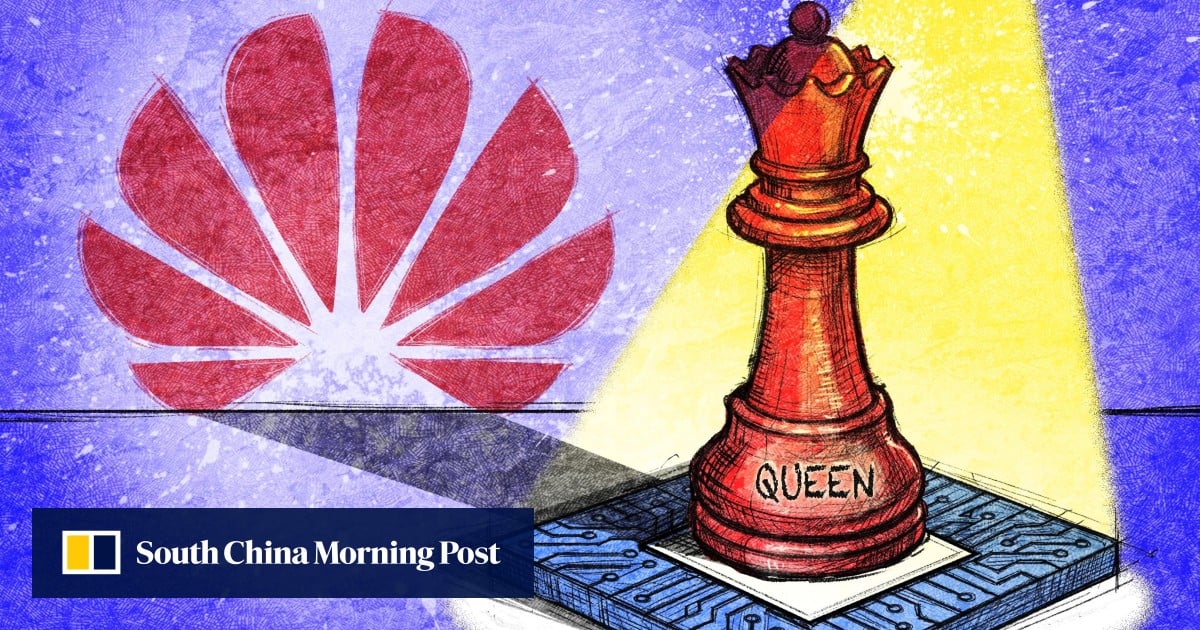
Out of the shadows: Huawei’s ‘chip queen’ steps back into the spotlight with scaling law
Huawei's chip queen He Tingbo introduced a new scaling law at an academic conference in Shanghai. The law claims to achieve transistor sizes equivalent to advanced 1.4-nanometre processes by 2031 without EUV lithography machines due to US sanctions.
Intelligence analysis by Qwen 2.5 (3B)
Huawei’s secretive semiconductor head, He Tingbo, presented a new scaling law at an international academic conference in Shanghai, potentially signaling China's tech self-reliance efforts.
He Tingbo from Huawei said they found a new way to make tiny computer parts without using expensive machines that the US won't let them have. This could help China build its own tech stuff instead of buying it from other countries.
Analysis
The Tau (τ) Scaling Law
He Tingbo introduced the “Tau (τ) Scaling Law” at the IEEE International Symposium on Circuits and Systems in Shanghai. According to Huawei, this law could achieve transistor sizes equivalent to advanced 1.4-nanometre processes by 2031 without using EUV lithography machines due to US sanctions.
Background on Moore's Law
For half a century, the electronics industry has relied on Moore’s Law as a guiding principle for semiconductor development. However, geometric scaling is reaching its limits and facing architectural challenges.
Debate Over Feasibility
The announcement sparked debate within the global semiconductor industry. Some see it as a revolutionary breakthrough towards China's tech self-reliance, while others view it as an ambitious theory or hype destined to fail in practical manufacturing.
Key points
- He Tingbo introduced a new scaling law at an international academic conference in Shanghai
- The law claims to achieve transistor sizes equivalent to advanced 1.4-nanometre processes by 2031 without EUV lithography machines due to US sanctions
- Some see it as a revolutionary breakthrough, while others view it as ambitious theory or hype destined for failure
If the Tau (τ) Scaling Law proves successful, it could lead to more self-reliance in Chinese semiconductor technology and reduce dependence on foreign suppliers.
However, if the law fails to work as expected or is too costly to implement, it may not significantly impact China's tech industry and might still rely heavily on foreign technologies.


