Over 11 million bitcoin has no known owner. Here's what it means
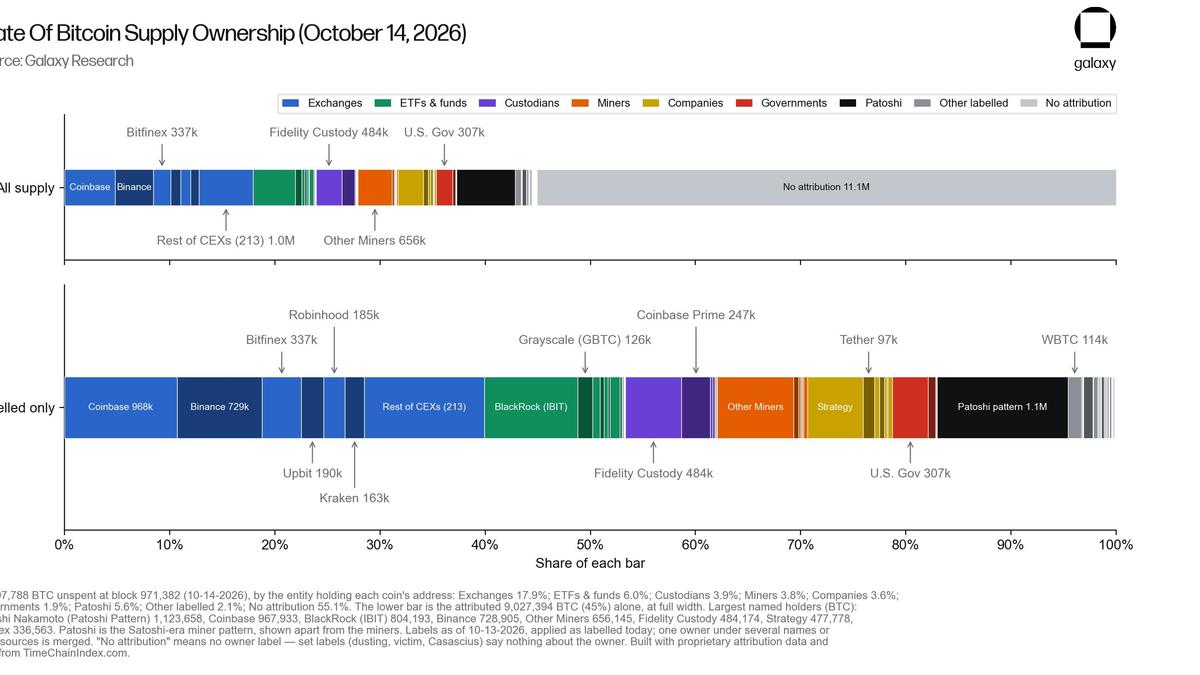
About 11.1 million bitcoin, or 55% of the total supply, is held in addresses that cannot be linked to any known entity, suggesting widespread self-custody among individuals despite institutional adoption.
Intelligence analysis by Gemini 2.5 Flash
Despite Bitcoin's growing acceptance on Wall Street and increasing institutional involvement, over half of its supply remains unattributed to known owners. This large segment of unidentified holdings is seen by some as evidence of strong retail self-custody, though it also includes potentially lost coins or unidentified institutional stashes.
Imagine a huge pile of digital gold coins. More than half of these coins are in secret piggy banks that nobody knows who owns, even though big banks and companies are now buying lots of them. Some people think this means regular folks are still keeping their own coins safe, like hiding their pocket money. But it could also mean some coins are lost because people forgot where they put their piggy banks, or maybe some big companies have secret piggy banks too!
Analysis
11.1 Million BTC
Approximately 11.1 million bitcoin, representing 55% of the total 20.1 million mined supply, is currently held in addresses that cannot be definitively linked to any known entity such as exchanges, funds, or governments. This substantial portion of the cryptocurrency's supply remains a mystery to blockchain analytics firms like Galaxy Research, which actively attempts to attribute ownership to various addresses. The sheer volume of these unattributed coins underscores a unique characteristic of the Bitcoin market, where a significant portion operates outside the easily identifiable structures of traditional finance.
This large, unnamed stack of bitcoin challenges the narrative that institutionalization has led to a complete centralization of ownership. While Wall Street's embrace of bitcoin has been a major theme, the data suggests that a foundational element of individual control and self-custody persists. The existence of such a vast unattributed supply indicates a robust, decentralized base of holders who prefer to manage their own private keys rather than relying on third-party custodians.
Alex Thorn
Alex Thorn, the head of research at Galaxy, views this substantial unattributed figure as compelling evidence for the continued prevalence of self-custody among bitcoin holders. He articulated this perspective on X, stating that "More than half of all BTC supply is sitting in addresses with no known attribution despite all the institutionalization and centralized ownership over the years, still a ton of bitcoin (maybe even most) is held by individuals in self-custody." This interpretation aligns with Bitcoin's original ethos of empowering individuals to be their own bank, bypassing traditional financial intermediaries.
This viewpoint is further supported by Xapo Bank, a bitcoin-focused institution, which commented on Thorn's post, suggesting that the large number of coins in unnamed wallets signifies the long-standing presence of retail investors in the market. They emphasized that retail participants have been involved for over a decade, predating much of the institutional interest. This perspective frames Bitcoin as a market that grew organically from the ground up, with individual users forming its core before larger entities began to catch up.
Patoshi Pattern
While the narrative of widespread self-custody is compelling, the article also introduces several important caveats regarding the 11.1 million unattributed BTC. Not all of this supply necessarily belongs to active individual holders practicing self-custody. A significant portion could include coins that are effectively lost, residing in wallets whose owners have either forgotten their private keys or are deceased, rendering the funds inaccessible. This factor is a known challenge in the cryptocurrency space, where the responsibility of key management lies solely with the individual.
Furthermore, some of these unattributed coins might belong to institutions that Galaxy Research has not yet identified. This could include various funds, companies, or Over-The-Counter (OTC) desks that facilitate large, private bitcoin trades away from public exchanges. The complexity of some custody arrangements, which involve distributing coins across numerous addresses, can also make tracing ownership more difficult. The article specifically mentions coins mined in Bitcoin's early years by miners other than the one behind the "Patoshi pattern," which researchers link to Satoshi Nakamoto, Bitcoin's anonymous creator, as a separately categorized holding.
Key points
- About 11.1 million BTC, or 55% of the total supply, is held in addresses with no known owner.
- Galaxy Research classifies this as 'unattributed' despite growing institutional adoption of Bitcoin.
- Alex Thorn of Galaxy Research suggests this indicates widespread individual self-custody of bitcoin.
- Xapo Bank supports this view, noting retail investors have been in the market for over a decade.
- Caveats include potentially lost coins, unidentified institutional holdings, and complex custody arrangements.
This large, unattributed supply suggests Bitcoin's core ethos of decentralization and individual control remains strong, indicating resilience against full institutional capture. It highlights the long-term commitment of retail investors who prioritize self-custody over centralized solutions, fostering a more robust and distributed network.
The significant portion of unattributed Bitcoin could also represent a substantial amount of permanently lost coins, reducing the effective circulating supply and potentially impacting market liquidity. Furthermore, some of these holdings might belong to unidentified large entities, masking true institutional concentration and potentially leading to unforeseen market dynamics.