Partial Lunar Eclipse Turns the Moon into a 'Blood Red' Celestial Display
A partial lunar eclipse transformed the moon into a deep reddish-copper hue, visible across multiple continents.
Intelligence analysis by Qwen 2.5 (3B)
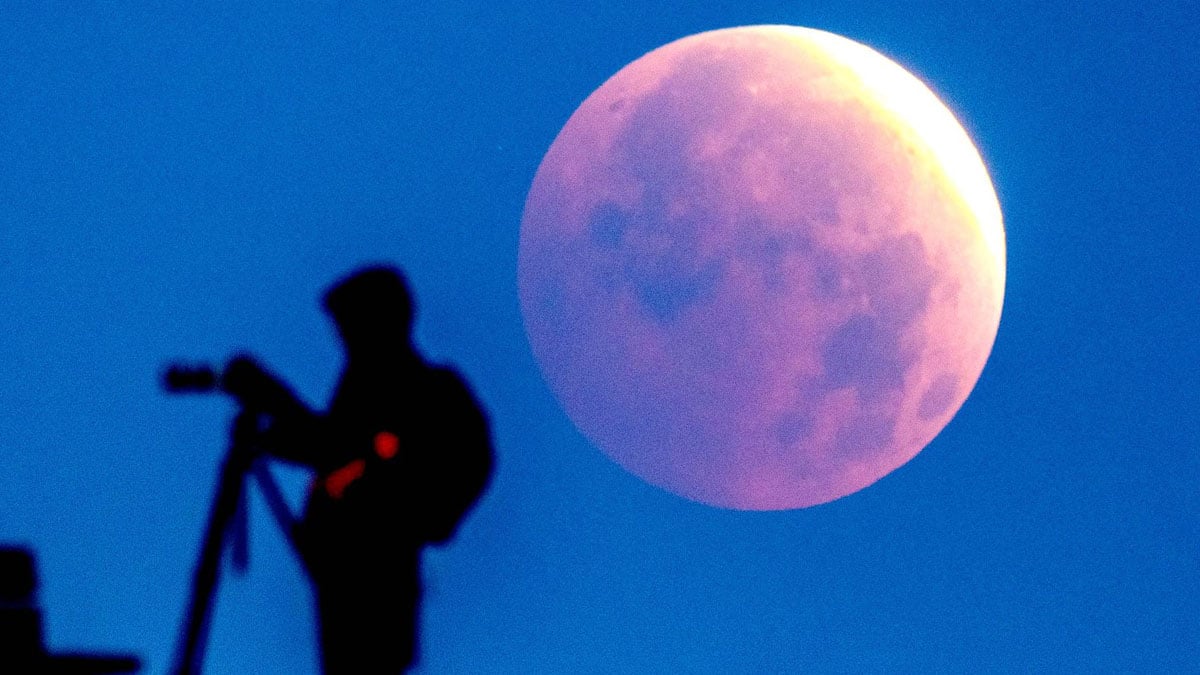
Astronomers observed a vivid astronomical event where the moon appeared blood red due to atmospheric light filtering.
When the Earth blocks the Sun from the Moon, the Moon looks red because the Sun's light travels through Earth's air and gets bent and mixed up, making the Moon look like it's wearing a red shirt.
Analysis
{"heading":"Understanding the Science Behind the Blood Moon","subheading":"Rayleigh Scattering and Atmospheric Conditions","content":["The phenomenon of a partial lunar eclipse turning the moon into a 'blood red' celestial display is primarily due to Rayleigh scattering, where sunlight passing through Earth's atmosphere loses shorter blue wavelengths while longer red and orange wavelengths bend toward the Moon.","Atmospheric conditions also play a crucial role in amplifying the deep copper-red tone projected onto the lunar disk during peak shadow alignment.","Dust and clouds within Earth's atmosphere contribute to this effect, enhancing the visual impact of the event."]}
Key points
- Partial lunar eclipse visible across multiple continents
- Event turns the moon into a deep reddish-copper hue
- Ideal viewing conditions in high-altitude and low-light regions
This event could inspire more people to look up at the sky and appreciate the beauty of the natural world.
The event might not have a significant impact on the general public or the economy.