Police issue warning over compromised Telegram accounts due to fake public transport voucher links
The Singapore police issued a warning about a scam involving compromised Telegram accounts. Victims receive a message with a fake public transport voucher link, which leads to a phishing page asking for personal details. The scammers then seize control of the victim's Tel…
Intelligence analysis by Llama
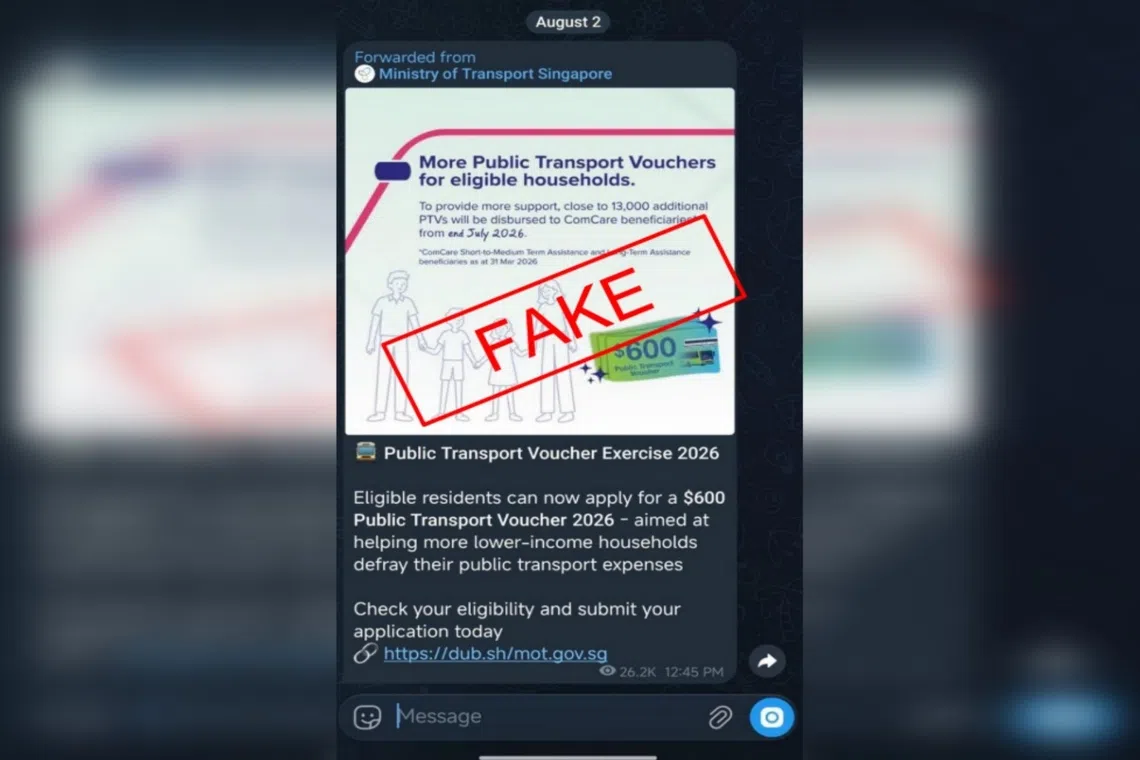
The police warned about a scam involving compromised Telegram accounts. Victims receive a message with a fake public transport voucher link, which leads to a phishing page asking for personal details. The scammers then seize control of the victim's Telegram account.
Imagine you get a message on Telegram that says you're eligible for a free public transport voucher. But when you click on the link, it asks for your personal details like your name, phone number, and ID number. This is a scam! The scammers want to take control of your Telegram account and use it to send fake messages to your friends. Always be careful when receiving unsolicited messages and never give out your personal details.
Analysis
Scam Variant Explained
The scam variant in question involves victims receiving a Telegram message containing an infographic that allegedly verifies their eligibility for a public transport voucher. However, the message also includes a fraudulent link that directs the victim to a web page requesting personal details such as their name, mobile number, NRIC number, and a Telegram verification code (OTP).
Once the victim provides the OTP, the scammers can seize control of the victim's Telegram account. The compromised accounts are then used to send similar phishing links to the victim's contacts or to add them to chat groups promoting fraudulent investment schemes.
Public Transport Voucher Scheme
The Ministry of Transport (MOT) has clarified that it will never send messages via Telegram or requests in which users will have to click on a link to claim a voucher. Information on legitimate public transport vouchers will be communicated only through official MOT channels such as its website or authorised social media accounts.
Police Warning
The police have advised members of the public to enable two-step verification and not to share verification codes or OTP with anyone. They should also avoid giving personal details in response to unsolicited messages.
Implications
This scam highlights the importance of being cautious when receiving unsolicited messages on Telegram. The police warning serves as a reminder to the public to be vigilant and to take necessary precautions to protect their personal information.
Key points
- The police issued a warning about a scam involving compromised Telegram accounts.
- Victims receive a message with a fake public transport voucher link, which leads to a phishing page asking for personal details.
- The scammers then seize control of the victim's Telegram account and use it to send similar phishing links to the victim's contacts or to add them to chat groups promoting fraudulent investment schemes.
- The Ministry of Transport (MOT) has clarified that it will never send messages via Telegram or requests in which users will have to click on a link to claim a voucher.
- The police have advised members of the public to enable two-step verification and not to share verification codes or OTP with anyone.
If people are more cautious when receiving unsolicited messages on Telegram, the number of compromised accounts may decrease. This could lead to a reduction in the spread of phishing links and fraudulent investment schemes.
If people are not careful, the scammers may continue to compromise more Telegram accounts. This could lead to a wider spread of phishing links and fraudulent investment schemes, causing more financial losses for victims.