President Ramaphosa unveils treatment plant to boost Hammanskraal clean water
President Cyril Ramaphosa has unveiled the Klipdrift 50-megalitre per day Water Treatment Plant in Hammanskraal, north of Pretoria, to enhance water security and provide safe drinking water to local communities.
Intelligence analysis by Gemini 2.5 Flash
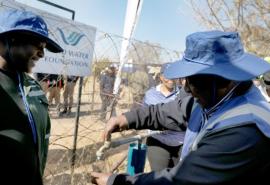
The commissioning of the new treatment plant, part of the Department of Water and Sanitation's Mandela Day programme, aims to address a severe water crisis in Hammanskraal. President Ramaphosa emphasized government's commitment to collaborative service delivery and improving water access across South Africa, while also highlighting the critical next step of rehabilitating the local re…
Imagine a big machine that cleans dirty water so it's safe to drink. The President of South Africa just opened a super big one in a town called Hammanskraal, which didn't have enough clean water for a long time. Now, the next big job is to make sure the clean water can travel through all the pipes right into people's houses, like making sure the water hose reaches your garden after you turn on the tap.
Analysis
A Significant Leap for Hammanskraal
The unveiling of the Klipdrift 50-megalitre per day Package Water Treatment Plant marks a pivotal moment for the Hammanskraal community, which has long grappled with a severe water crisis. President Ramaphosa lauded the plant as a 'phenomenal' achievement, capable of delivering 50 million litres of water daily, significantly boosting water security and access to safe drinking water. This infrastructure development is not merely a technical upgrade but a direct response to the urgent needs of residents, reflecting a tangible commitment from the government to improve living conditions and public health in the area.
The Power of Collaborative Governance
The project's success is attributed to a robust collaborative effort involving national, provincial, and local government, as well as a dedicated national water committee comprising business, organised labour, and other stakeholders. This multi-sectoral approach, highlighted by President Ramaphosa, underscores a model of governance where diverse entities unite to tackle complex service delivery challenges. Gauteng Premier Panyaza Lesufi further reinforced this, emphasizing that strong intergovernmental relations were key to overcoming obstacles and fulfilling the President's commitment to the community. This collaborative framework is presented as a blueprint for future infrastructure projects across the country.
The Next Hill to Climb: Ensuring Household Access
While the treatment plant's completion is a major victory, President Ramaphosa stressed that the immediate next priority is ensuring the treated water actually reaches households. He issued a clear directive to the City of Tshwane to accelerate the rehabilitation of the local reticulation network and provide definite timeframes for restoring water to homes, emphasizing that residents should not have to wait years. This focus on the 'last mile' delivery is critical, as the efficacy of the new plant hinges on a functional distribution system. The President invoked Nelson Mandela's legacy, noting that while one hill has been climbed, many more remain, underscoring the ongoing commitment required to ensure all South Africans have access to reliable basic services.
Key points
- President Ramaphosa unveiled the Klipdrift 50-megalitre per day Water Treatment Plant in Hammanskraal.
- The plant aims to improve water security and provide safe drinking water to the community.
- The project is part of the Department of Water and Sanitation's Mandela Day programme and broader service delivery initiatives.
- Government emphasizes intergovernmental collaboration as key to the project's success.
- The next priority is the rehabilitation of the local reticulation network to ensure water reaches households quickly.
The new treatment plant promises to significantly alleviate the long-standing water crisis in Hammanskraal, improving public health and quality of life for residents. The collaborative approach demonstrated by various government spheres and stakeholders could serve as an effective model for addressing similar infrastructure challenges nationwide.
Despite the new plant, the critical challenge of rehabilitating the local water reticulation network remains, and delays in this process could mean residents still wait for clean water in their homes. The President's call for clear timeframes suggests potential difficulties in ensuring swift and effective last-mile delivery.