Protesters in Manila denounce US war on Iran, Label Marco Rubio a ‘war criminal’
Anti-war protesters in Manila denounced US military operations against Iran and labeled Secretary of State Marco Rubio a 'war criminal' during his visit for the ASEAN Foreign Ministers’ Meeting.
Intelligence analysis by Gemini 2.5 Flash
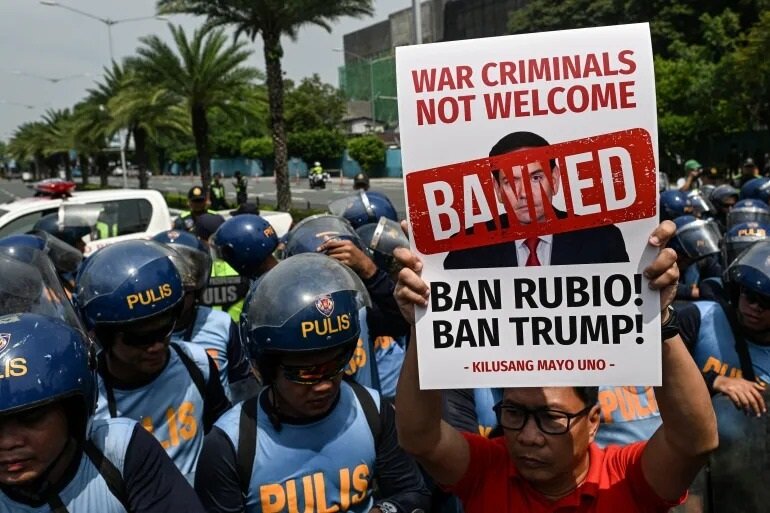
Demonstrators gathered in the Philippine capital to protest Washington's aggressive foreign policy, specifically targeting US military actions in the Middle East and its expanding presence in the Indo-Pacific. They called for an end to foreign military entanglements and criticized the Marcos Jr. administration's alignment with US geopolitical interests.
Imagine a big meeting where important people from different countries talk about how to get along. But outside, many people are upset because they think a powerful country, the United States, is causing too many fights, especially with a country called Iran. They're saying that a US leader, Marco Rubio, is like a 'war criminal' because of these fights, and they want their own country, the Philippines, to stop being so close to the US military.
Analysis
Manila's Anti-War Stance Takes Center Stage
Public demonstrations erupted in Manila during the Association of Southeast Asian Nations (ASEAN) Foreign Ministers’ Meeting, directly confronting the presence of US Secretary of State Marco Rubio. Protesters, carrying signs like “War criminals not welcome” and “Ban Trump! Ban Rubio!”, voiced strong opposition to Washington's military operations against Iran and its broader strategic footprint in the Indo-Pacific region. The timing of these rallies, coinciding with Rubio's diplomatic engagements, underscores a deliberate effort by civil society groups to challenge US foreign policy on a prominent international stage.
Rubio's visit aimed to justify the US military posture and reinforce defense commitments with regional allies, but it was met with demands for an immediate cessation of US warfare abroad. This direct confrontation suggests a significant disconnect between official diplomatic narratives and public sentiment in some allied nations. The protests serve as a visible manifestation of international blowback against perceived American unilateralism, particularly concerning its military interventions.
Accusations of War Crimes and Interventionism
Human rights advocate Cristina Palabay, speaking at the rally, condemned Washington's global military actions, asserting that the US, especially under the Trump administration, has been the world’s foremost 'war criminal.' Palabay specifically cited US military actions in Palestine, Iran, and the Philippines, highlighting a long pattern of interventionism and the continued presence of US military bases. These accusations reflect a deep-seated grievance regarding the human cost and geopolitical instability attributed to US foreign policy.
The labeling of US officials as 'war criminals' by protesters is a potent rhetorical device aimed at delegitimizing American military actions and holding leaders accountable. This sentiment is not isolated to Manila but is part of a broader global movement demanding an end to US military aggression against Iran and Western intervention in regional affairs. The protests underscore a moral and ethical challenge to the legitimacy of US military power and its global deployment.
Philippines at a Geopolitical Crossroads
Beyond criticizing US actions, protesters also targeted the Philippine government's alignment with Washington’s geopolitical agenda. Activist Mong Palatino urged President Ferdinand Marcos Jr.'s administration to sever ties with top US officials, warning that deeper military cooperation primarily serves American imperial interests. Palatino specifically cautioned that Rubio's visit would lead to more US military bases in the Philippines and the further 'plunder of natural resources,' condemning the Marcos government for 'colluding' with the US.
These concerns highlight the internal debate within the Philippines regarding its foreign policy orientation and national sovereignty. The protests suggest a significant segment of the population views closer military ties with the US as detrimental to national interests, potentially drawing the country into conflicts like the one with Iran. This internal pressure could complicate the Marcos Jr. administration's efforts to balance its strategic alliance with the US against domestic demands for greater independence and non-alignment.
Key points
- Anti-war protesters in Manila denounced US military operations against Iran during Secretary of State Marco Rubio's visit.
- Demonstrators labeled Marco Rubio and former President Trump as 'war criminals' due to US interventionism.
- Human rights advocate Cristina Palabay cited US military actions in Palestine, Iran, and the Philippines as examples of intervention.
- Activists urged the Philippine government to cut ties with US officials, warning against increased US military bases and resource exploitation.
- The protests reflect growing international opposition to American unilateralism and military aggression against Iran.
The protests indicate a deepening rift between public sentiment and government policy in the Philippines regarding US military presence, potentially leading to increased internal political instability. Continued US military actions, particularly against Iran, risk further escalating regional tensions and drawing allies into unwanted conflicts, as feared by the demonstrators.


