Putin offers help to end Iran war while Russia continues its own in Ukraine
Russian President Vladimir Putin offered to mediate an end to the US-Iran war during a meeting with Iranian counterpart Masoud Pezeshkian, even as Russia's own war in Ukraine continues.
Intelligence analysis by Gemini 2.5 Flash
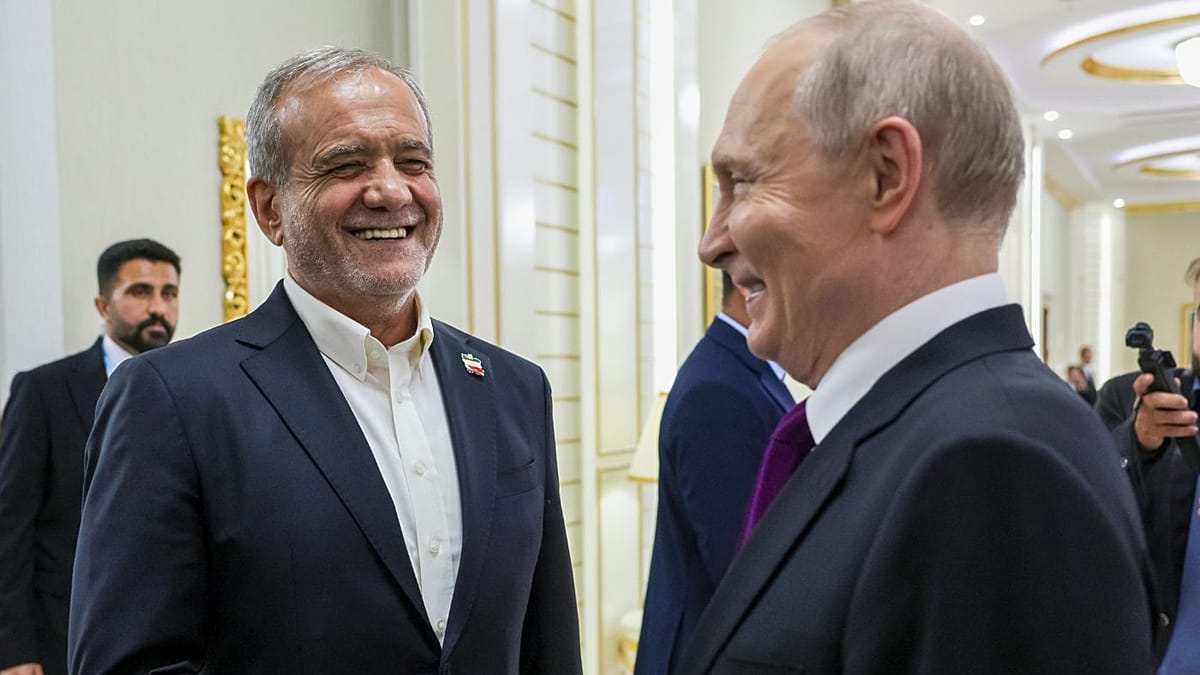
Russian President Vladimir Putin has positioned his country as a potential mediator in the ongoing conflict between the US and Iran, pledging assistance to resolve the war during a meeting with Iranian counterpart Masoud Pezeshkian. This diplomatic overture comes as Russia itself remains deeply embroiled in its fifth year of war in Ukraine, highlighting a complex and seemingly contrad…
Imagine two kids, Iran and the US, are having a big argument. Another kid, Russia, who is also in a fight with someone else (Ukraine), steps in and says, "Hey, I can help you two stop fighting!" Meanwhile, Russia is also giving toys and tools to Iran, making their friendship stronger. It's a bit like Russia trying to be a peacemaker in one argument while still being part of another big disagreement.
Analysis
The recent meeting between Russian President Vladimir Putin and Iranian President Masoud Pezeshkian in Turkmenistan underscores a complex geopolitical landscape where Russia seeks to expand its diplomatic influence while simultaneously prosecuting a major conflict. Putin's offer to mediate in the US-Iran war, despite Russia not being an official mediator, positions Moscow as a key player in Middle Eastern affairs. This move is particularly notable given the ongoing full-scale invasion of Ukraine, now in its fifth year, which has isolated Russia from many Western nations. The dual approach reveals Russia's strategy to leverage its relationships with countries like Iran to challenge the existing global order and assert its role on multiple international fronts.
Masoud Pezeshkian
Iranian President Masoud Pezeshkian confirmed that Iran and the United States have exchanged proposals aimed at ending their conflict and reopening the vital Strait of Hormuz. Pezeshkian stated that Tehran is actively reviewing and amending these proposals before consolidating them through existing mediators, which currently include Qatar and Pakistan. Despite continued US attacks, Iran has committed to remaining at the negotiating table, signaling a willingness to pursue a diplomatic resolution. This stance highlights Iran's strategic patience and its efforts to navigate complex international pressures while seeking to protect its national interests and maritime access.
Shahed drone technology
The military and diplomatic ties between Iran and Russia have significantly deepened since Russia's invasion of Ukraine in early 2022. A critical aspect of this cooperation involves Iran supplying Russia with Shahed drone technology, which Moscow has subsequently adapted into its own Geran-type variants. These drones have become a crucial tool in Russia's daily attacks on Ukrainian civilian infrastructure, demonstrating the tangible impact of this strategic partnership on the ongoing conflict in Europe. Furthermore, Moscow faces accusations of providing Tehran with targeting information for attacks on US interests in the Middle East, suggesting a broader, more integrated military collaboration that extends beyond mere arms transfers.
$1 billion loan
Economic relations between the two nations have also seen substantial growth, with trade increasing by over 21% in 2025 and maintaining this trajectory into 2026. This economic deepening is underpinned by a comprehensive strategic partnership agreement signed early last year. A significant financial component of this relationship is a reported $1 billion loan from Russia to Tehran, intended as the first tranche of a larger $20 billion package. However, the disbursement of this loan has been delayed due to internal disagreements among Iranian authorities regarding how the funds should be allocated. Different ministries, including the Planning and Budget Organisation, the Oil Ministry, and the Agriculture Ministry, are vying for control over the funds, illustrating internal challenges within Tehran's economic planning.
Key points
- Russian President Vladimir Putin offered to help mediate an end to the US-Iran war during a meeting with Iranian President Masoud Pezeshkian in Turkmenistan.
- This offer comes as Russia continues its fifth year of full-scale invasion of Ukraine, highlighting a contradictory foreign policy stance.
- Iran and the US have exchanged proposals to end the war and reopen the Strait of Hormuz, with Iran reviewing them for consolidation through mediators like Qatar and Pakistan.
- Military and economic ties between Iran and Russia have strengthened significantly since 2022, including Iran supplying Shahed drone technology to Russia.
- A reported $1 billion loan from Russia to Iran is delayed due to internal disagreements among Iranian authorities over fund allocation.
The ongoing exchange of proposals between Iran and the US, coupled with Russia's offer to mediate, could potentially lead to a de-escalation of tensions and a diplomatic resolution to the conflict. If successful, this could stabilize the Middle East and ensure the safe passage through the Strait of Hormuz, benefiting global trade and regional security.
Russia's dual role as a self-proclaimed mediator in the US-Iran conflict while actively prosecuting its own war in Ukraine could complicate peace efforts and be perceived as disingenuous. The deepening military and economic ties between Russia and Iran, including drone technology transfers and potential intelligence sharing, could further destabilize both the Middle East and Eastern Europe, prolonging conflicts and increasing geopolitical friction.
Market signals
- OIL Ongoing US attacks and the conflict's impact on the Strait of Hormuz, a critical shipping lane, introduce supply-route risk that could push oil prices higher.
AI-generated analysis of potential market relevance. Not financial advice.
