Russian missile strike on a market in Kyiv and Ukraine's 'largest drone attack' on a commercial warehouse in Moscow
Russia hit a market in Kyiv with missiles, killing at least five and injuring more than ten, while Ukraine struck a Wildberries warehouse near Moscow in what officials called one of the largest drone attacks of the year.
Intelligence analysis by Llama
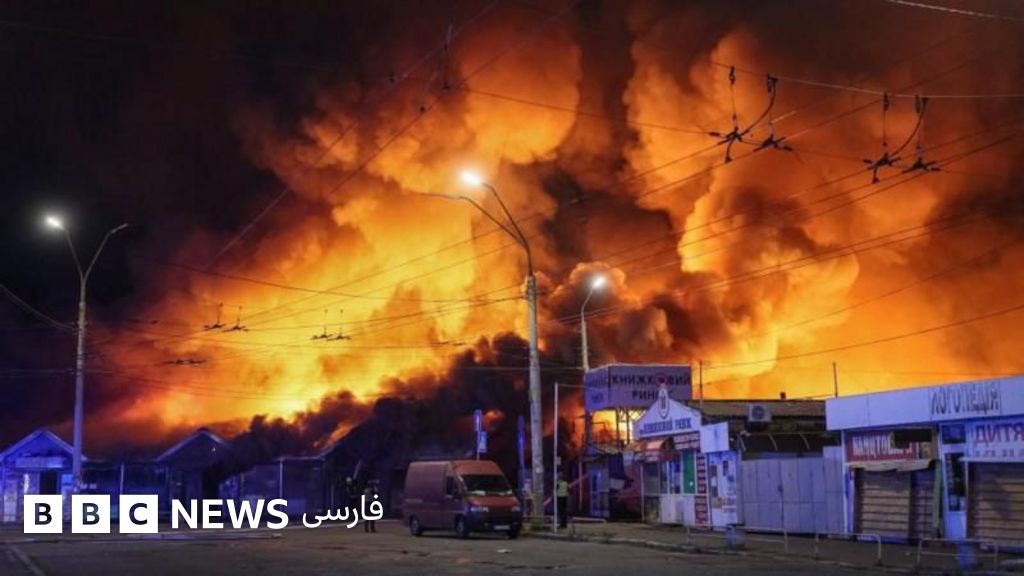
Russia and Ukraine exchanged massive aerial blows overnight, with a Russian missile strike igniting a market in Kyiv and Ukraine launching hundreds of drones at a commercial logistics hub in the Moscow region, intensifying the war's air-power dimension.
Russia and Ukraine are fighting a war mostly with flying robots instead of soldiers on the ground. Russia shot missiles at a market in Ukraine's capital, and Ukraine sent hundreds of drones to hit a big warehouse near Moscow. It's like two kids throwing water balloons at each other, but the balloons are very big and the splash hurts real people.
Analysis
The 822-drones barrage
Russia's defense ministry, as reported by the state TASS news agency, said its air defenses intercepted 822 Ukrainian drones overnight, calling it the largest Ukrainian attack since the start of the calendar year. Moscow mayor Sergei Sobyanin separately said more than 600 drones had been intercepted on their way to the capital. The sheer volume of unmanned aircraft involved underscores a structural shift in the war: both sides have moved from occasional precision strikes to sustained, industrial-scale drone campaigns intended to overwhelm air defenses, drain interceptor stockpiles, and impose economic cost deep inside enemy territory. For observers tracking Iran's drone programs — including the Shahed-series munitions Russia itself deploys against Ukraine — the optics of Kyiv fielding comparable mass-launch capability is itself a notable signal.
Wildberries as a military-logistics target
The most prominent target in the Moscow region was a warehouse belonging to Wildberries, Russia's largest online retailer, located in the Koldino industrial settlement. Kyiv's defense ministry said it believed the strike halted operations at the site. Ukraine has previously hit multiple Wildberries logistics hubs, arguing the company supplies drone components, navigation equipment, and other materiel to the Russian armed forces — a claim Moscow rejects. The framing is significant: by designating a private commercial platform as a dual-use military target, Ukraine is testing the legal and economic threshold of what counts as a legitimate wartime objective. For Iran, which has faced similar questions over the use of commercial shipping for sanctioned goods, the precedent is directly relevant.
A war fought mostly in the air
The BBC Persian report notes that, with both sides making negligible territorial gains along a long, grinding front line, the conflict has largely become an aerial war of missile and drone exchanges aimed at degrading the other's combat capacity. Russia's February 2022 full-scale invasion has now produced a battlefield in which strategic effect is measured less in kilometers captured than in the volume of drones launched, interceptors expended, and rear-area infrastructure burned. The attacks landed simultaneously — a Kyiv market fire, a Moscow-region logistics park in flames — within a single news cycle, illustrating how synchronised the two air campaigns have become. For Iranian policymakers, the implication is that any future confrontation involving sophisticated drone and missile exchanges will be defined by similar industrial-scale production, layered air defense, and attacks on economic infrastructure rather than purely on military formations.
Key points
- Russia struck a market in Kyiv with missiles, killing at least five and wounding more than ten, according to Ukrainian officials.
- Ukraine launched what Moscow officials called the largest drone attack of the year, hitting a Wildberries warehouse in the Koldino industrial area near Moscow.
- Russia's defense ministry, via TASS, said 822 Ukrainian drones were intercepted overnight, with Moscow mayor Sobyanin reporting more than 600 drones heading for the capital.
- Ukraine has previously targeted multiple Wildberries logistics centers, claiming the retailer supplies components to the Russian military; Russia denies this.
- The BBC Persian report notes the war has become predominantly an aerial conflict of missile and drone exchanges, as ground advances on both sides remain negligible.
The escalating aerial exchange has not yet produced a decisive breakthrough, and the mutual economic costs of strikes on commercial infrastructure on both sides could create pressure for de-escalation talks; the report's framing of the war as a stalemate along the front line suggests room for diplomatic movement if the air campaigns continue to inflict civilian and economic damage without changing the territorial balance.
The reported scale of 822 drones intercepted in a single night, alongside strikes on civilian markets and commercial warehouses, signals a dangerous escalation that risks further civilian casualties, deeper economic damage to both countries, and a longer conflict; for partners of either side, including Iran, this trajectory raises the prospect of expanded defense commitments and heightened risk of miscalculation.
Market signals
- OIL A major escalation in the Russia-Ukraine air war raises supply-risk concerns for Russian energy exports, supporting crude prices.
- XAU The reported scale of overnight strikes and mounting economic damage on both sides drive safe-haven demand for gold.
AI-generated analysis of potential market relevance. Not financial advice.