Saudi Arabia asserts territorial integrity and security as non-negotiable at BRICS Summit
Saudi Foreign Minister Prince Faisal bin Farhan stated at the BRICS Summit that the Kingdom's sovereignty, security, and vital infrastructure are non-negotiable, warning against aggression and emphasizing regional stability.
Intelligence analysis by Gemini 2.5 Flash
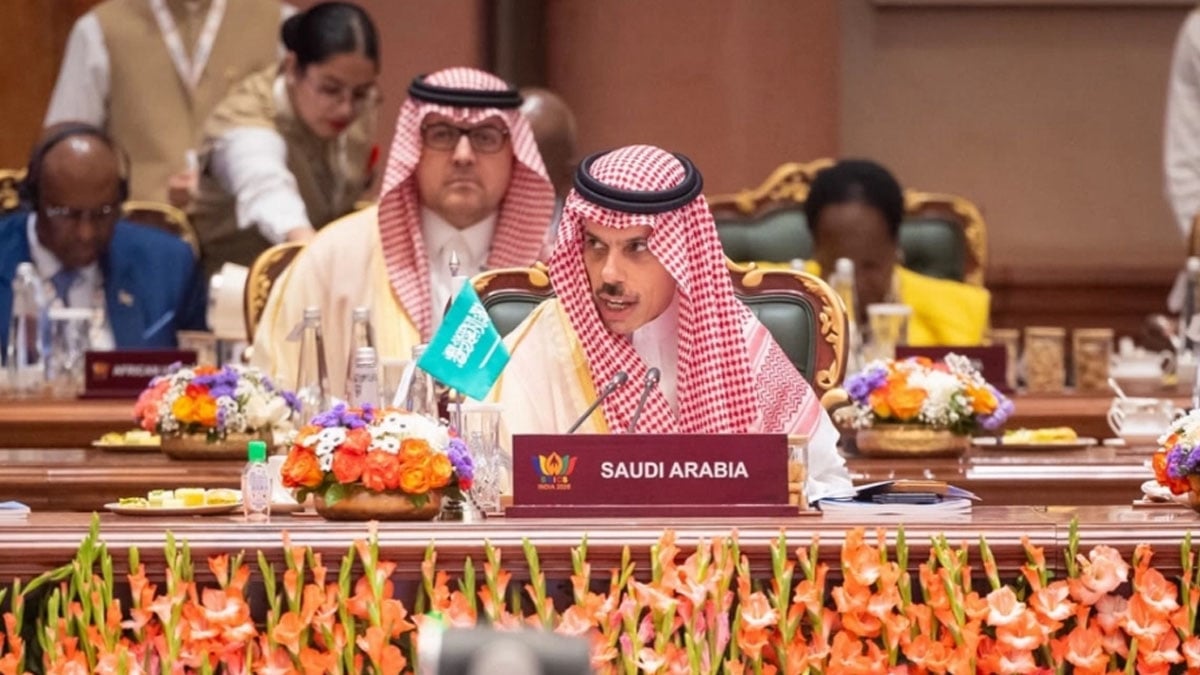
At the 18th BRICS Summit in New Delhi, Saudi Arabia's Foreign Minister Prince Faisal bin Farhan underscored the non-negotiable nature of the Kingdom's territorial integrity and security. He warned against external aggression, stressed the importance of respecting sovereign rights, and highlighted the critical role of the Strait of Hormuz for global energy security amidst rising region…
Imagine Saudi Arabia is like a kid's treehouse, and its leader, Prince Faisal, told a big club meeting (BRICS Summit) that nobody is allowed to mess with their treehouse or the special path (Strait of Hormuz) that everyone uses to get their toys (oil). He wants everyone to be friends and not fight, because if they do, it could make things tricky for everyone's toy supply.
Analysis
Prince Faisal bin Farhan
Saudi Arabia's Foreign Minister, Prince Faisal bin Farhan bin Abdullah, delivered a resolute message at the 18th BRICS Summit in New Delhi, asserting the Kingdom's territorial integrity, security, and vital national infrastructure as unequivocally non-negotiable. Representing Crown Prince and Prime Minister Mohammed bin Salman, his address underscored a firm commitment to national defense. The minister explicitly warned that Saudi Arabia, alongside its Gulf Cooperation Council (GCC) partners, would decisively counter any aggression targeting their sovereign territory or critical economic interests, regardless of the justification offered by external actors. This declaration highlights a heightened sense of vigilance in the face of evolving regional dynamics.
His remarks also conveyed deep concern over escalating tensions in the Middle East, cautioning that such conflicts possess the potential to expand into broader regional dimensions, thereby jeopardizing both regional and global stability. Prince Faisal urged all involved parties to immediately de-escalate the current conflicts, advocating for the creation of diplomatic space through dialogue and a fundamental respect for the sovereign rights of nations in the region. He articulated that enduring political stability and a pervasive sense of security within the Gulf region are contingent upon upholding state sovereignty, independence, and the principle of non-interference in internal affairs.
Strait of Hormuz
A significant portion of Prince Faisal's address focused on the imperative of safeguarding international trade interests, particularly ensuring the unimpeded flow of commerce through the Strategic Strait of Hormuz and its adjacent maritime corridors. The minister explicitly linked the safe transit through these waters to broader global energy security concerns. He underscored that any disruption to maritime operations within this strategically vital area would trigger immediate and far-reaching impacts on the global economy, extending well beyond the immediate confines of the Middle East. This emphasis reflects the critical role the Strait plays as a chokepoint for a substantial portion of the world's oil supply.
The vulnerability of this maritime artery to regional instability makes its security a paramount international concern. Saudi Arabia's insistence on its protection at a global forum like BRICS highlights the interconnectedness of regional security with global economic stability. The Kingdom's position suggests a proactive approach to mitigating risks that could arise from geopolitical friction, aiming to secure not only its own economic interests but also the stability of international energy markets. The minister's warning serves as a stark reminder of the potential ripple effects that localized conflicts can have on global supply chains and economic prosperity.
BRICS Summit
Prince Faisal's participation and strong statements at the 18th BRICS Summit, held under India's Chairship, provided a significant platform for Saudi Arabia to articulate its strategic priorities on the global stage. His concluding remarks reiterated that Gulf stability is not merely a regional issue but a matter of profound concern for the entire world economy. He specifically appealed to the other BRICS nations—Brazil, Russia, India, China, and South Africa—to intensify their political efforts aimed at preserving regional security and halting military conflicts across the Middle East. This call to action underscores Saudi Arabia's desire for multilateral cooperation in addressing complex security challenges.
The choice of the BRICS forum for such a forceful declaration is notable, signaling Saudi Arabia's growing engagement with emerging economies and its intent to leverage diverse international platforms to advance its national and regional security agenda. By framing Gulf stability as a global economic concern, Prince Faisal sought to galvanize broader international support for de-escalation and diplomatic solutions. His address positioned Saudi Arabia not just as a regional power, but as a key player whose security interests are intrinsically linked to global economic well-being, urging a collective responsibility among major global actors to maintain peace in a volatile region.
Key points
- Saudi Arabia declared its sovereignty, security, and vital infrastructure non-negotiable at the 18th BRICS Summit.
- Foreign Minister Prince Faisal bin Farhan warned against aggression by external actors and emphasized the need for regional stability.
- He called for immediate de-escalation and diplomatic dialogue to resolve conflicts in the Middle East.
- The minister highlighted the critical importance of the Strait of Hormuz for global energy security and trade.
- Disruption in the Gulf region's maritime operations could have immediate and far-reaching global economic impacts.
Prince Faisal's strong stance and call for diplomacy at the BRICS Summit could encourage de-escalation efforts, fostering dialogue among regional nations. This might lead to greater respect for sovereignty and non-interference, potentially stabilizing the Middle East and securing global trade routes.
Despite Saudi Arabia's warnings, ongoing regional tensions could escalate further, potentially disrupting the Strait of Hormuz and global energy supplies. Such a scenario would severely impact the global economy, leading to increased instability and higher costs for nations reliant on Middle Eastern oil.
Market signals
- OIL Concerns over potential disruption in the Strait of Hormuz, a critical maritime corridor, could lead to increased global oil prices.
AI-generated analysis of potential market relevance. Not financial advice.