Self Custody Is Dead. Long Live Self Custody
A firmware bug in Coldcard hardware wallets led to the theft of more than 1,300 BTC and pushed over 11,000 BTC onto custodial exchanges. The piece argues self-custody remains inseparable from Bitcoin's core mission.
Intelligence analysis by Llama
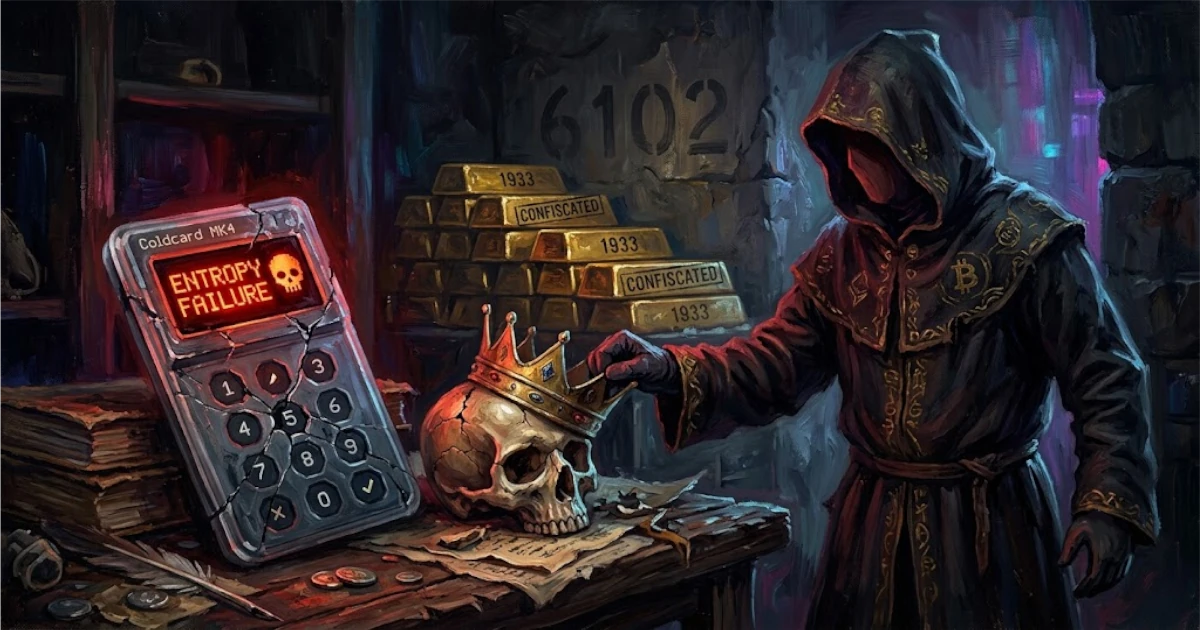
A Coldcard entropy bug let thieves guess private keys, draining 1,300-2,000 BTC and prompting users to move 11,000+ BTC to custodial exchanges. Despite the blow, the author argues self-custody cannot die without betraying Satoshi's anti-custodial vision, anchored in the 2008 crisis and 1933 gold confiscation history.
Imagine hiding your allowance in a piggy bank that only you can open. Bitcoin lets grown-ups do the same thing digitally, but someone recently found a sneaky trick that let them crack open thousands of those piggy banks at once. Even though it was scary, lots of people still believe keeping your own money safe yourself is super important, because long ago, governments once took everyone's gold away.
Analysis
When the Fortress Door Swings Open
The irony cuts deep. Coinkite built Coldcard's reputation on what it called paranoid design choices: airgapped operation, deliberately low-resolution LED screens, the BBQR protocol, NFC handshakes that never let the device touch a computer or share SD cards. Each feature was a brick in a fortress wall around the user's private keys. Yet the thieves who drained more than 1,300 BTC last week, with some estimates reaching 2,000, did not need a USB exploit, a supply-chain interdiction, or a malware payload. According to the article, they walked through the front door: a firmware bug that degraded the entropy used to generate keys, reducing what should have been unguessable secrets to mathematically breakable ones. A vulnerability that hid for years in a product whose user base only grew is a textbook reminder that the gap between "secure in theory" and "secure in practice" is where trust collapses.
The Betrayal That Cannot Become the Surrender
The piece pivots from damage assessment to a thesis: self-custody is too foundational to Bitcoin's reason for being to abandon because one vendor failed. Satoshi's white paper, the author notes, framed Bitcoin explicitly as an exit from trusted third parties, an answer to a financial system whose 2008 collapse proved the cost of misplaced trust. The quoted Nayib Bukele tweet captures a popular framing: that the 2008 crisis was never resolved, only displaced. If a generation of Bitcoiners surrenders custody at the first major hardware-wallet incident, the article argues, the project concedes the very fight it was launched to win. NVK and Coinkite may carry the public blame; the principle of holding one's own keys, the author concludes, cannot afford to.
Gold, Flesh, and the Long Custodial Record
To make the stakes concrete, the article reaches back nearly a century to Executive Order 6102, when FDR's administration confiscated American gold at $20.67 per ounce and repriced it at $35 after the Gold Reserve Act, a 69% dollar devaluation executed in months. From that "unholy alliance between the banking system and politicians," the author draws a line through fiat-funded world war to today's near-trillion-dollar annual U.S. interest bill and debt-to-GDP at 123%. The Coldcard breach, in this framing, is not an argument against self-custody but a warning about which custodian you trust — vendor, software stack, or third-party exchange. Custody is a spectrum; the only directionally safe move, the article insists, is to keep walking toward the user-held end of it.
Key points
- A Coldcard firmware bug reduced entropy in key generation, making private keys mathematically guessable and enabling the theft of 1,300-2,000 BTC.
- Approximately 11,000 BTC were migrated to custodial exchanges within a week as users fled the device.
- The article defends self-custody as inseparable from Bitcoin's anti-custodial thesis, citing Satoshi's white paper and the 2008 financial crisis.
- Historical analogies include FDR's 1933 gold confiscation under Executive Order 6102 and the subsequent 69% dollar devaluation via the 1934 Gold Reserve Act.
- U.S. debt service is cited at roughly a trillion dollars annually, with debt-to-GDP at 123%, as evidence of fiat's long-run cost.
If the Bitcoin community treats the Coldcard breach as a lesson in vendor due diligence rather than a verdict on self-custody itself, hardware-wallet security standards could mature quickly, with coordinated disclosure and audits becoming table stakes. A stronger self-custody stack emerging from the failure would reinforce Bitcoin's fundamental pitch: money that does not require trusting a custodian to keep.
If users internalize this hack as evidence that DIY key management is too error-prone, the next 11,000 BTC migration could be the leading edge of a multi-year flow back into custodial venues, hollowing out the very sovereignty thesis that underwrites Bitcoin's premium over centrally issued digital assets. A second similar breach at another major hardware vendor could harden that narrative into a permanent retreat.