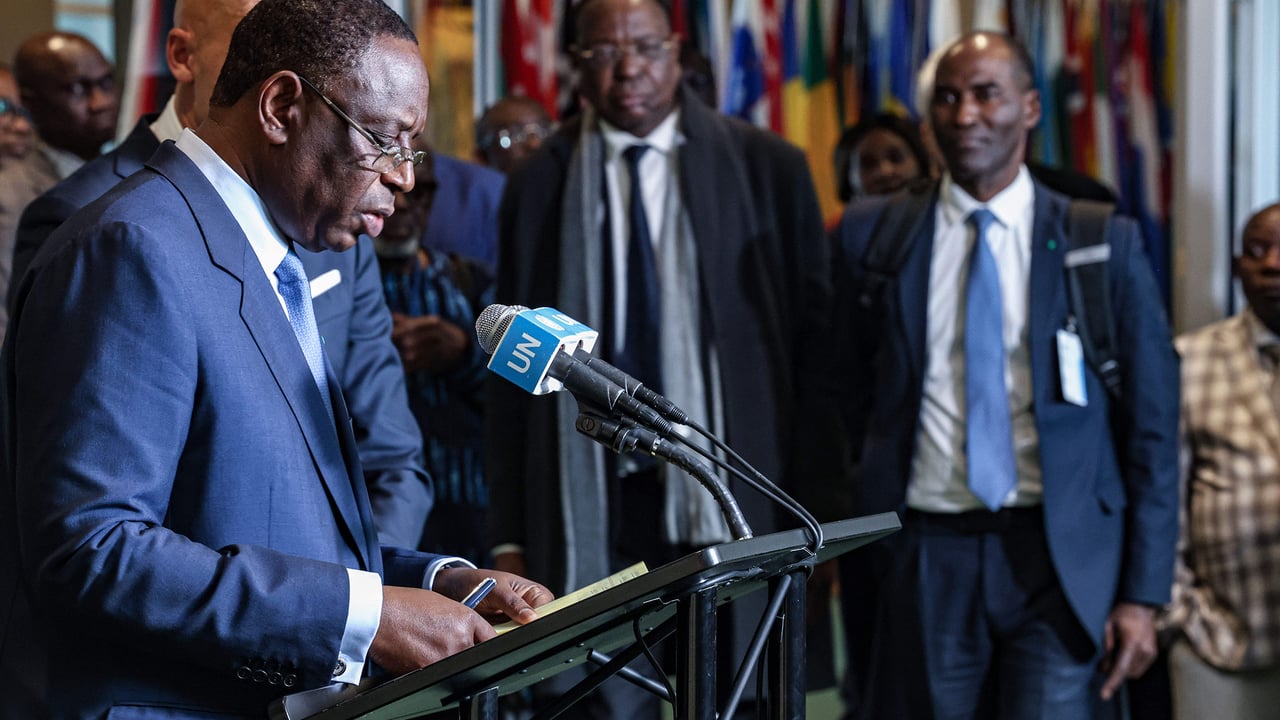
Senegal's Macky Sall withdraws from race for UN top job
Former Senegalese President Macky Sall has withdrawn his candidacy for the UN's top job after an informal Security Council poll showed all candidates received at least one veto. His withdrawal leaves Uganda's Olara Otunnu as the sole African contender.
Intelligence analysis by Gemini 2.5 Flash
Former Senegalese President Macky Sall has announced his withdrawal from the race to become the next United Nations Secretary-General. This decision follows an informal straw poll where all seven candidates, including Sall, received at least one veto from permanent UN Security Council members, highlighting the difficulty in achieving consensus for the role.
Imagine a big club where countries decide who gets to be the main leader. Macky Sall, a former president from Senegal, wanted that job, but after a secret vote where some big countries said "no" to everyone, he decided to step out. Now, only one person from Africa is still trying for the job, like being the last player from your team in a big game.
Analysis
The withdrawal of Macky Sall, Senegal's former president, from the race for the United Nations' top job marks a significant development in the ongoing selection process for the next Secretary-General. His decision comes after an informal straw poll by UN Security Council members revealed that all seven candidates vying for the position received at least one 'discourage' vote, which effectively acts as a veto from any of the five permanent members: Britain, China, France, Russia, and the United States. This outcome underscores the profound challenges in securing broad consensus for such a high-profile international role, particularly given the geopolitical complexities and divergent interests among the Council's most powerful nations.
Macky Sall's Candidacy
Macky Sall's bid for the UN Secretary-General position faced hurdles from its inception. Initially, Senegal, his home country, did not back his candidacy, with his nomination instead coming from Burundi. However, Senegal's current President Bassirou Diomaye Faye later threw his support behind Sall in July, following a meeting between the two leaders. Despite this domestic endorsement, Sall's performance in earlier straw polls was not strong, having received only six votes in favor, with seven against, and two abstentions in a previous round. His withdrawal, therefore, appears to be a pragmatic response to the lack of sufficient support within the Security Council, aiming to facilitate the emergence of a more widely accepted candidate.
UN Security Council Dynamics
The informal straw poll results highlight the formidable power of the UN Security Council's five permanent members. The fact that every candidate, including frontrunner Rebecca Grynspan of Costa Rica, received 'discourage' votes—including two from permanent members for Grynspan—demonstrates the intricate web of national interests and diplomatic maneuvering at play. Candidates require nine 'encourage' votes from the Council's 15 members, but a single veto from a permanent member is enough to derail a bid. This system often leads to prolonged selection processes and can result in compromise candidates who are less objectionable rather than universally preferred, reflecting the deep-seated divisions that can impede global governance.
African Representation
Sall's withdrawal has immediate implications for African representation in the race. With his departure, Uganda's Olara Otunnu is now left as the sole African contender for the Secretary-General post. This development occurs against the backdrop of a long-standing tradition that the UN's top job should rotate between different regions. Under this premise, the current rotation is widely expected to favor a candidate from Latin America, a region from which most of the remaining candidates hail. The narrowing of the African field means that the continent's chances of securing the position in this particular cycle may diminish further, emphasizing the importance of strategic alliances and unified regional support in future bids.
Key points
- Former Senegalese President Macky Sall has withdrawn from the race for UN Secretary-General.
- His decision followed an informal Security Council straw poll where all seven candidates received at least one veto.
- Sall initially received only six 'encourage' votes in an earlier poll, with seven against.
- His withdrawal leaves Uganda's Olara Otunnu as the sole African contender for the position.
- The tradition suggests the role should go to a candidate from Latin America this time, where most candidates are from.
Sall's withdrawal could potentially streamline the selection process by reducing the number of candidates, possibly allowing for a clearer path towards a consensus candidate who can garner broader support among Security Council members. His stated hope to contribute to the emergence of a consensus candidate suggests a willingness to support a unified choice.
The fact that all seven candidates received vetoes in the informal poll highlights deep divisions within the UN Security Council, suggesting that finding a universally acceptable candidate for the top job will remain a significant challenge, potentially leading to prolonged deadlock or a compromise candidate lacking strong backing.