Skild AI Taps NVIDIA Physical AI to Teach Robots New Tasks From a Single Video
Skild AI has launched its S1 robot foundation model, enabling robots to learn complex, previously unseen tasks from a single video demonstration without retraining. This in-context learning approach, developed with NVIDIA AI infrastructure, significantly improves robot ad…
Intelligence analysis by Gemini 2.5 Flash
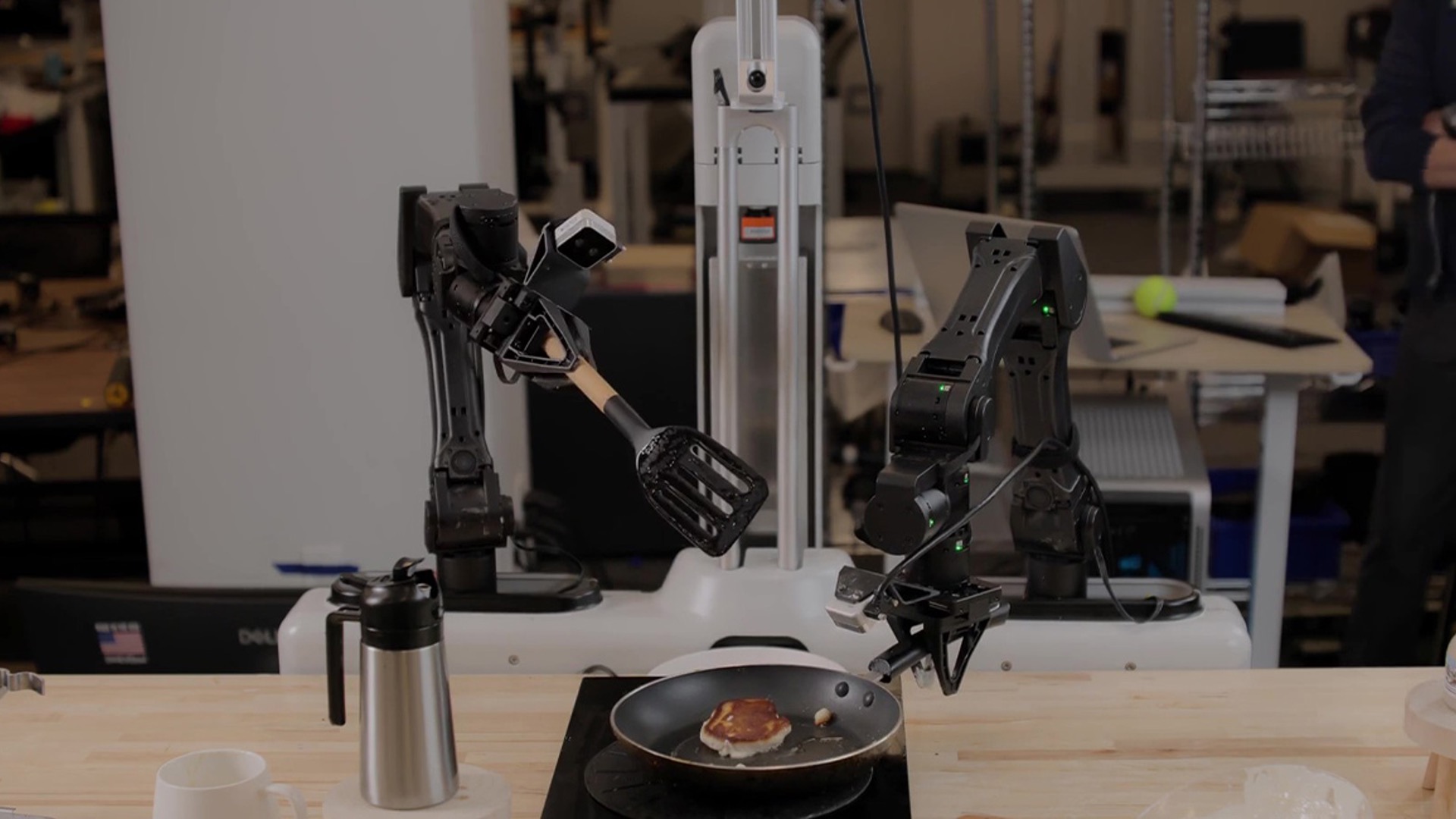
Skild AI's S1 model represents a significant leap in robotics by allowing industrial robots to quickly adapt to new tasks and environments using only a video demonstration. This eliminates the need for extensive reprogramming and retraining, promising to revolutionize manufacturing and logistics by making robots more versatile and efficient.
Imagine you have a toy robot, and you want it to do a new chore, like putting your toys away. Instead of spending hours teaching it every single move, Skild AI's special robot brain, called S1, lets you just show it one video of you doing the chore. The robot watches the video, understands what you want, and then does it itself, even if it's never seen that exact chore before! It's like teaching a friend by showing them a quick video instead of explaining every tiny step.
Analysis
Skild AI
Skild AI is at the forefront of a paradigm shift in robotics, moving from pre-programmed, fixed-task robots to adaptable, learning machines. Their S1 robot foundation model is designed to interpret and execute complex, long-horizon tasks from a single video demonstration, a technique known as in-context learning. This capability allows robots to perform unfamiliar tasks lasting up to 10 minutes, encompassing dozens of manipulation steps and requiring the composition of skills not explicitly pre-programmed.
The company's rapid growth underscores the market demand for such flexibility. Just 10 months after its first commercial deployment, Skild AI has achieved a $100 million annual revenue run rate and established over 60 deployment partnerships across diverse sectors including manufacturing, logistics, and food preparation. This commercial traction demonstrates the practical applicability and value of their innovative approach to robot learning.
S1 Model
The S1 model's core innovation lies in its ability to learn from a single video prompt without requiring updates to its weights or task-specific post-training. This means an operator can record a video of a desired task, and the S1 model will interpret the intent, objects, and sequence, then translate these into actions for the robot. This process bypasses the traditional need for extensive data collection, retraining, and validation cycles that typically accompany changes in products, processes, or layouts.
Performance metrics highlight the S1 model's effectiveness. In tests involving new, multistep tasks, Skild's S1 robot achieved a 66% success rate at each step, a sevenfold improvement over a similar AI system which managed only 9%. Furthermore, Skild estimates that a single short video demonstration can be as effective as approximately 380 hands-on training examples, potentially saving 50-100 hours of manual training effort. This efficiency gain is critical for accelerating robot deployment and adaptation in dynamic industrial settings.
NVIDIA Isaac Lab
NVIDIA's extensive AI infrastructure and simulation frameworks are integral to Skild AI's development and deployment strategy. Skild utilizes NVIDIA Isaac Lab, an open modular robot learning framework, to strengthen the skills of its robot brain through reinforcement learning. Isaac Lab, powered by the Newton physics engine, enables engineers to accurately model various physical parameters such as forces, contact, collision, and pressure, thereby significantly reducing the simulation-to-reality gap.
Beyond Isaac Lab, Skild leverages a suite of NVIDIA technologies throughout the development cycle. NVIDIA Cosmos open world foundation models help diversify training data and convert video into structured descriptions, while Cosmos Curator assists in annotating, filtering, and organizing data at scale. The use of NVIDIA Omniverse libraries and Isaac Sim provides physically based virtual environments for generating data, testing edge cases, and validating robot behaviors before real-world deployment. This comprehensive ecosystem ensures that Skild's robots are robustly trained and validated, facilitating their transition from research to factory work, as exemplified by the collaboration with Foxconn for NVIDIA Blackwell systems assembly.
Key points
- Skild AI launched its S1 robot foundation model for in-context learning from single video demonstrations.
- S1 enables robots to learn and execute complex, previously unseen tasks without retraining or weight updates.
- The model achieved a 66% success rate per step in new multistep tasks, a sevenfold improvement over similar systems.
- Skild AI's approach can save 50-100 hours of manual training per task, equivalent to 380 hands-on examples.
- The development leverages NVIDIA AI infrastructure, including Isaac Lab, Cosmos, Omniverse, and Isaac Sim.
- Skild, NVIDIA, and Foxconn are deploying the Skild Brain for high-precision assembly of NVIDIA Blackwell systems.
This technology promises to dramatically accelerate the adoption of robotics in industries by making them far more adaptable and easier to program. The ability for robots to learn complex tasks from a single video could lead to significant cost savings and efficiency gains, allowing businesses to rapidly reconfigure production lines and deploy automation in dynamic environments previously deemed too complex for robots.
While promising, the 66% success rate at each step, though a significant improvement, still implies a notable failure rate for multi-step tasks, which could hinder widespread adoption in critical industrial applications requiring near-perfect reliability. Furthermore, the reliance on high-quality video demonstrations and the underlying complexity of the AI model could present challenges for non-expert operators in diverse real-world scenarios.
Market signals
- NVDA NVIDIA's collaboration with Skild AI and Foxconn for deploying the Skild Brain in manufacturing demonstrates real-world adoption of NVIDIA's AI and robotics platforms, potentially boosting its market position.
AI-generated analysis of potential market relevance. Not financial advice.