Spacecraft bound for Mercury begins 'tricky' arrival
Spacecraft carrying European and Japanese probes begins high-risk approach to Mercury after 8-year journey, with complex trajectory and separation from transfer module.
Intelligence analysis by Qwen 2.5 (3B)
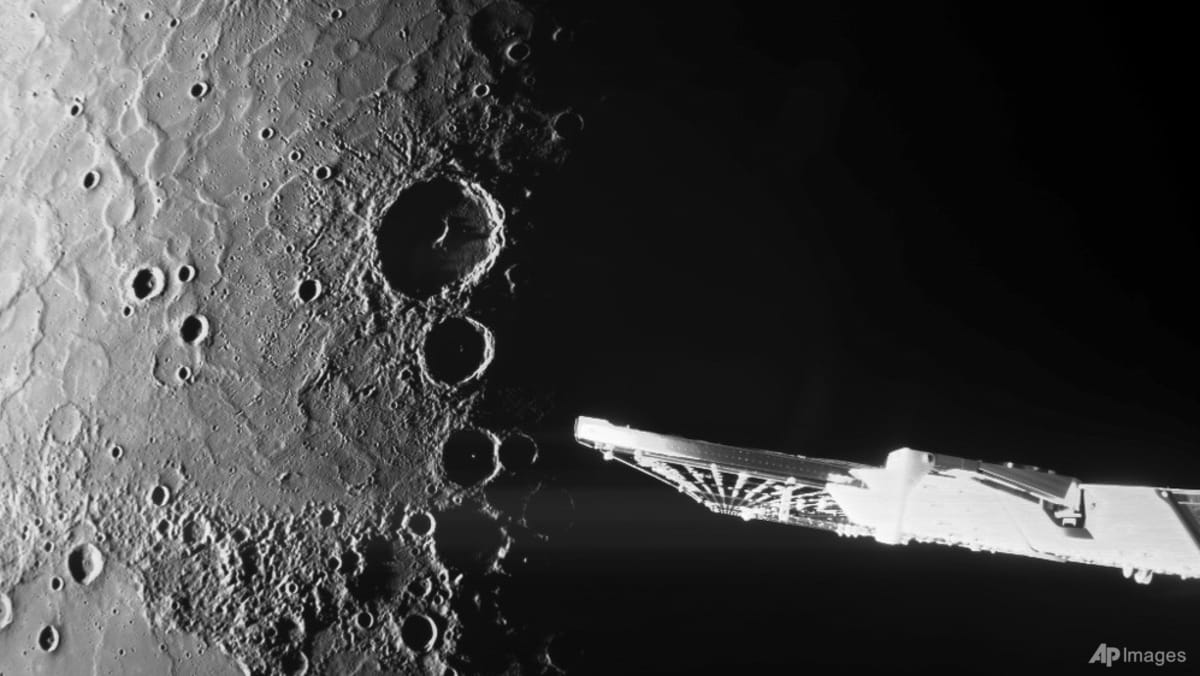
A spacecraft carrying European and Japanese probes has begun its high-risk approach to Mercury after an 8-year journey, with complex trajectory and separation from a transfer module.
A spacecraft carrying two probes is heading to Mercury, the closest planet to the Sun. It had to travel a long way and do some tricky maneuvers to get there. Now, it's separating from a helper spacecraft and will soon be orbiting Mercury on its own.
Analysis
Mercury's Attraction
Mercury, the closest planet to the Sun, is a challenging target for spacecraft due to its weak gravitational pull and proximity to the Sun. The BepiColombo mission, which began its journey in 2018, had to execute a series of nine flybys to reach Mercury. The mission's success hinges on the precise separation of the two probes from the transfer module, a critical step in the final approach.
Autonomous Separation
The separation of the probes from the transfer module was an autonomous process, requiring the spacecraft to check and execute commands at a speed of 40 centimeters per second. The delay between ground commands and the spacecraft's response was about 30 minutes, highlighting the complexity of the mission.
Future Phases
The next tricky phase will occur on December 9 and 10, when the two probes will separate into their respective orbits around Mercury. This phase will be crucial for the mission's success and will provide valuable data on Mercury's environment and composition.
Key points
- BepiColombo mission begins its approach to Mercury after an 8-year journey
- Separation of the two probes from the transfer module was an autonomous process
- Next tricky phase will occur on December 9 and 10, when the probes separate into their orbits
If the mission is successful, it will provide valuable insights into Mercury's environment and composition, potentially revolutionizing our understanding of the planet.
If the separation or orbiting phases fail, it could delay the mission and potentially lead to the loss of the probes.