Spain high-speed train crash kills 68
A high-speed train collision in Spain killed 68 people and injured over 100, raising concerns about rail safety. The crash occurred due to an "error" in resuming traffic after a technical failure.
Intelligence analysis by Gemini 2.5 Flash Lite
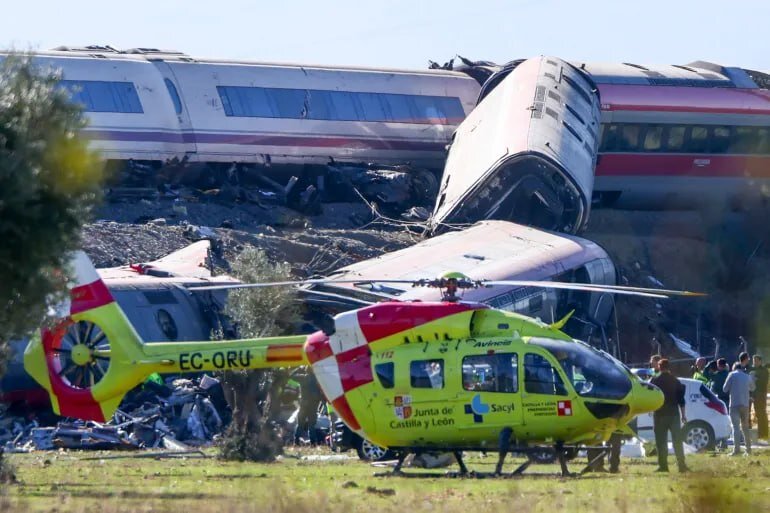
A catastrophic collision between two high-speed trains in Spain has resulted in 68 fatalities and over 100 injuries, prompting urgent questions about the nation's rail safety protocols. Authorities are investigating an "inexplicable" decision to resume train traffic despite a technical failure, leading to the crash.
Imagine two super-fast toy trains on a track. One train was supposed to stop because of a broken signal, but someone accidentally turned the signal back on too soon. The stopped train was then hit by the moving train, causing a big mess and sadly, many people got hurt.
Analysis
Castilla-La Mancha
The central region of Castilla-La Mancha became the site of one of Europe's most devastating train accidents this century. Emergency services and funeral vans converged on the scene, where twisted metal and derailed carriages painted a grim picture of the disaster. Local leaders confirmed a rising death toll, which surpassed 68, with a significant number of injured, many in critical condition, requiring immediate hospitalization. The proximity of the accident to the village of Urda meant residents like Manuel Ortiz were among the first responders, describing a horrific scene filled with the smell of burnt metal and the chaos of survival.
Renfe
The state railway operator, Renfe, confirmed that its high-speed line connecting Madrid to southern Spain was suspended following the collision involving one of its services and a train operated by the private company Iryo. The incident is under intense scrutiny, with Transport Minister Oscar Puente pointing to a critical "error" in resuming train traffic. A technical failure had halted services on a 69-kilometer stretch of track, but the control center reportedly allowed a Renfe train to proceed before the automatic control system was restored. This train then traveled approximately 25 kilometers before colliding with a stationary Iryo train at high speed, potentially reaching up to 200 kilometers per hour.
Pedro Sanchez
The crash occurs at a politically sensitive time for Prime Minister Pedro Sanchez, who is seeking re-election in an early general election on November 29. This is the second major high-speed rail accident in Spain this year, following a January collision that killed 46 people. Sanchez, who faced criticism after the first incident, has declared three days of national mourning and acknowledged the unacceptability of two such collisions within months. His Socialist party has suspended campaign activities, while the opposition leader, Alberto Nunez Feijoo, also paused his campaign but called for transparency regarding the country's infrastructure safety.
Key points
- A high-speed train collision in Spain resulted in 68 deaths and over 100 injuries.
- The crash occurred due to an alleged error in resuming train traffic after a technical failure.
- Transport Minister Oscar Puente described the circumstances leading to the collision as "inexplicable."
- This is the second major high-speed train accident in Spain this year, prompting renewed concerns about rail safety.
- Prime Minister Pedro Sanchez has declared three days of national mourning and acknowledged the unacceptability of the incidents.
The Spanish government's swift acknowledgment of the severity of the situation and commitment to national mourning suggest a strong resolve to thoroughly investigate the causes and implement stringent safety reforms. This could lead to enhanced rail safety standards across Europe, bolstering public confidence in high-speed rail travel.
The recurrence of a major high-speed train crash within the same year, coupled with allegations of inexplicable errors in traffic control, raises serious doubts about the efficacy of current safety protocols and oversight. This could lead to a significant erosion of public trust in Spain's rail infrastructure and potentially deter future investment.


