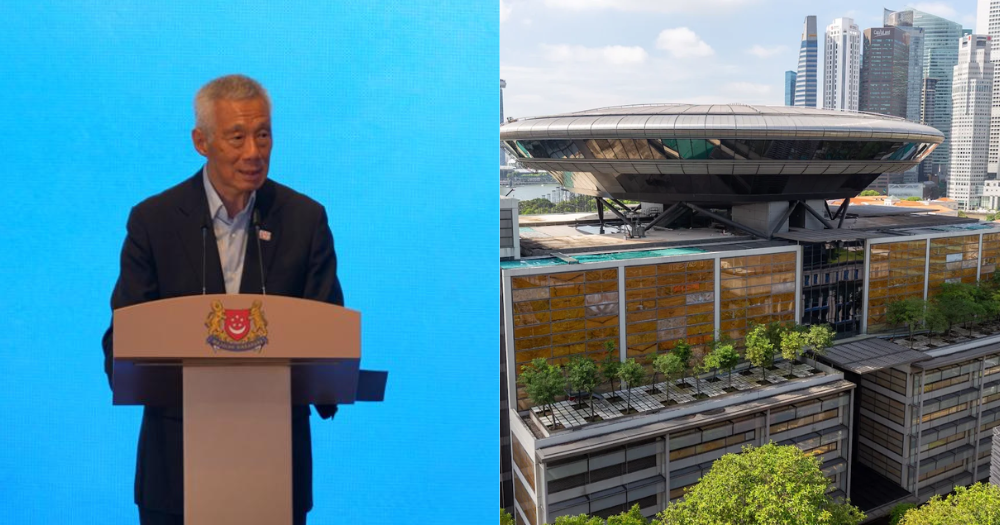
S'pore's Constitution shouldn't be changed on a whim, but must be updated to meet evolving needs: SM Lee
Singapore's Constitution should not be changed on a whim, but it must be updated to meet evolving needs, said Senior Minister Lee Hsien Loong. He highlighted several major Constitutional changes Singapore has enacted to remedy significant vulnerabilities in its legal fram…
Intelligence analysis by Llama
Singapore's Constitution needs to be updated from time to time as society develops and the world changes, said Senior Minister Lee Hsien Loong. He emphasized the importance of responding to new challenges, social change, and crises through legal reform.
Imagine Singapore's Constitution as a living document that needs to adapt to the changing needs of the country. Just like how laws need to be updated to respond to new challenges and social change, Singapore's Constitution must also be updated to meet evolving needs.
Analysis
A Continuous Undertaking: Legal Reform in Singapore
Singapore's approach to governance is to ensure its legal system responds to changes. Senior Minister Lee Hsien Loong emphasized that the country has never treated law reform as an occasional, one-off exercise. It is a continuous undertaking that requires each generation to review the system it has inherited, decide what remains fit for purpose, update or repeal those parts which are outdated, and design and pass new laws to deal with new circumstances.
Addressing National Imperatives
Singapore has used the law to address enduring national imperatives, particularly social cohesion. Senior Minister Lee Hsien Loong detailed how the country implemented policies to foster social mixing, build common spaces, and forge a national identity in response to the communal riots of the 1950s and 1960s. In 2025, Parliament passed the Maintenance of Racial Harmony Act to counter new and emerging threats to social cohesion on the internet.
Responding to New Challenges
Singapore has also had to develop new legal tools to respond to new challenges in the digital age. Senior Minister Lee Hsien Loong brought up the Protection from Online Falsehoods and Manipulation Act (POFMA), Foreign Interference (Countermeasures) Act (FICA), and the Online Safety (Relief and Accountability) Act as recent measures enacted to tackle misinformation, foreign interference, scams, online harassment, and other forms of digital harm.
Responding Quickly in Times of Crisis
While legislation usually requires extensive and deliberate study, consultation and debate, crises do not wait for this normal stately pace of legislation, Senior Minister Lee Hsien Loong stressed. In such moments, governments must respond swiftly while remaining anchored in the rule of law. For example, during the Covid pandemic, the Singapore government worked quickly to put together and pass the COVID-19 (Temporary Measures) Act 2020 to address urgent issues of the pandemic, and amended the Act eight times as new challenges emerged.
Key points
- Singapore's Constitution needs to be updated from time to time as society develops and the world changes.
- Senior Minister Lee Hsien Loong emphasized the importance of responding to new challenges, social change, and crises through legal reform.
- Singapore has used the law to address enduring national imperatives, particularly social cohesion.
- The country has developed new legal tools to respond to new challenges in the digital age.
- Governments must respond swiftly while remaining anchored in the rule of law in times of crisis.
If Singapore continues to update its Constitution to meet evolving needs, it can maintain social cohesion and address new challenges effectively. This will ensure that the country remains a stable and prosperous place to live.
If Singapore fails to update its Constitution to meet evolving needs, it may struggle to address new challenges and maintain social cohesion. This could lead to social unrest and instability in the country.