SPSC CCE 2024 Candidates Begin March to Karachi, Demand Re-Test
Unsuccessful candidates of the Sindh Public Service Commission's (SPSC) Combined Competitive Examination (CCE) 2024 have begun a march to Karachi, demanding a re-test and a judicial inquiry into alleged exam irregularities.
Intelligence analysis by Gemini 2.5 Flash
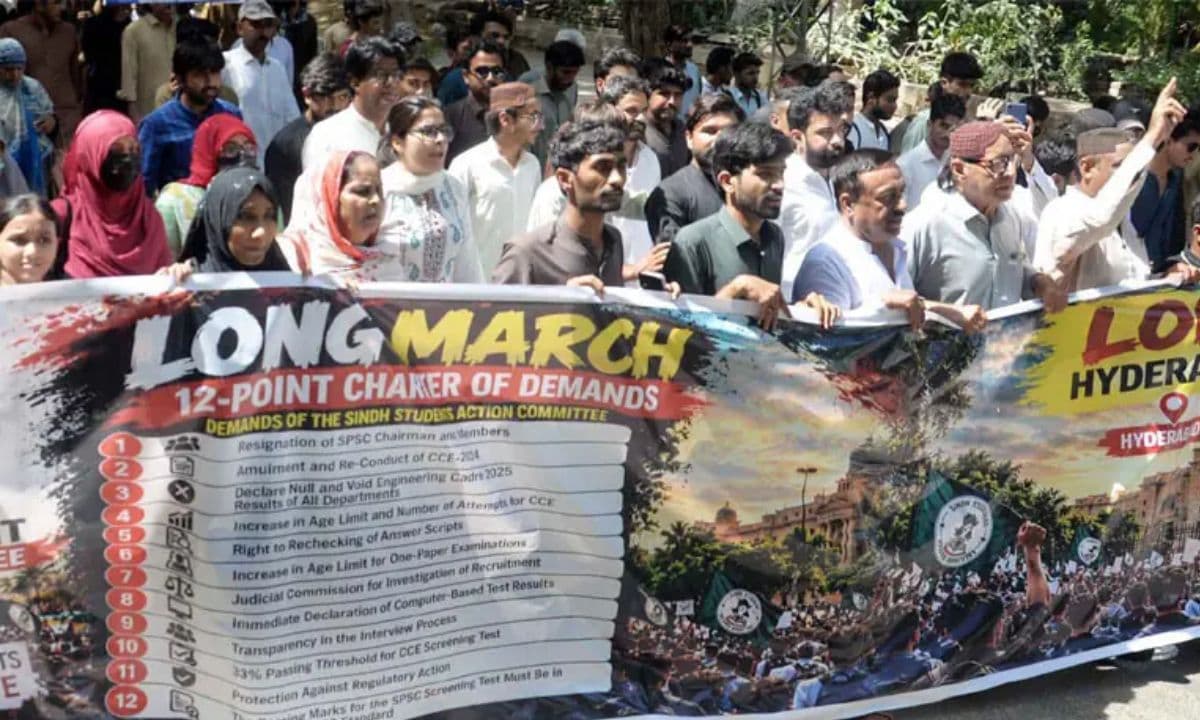
The march, which started from Hyderabad, aims to reach the Chief Minister's House in Karachi, pressing for a re-test of the CCE 2024, comprehensive reforms within the SPSC, and the dismissal of its current management. This follows an 81-day protest camp and a suspended Sindh High Court order for rechecking answer scripts.
Imagine a big test that many grown-ups take to get important jobs in the government. Lots of people studied super hard, but when the results came out, many felt something was wrong, like the test wasn't fair. So, they're walking all the way to the big boss's house in Karachi to ask for the test to be done again and for the people who run the test to be changed, because they believe there were mistakes.
Analysis
The ongoing protest by candidates of the Sindh Public Service Commission's (SPSC) Combined Competitive Examination (CCE) 2024 underscores a deep-seated crisis of confidence in public institutions within Pakistan. The march to Karachi, initiated after 81 days of a protest camp in Hyderabad, signifies an escalation of demands for accountability and transparency. The candidates allege widespread irregularities in the CCE 2024 results, which they believe have compromised the integrity of the examination process and unfairly disadvantaged many aspirants.
SPSC CCE 2024
The Combined Competitive Examination (CCE) 2024 is a crucial gateway for many young Pakistanis seeking careers in the provincial civil service. The allegations of irregularities surrounding its results have ignited a significant public outcry, leading to sustained protests. Candidates are not merely seeking a re-evaluation of their individual results but are demanding a complete re-test, suggesting a fundamental lack of faith in the initial examination's fairness. This collective action highlights the desperation and frustration among the youth who perceive their futures to be jeopardized by systemic issues within the SPSC.
The protest camp, which lasted for over two months, failed to elicit a satisfactory response from the government, pushing the candidates to undertake a more visible and impactful demonstration. The involvement of various student action committees and political leaders, such as Zabiullah Mastoi and Dr Qadir Magsi, indicates the broad support and political weight behind these demands. Their participation transforms the issue from a localized grievance into a broader political and governance challenge, demanding attention from higher authorities.
Sindh High Court (SHC)
The legal dimension of this dispute adds another layer of complexity and public scrutiny. Initially, some candidates sought redress through the Sindh High Court (SHC), which on June 30, ordered the rechecking of answer scripts by an independent body, the Institute of Business Administration (IBA), Sukkur. This judicial intervention provided a glimmer of hope for the protesting candidates, validating their concerns to some extent.
However, the SPSC challenged these interim orders before the Federal Constitutional Court (FCC), which subsequently suspended the SHC's directives on July 15. This suspension allowed the SPSC to proceed with interviews for the 70 successful CCE 2024 candidates, effectively nullifying the immediate relief sought by the petitioners. This legal back-and-forth has likely intensified the candidates' resolve, as they now perceive the judicial avenue to be temporarily blocked, forcing them to resort to direct public action to press their demands.
Chief Minister’s House
The decision to march to the Chief Minister’s House in Karachi is a strategic move to directly confront the highest provincial authority with their grievances. By targeting the Chief Minister, the protesters aim to bypass the SPSC management, which they accuse of being part of the problem, and seek direct intervention from the provincial government. Their demands extend beyond a mere re-test to include comprehensive reforms within the SPSC and the dismissal of its entire management, indicating a desire for systemic change rather than just a superficial fix.
The solidarity shown by various political parties and civil society activists, including the Sindh Taraqqi-pasand Party (STP) and Awami Workers Party (Marxists), amplifies the political pressure on the government. This broad-based support suggests that the issue resonates beyond the immediate concerns of the candidates, touching upon wider themes of good governance, meritocracy, and social justice in Sindh. The march serves as a powerful symbol of public discontent and a direct challenge to the government's perceived inaction on critical issues of public trust and institutional integrity.
Key points
- Unsuccessful SPSC CCE 2024 candidates began a march to Karachi from Hyderabad.
- Protesters demand a re-test of the CCE 2024 and a judicial inquiry into alleged irregularities.
- They also seek reforms in the SPSC and the dismissal of its current management.
- The march follows an 81-day protest camp outside the SPSC office.
- The Sindh High Court's order for rechecking answer scripts was suspended by the Federal Constitutional Court.
If the government responds positively to the protests, it could lead to a transparent re-evaluation of the CCE 2024 results or a fair re-test, restoring public trust in the SPSC. This could also trigger much-needed reforms within the commission, ensuring future examinations are conducted with integrity and meritocracy.
Should the government ignore or forcefully suppress the protests, it could further erode public confidence in state institutions and fuel widespread discontent among the youth. This might lead to prolonged instability, continued legal battles, and a perception that merit is not valued in public service appointments.