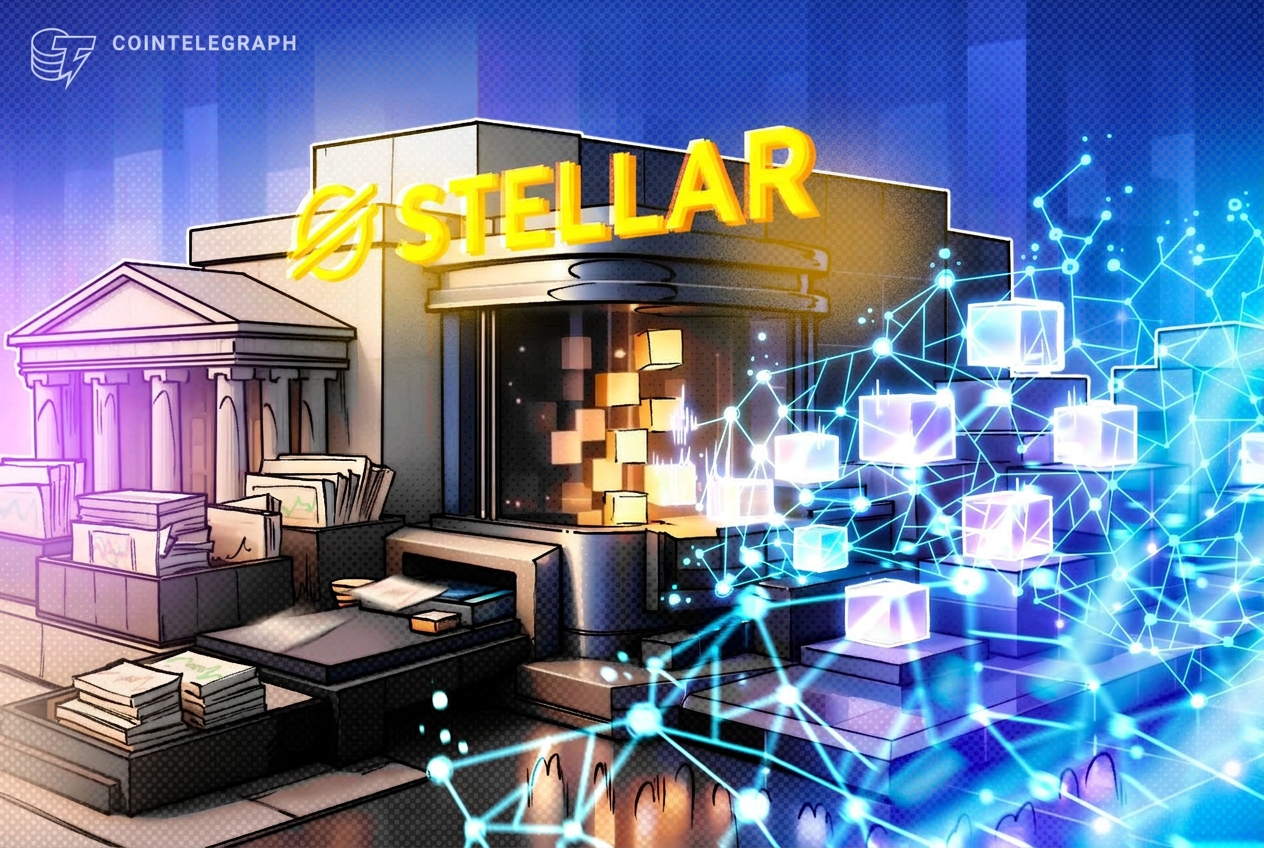
Stellar tokenized RWA market more than quadruples to nearly $4B
Stellar's tokenized real-world asset (RWA) market has surged by approximately 360% in 2026, reaching nearly $4 billion, driven by institutional adoption and increased tokenization activity.
Intelligence analysis by Gemini 2.5 Flash
The Stellar network has seen its tokenized RWA market cap grow from $868.8 million to almost $4 billion this year, fueled by major financial institutions and tokenization platforms integrating with the blockchain. This expansion includes diverse assets like US Treasurys and non-US government debt, despite its native XLM token experiencing an 11% year-to-date decline.
Imagine you have a toy car, but instead of just playing with it, you could turn it into a special digital coin that represents its value. Stellar is like a super-fast digital playground where people are turning real things, like parts of buildings or government IOUs, into these digital coins. This year, the value of all these digital coins on Stellar grew four times bigger, almost reaching $4 billion, because big banks and companies are starting to use this playground to make trading these 'digital assets' easier and faster.
Analysis
The Stellar network is rapidly emerging as a significant player in the tokenized real-world asset (RWA) space, demonstrating substantial growth in 2026. The value of RWAs on Stellar has quadrupled, climbing from $868.8 million at the close of last year to nearly $4 billion by late August. This expansion underscores a broader trend of institutional entities leveraging blockchain technology for asset tokenization, transforming illiquid assets into digital tokens that can be traded more easily and efficiently. The market's concentration among a few key issuers, such as Spiko and Franklin Templeton, indicates a maturing ecosystem where established players are taking a leading role in defining the landscape of tokenized finance.
Spiko
Spiko stands out as a dominant force within Stellar's burgeoning RWA market, accounting for a substantial $1.55 billion of the network's total tokenized value. This significant contribution highlights the critical role that specific issuers play in driving the overall growth and liquidity of the RWA ecosystem on Stellar. Their focus on tokenizing various asset classes, including private and public credit, demonstrates the versatility of the Stellar blockchain in accommodating diverse financial instruments. The success of such issuers is crucial for attracting further institutional interest and expanding the range of real-world assets available for tokenization, thereby solidifying Stellar's position in this evolving sector.
DTCC
The Depository Trust & Clearing Corporation (DTCC) announced plans to integrate its tokenization service with Stellar, a move poised to significantly bolster the network's institutional footprint. This collaboration, expected to materialize in the first half of 2027, could enable the tokenization of a wide array of traditional financial assets, including US Treasurys, major index ETFs, and Russell 1000 stocks. The DTCC's involvement signals a strong validation of Stellar's infrastructure and its capacity to handle high-value, regulated financial products. Such integrations are pivotal for bridging the gap between conventional finance and decentralized ledger technology, offering a pathway for mainstream adoption and liquidity for tokenized securities.
MGUSD
Stellar's utility extends beyond RWAs into the realm of digital payments, exemplified by MoneyGram's launch of its MGUSD dollar stablecoin on the network in June. This stablecoin allows users to maintain dollar-denominated balances and facilitate cross-border fund transfers through MoneyGram's extensive global payments network. The introduction of MGUSD, alongside approximately $438 million in other reserve-verified stablecoins on Stellar, reinforces the network's role as a robust platform for stable value transfer. This dual focus on both tokenized real-world assets and stablecoins positions Stellar as a comprehensive solution for various financial applications, from investment to everyday transactions, further enhancing its appeal to both institutional and retail users.
Key points
- Stellar's tokenized RWA market has grown by 360% in 2026, reaching nearly $4 billion.
- The market includes US Treasurys, private/public credit, and non-US government debt.
- Key issuers like Spiko ($1.55B) and Franklin Templeton ($546M) dominate the RWA value.
- The DTCC plans to integrate its tokenization service with Stellar by H1 2027, potentially supporting tokenized stocks and ETFs.
- MoneyGram launched its MGUSD dollar stablecoin on Stellar in June, expanding its role in digital payments.
The rapid expansion of tokenized real-world assets on Stellar, coupled with significant institutional integrations like the DTCC, suggests a future where traditional financial instruments are seamlessly integrated into blockchain ecosystems, enhancing liquidity and accessibility. This trend could lead to a more efficient global financial system, attracting further capital and innovation to the Stellar network.
Despite the impressive growth in tokenized assets and institutional adoption, Stellar's native XLM token has seen an 11% decline year-to-date, indicating that network utility and token value do not always move in lockstep. This divergence could suggest that the benefits of RWA tokenization are not fully translating into direct value for the underlying protocol's token holders, potentially raising questions about long-term token economics.