Supermassive black hole found emitting powerful cosmic wind in Milky Way
Astronomers say Sagittarius A* is driving a powerful cosmic wind, revealing a clearer view of how the Milky Way's central black hole affects nearby gas.
Intelligence analysis by GPT-5.4 Mini
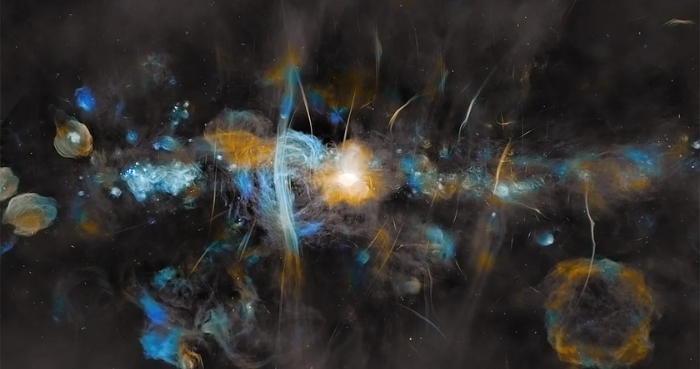
A five-year ALMA study, backed by NASA's Chandra data, found a cone-shaped cavity of missing cold gas near Sagittarius A*, which researchers say was likely carved by a hot outflow from the black hole. The result is presented as the clearest evidence yet of a black hole wind in our galaxy's quiet central engine.
Scientists looked at the Milky Way's giant black hole like using a special camera to see smoke around a campfire. They found a big empty space near it, and think a fast blast of hot gas from the black hole made that gap.
Analysis
What researchers found
Astronomers studying Sagittarius A*, the supermassive black hole at the center of the Milky Way, say they have identified a strong cosmic wind coming from the object. The team used five years of deep observations from the ALMA observatory in Chile and combined them with data from NASA's Chandra X-ray Observatory.
The key clue was a large cone-shaped region close to the black hole where cold molecular gas was missing. After removing the black hole's strong radio signal from the images, the researchers saw a clear void within about three light-years of the center. They concluded that a hot, energetic outflow from Sagittarius A* was the most likely explanation for that empty space.
Why it stands out
Scientists have long predicted that black holes do more than pull matter in. As gas falls inward, some of it can be pushed back out as wind or jets. What made this study important is that the team says it offers the clearest view so far of that process around Sagittarius A*.
The article says the wind may have been active for at least 20,000 years. It also says the Milky Way's black hole appears to be in a quiet phase, unlike more active black holes in other galaxies that are described as being in a more explosive stage.
The researchers treat the finding as a strong match for theory rather than a surprise result. In their view, Sagittarius A* now provides a useful example of how a black hole behaves when it is not in a highly active phase, while still shaping its surroundings through a powerful outflow.
Key points
- Astronomers say Sagittarius A* is producing a strong cosmic wind.
- The evidence comes from five years of ALMA observations plus NASA Chandra data.
- Researchers found a cone-shaped cavity with no cold gas near the black hole.
- The wind is estimated to have been active for at least 20,000 years.
- The study suggests the Milky Way's black hole is in a relatively quiet phase.
If the finding holds up, it gives astronomers a clearer picture of how quiet black holes still affect nearby space. It also strengthens models that explain how gas falls in and gets blown back out around black holes.
The result still depends on careful image processing and interpretation of indirect signals, so later observations will need to confirm the exact shape and strength of the wind. If the gas cavity has other causes, the current explanation may need revision.