Sweden general election: close race as far right eyes role in government – Europe live
Sweden's general election is a tight contest between the left and right blocs, with the far-right Sweden Democrats potentially playing a significant role in government for the first time as polls close.
Intelligence analysis by Gemini 2.5 Flash
Sweden's parliamentary election is heading for a nail-biting finish, with the ruling Social Democrats and the opposition bloc in a near dead heat. The far-right Sweden Democrats are poised to gain influence, making their potential involvement in a future government a central talking point amidst voter unease over a divisive campaign.
Imagine Sweden is having a big school election for who gets to be in charge. It's super close, like a tie! One group, the Social Democrats, wants to keep things mostly the same, while another group wants a "new direction." A third group, called the Sweden Democrats, who are considered far-right, might get to help decide who wins, which is a big deal because they haven't been in charge before. Everyone is a bit nervous about who will win and what changes might happen.
Analysis
The 2026 Swedish general election is characterized by an exceptionally close race, with the latest polling indicating a mere 0.3-point gap between the left and right-wing blocs. This narrow margin has intensified the focus on the far-right Sweden Democrats, who are eyeing their first potential role in government, a development that could significantly alter Sweden's political landscape.
Magdalena Andersson
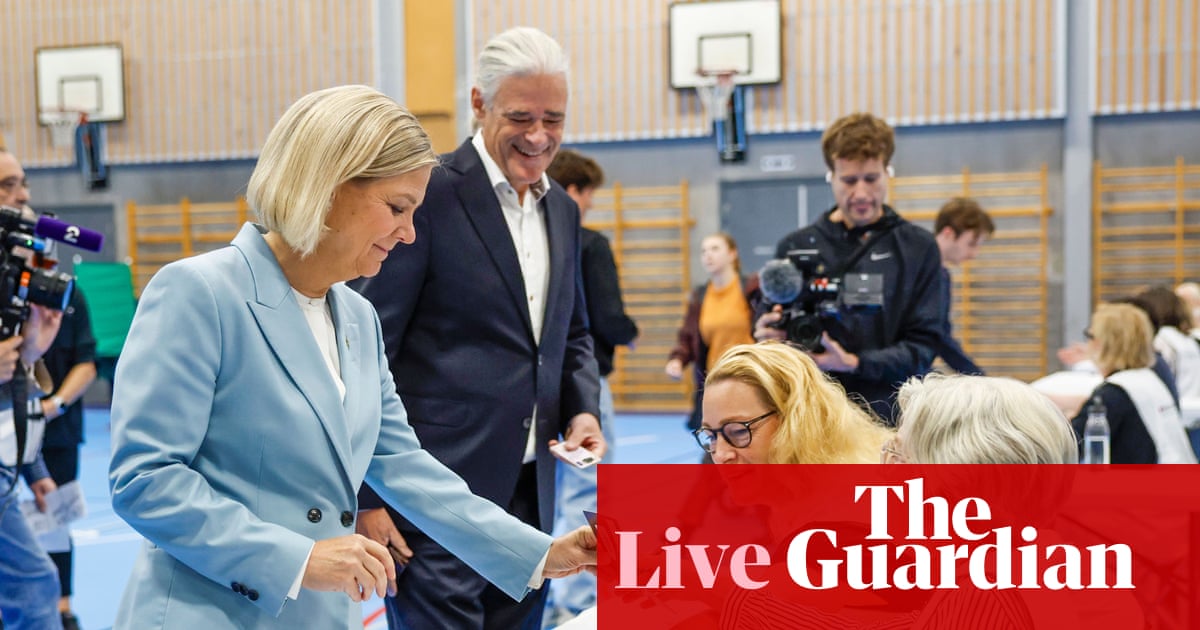
Opposition leader Magdalena Andersson, representing the Social Democrats, cast her ballot in Nacka, Stockholm, describing the campaign as a "tale of two sides." She articulated a vision for a "new direction" for Sweden, expressing concerns that the country has become a "harder society, a quieter society, but also a poorer society." Andersson highlighted issues such as growth falling below potential and households experiencing reduced purchasing power, framing her party's objective as winning to address these societal challenges. Her campaign even saw a unique show of support from Abba's Benny Andersson, who performed a reworked version of 'Mamma Mia' at a rally.
Ulf Kristersson
Prime Minister Ulf Kristersson, leader of the conservative Moderates, also voted with his family, including his Welsh springer, Winston. Despite his party reportedly losing support in recent polls, Kristersson expressed optimism, stating he expected a "very, very exciting" evening and insisting that "the momentum" was on his side. He emphasized his role as a "team leader" in Swedish politics, stressing the importance of compromise and pragmatism to achieve governmental objectives. Kristersson's focus remains on securing a bloc victory to continue his government's work for the next four years, underscoring the need for a clear vision coupled with practical governance.
Sweden Democrats
The potential role of the far-right Sweden Democrats is a central theme of this election. While an expert noted that the election is "not a referendum on far-right," the party's expected gains mean they will be a key talking point in post-election negotiations and government formation. Their leader, Åkesson, was among the over 3.5 million voters who cast their ballots early, signaling the party's significant mobilization. The prospect of the Sweden Democrats entering government or wielding substantial influence marks a historic shift for Sweden, a country long known for its social democratic traditions. This development reflects broader European trends of increasing support for populist and far-right parties, making the outcome of this election particularly watched across the continent.
Key points
- Sweden's general election is a very close contest between left and right blocs, with a 0.3-point gap in recent polls.
- The far-right Sweden Democrats are expected to play a key role in government formation, potentially for the first time.
- Opposition leader Magdalena Andersson seeks a "new direction" for Sweden, citing a "harder" and "poorer" society.
- Prime Minister Ulf Kristersson believes "momentum is on our side" and emphasizes compromise for effective governance.
- Over 3.5 million voters cast ballots early, and long queues were reported at some polling stations.
If a stable coalition emerges from this close election, it could lead to pragmatic governance focused on addressing voter concerns about societal changes and economic growth, potentially fostering a period of political stability and effective policy implementation in Sweden.
The close election and potential for the far-right to gain influence could lead to political instability, difficulties in forming a functional government, and a more polarized society, potentially impacting Sweden's international standing and social cohesion.