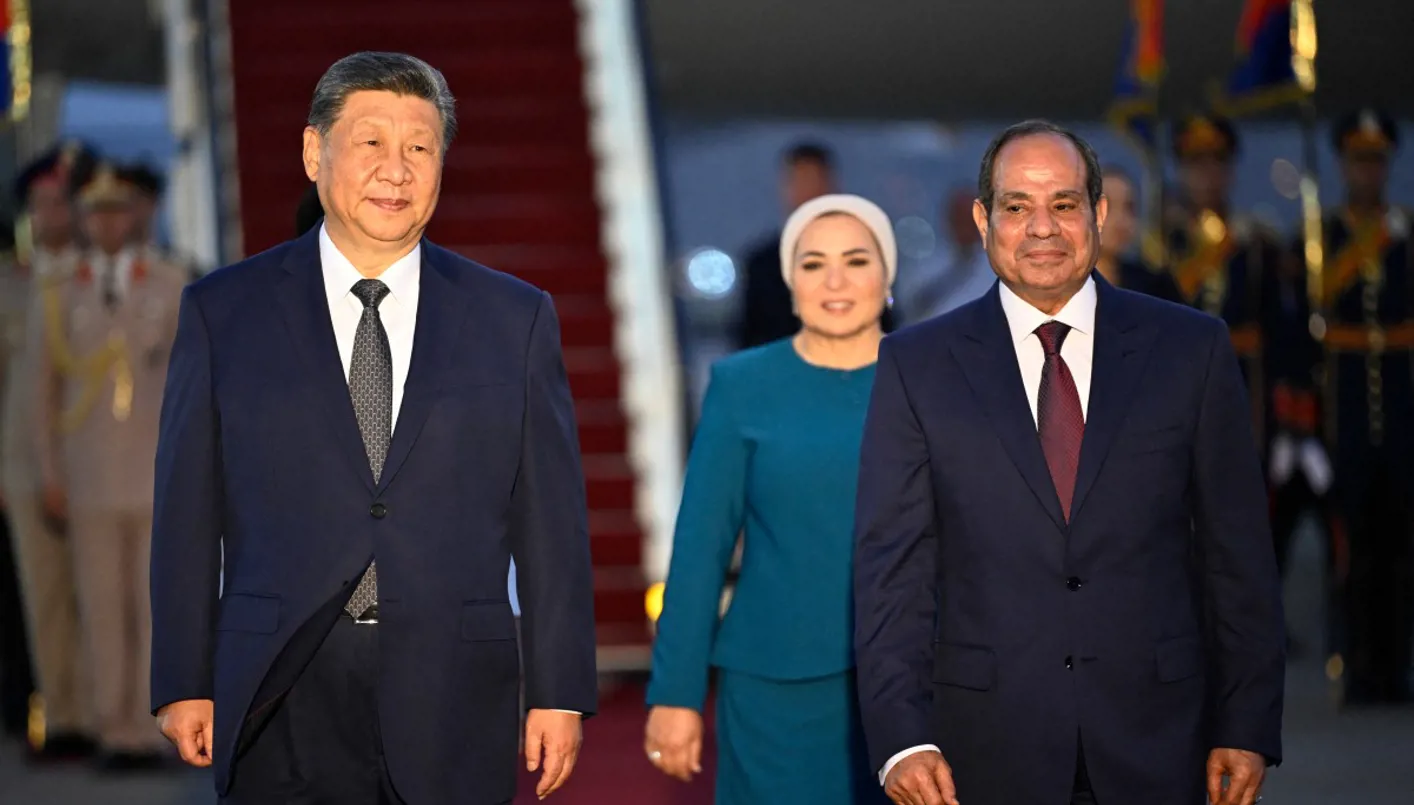
Talks between Sisi and Xi Jinping in Chinese President's first visit to Cairo in a decade
Egyptian President Abdel Fattah al-Sisi held talks with Chinese President Xi Jinping in Cairo, marking Xi's first visit in a decade, amidst shifting Middle East alliances and US pressure on Iran.
Intelligence analysis by Gemini 2.5 Flash
The two-day visit aims to bolster economic and military cooperation between Egypt and China, with discussions on investments, trade, and strategic partnerships. This comes as Washington intensifies pressure on countries maintaining ties with Iran, prompting Egypt to assert its strategic independence by strengthening relations with both the US and China.
Imagine two big countries, China and Egypt, are becoming even better friends. China's leader, Xi Jinping, visited Egypt's leader, Sisi, for the first time in ten years. They talked about building new things together, like big cities and roads, and even practiced flying fighter jets. This is happening while another big country, America, is telling other countries not to trade too much with Iran, which is making things a bit tricky. But Egypt wants to show it can be friends with everyone and make its own choices.
Analysis
The visit of Chinese President Xi Jinping to Cairo, his first in ten years, underscores a significant pivot in Egypt's foreign policy and a strategic move by China to solidify its influence in the Middle East. The timing is particularly salient, coinciding with renewed military actions in the region and Washington's intensified pressure on Iran's trading partners, including China and Egypt. The United States has explicitly warned countries maintaining ties with Iran, threatening to exclude them from the American financial system, a move that directly impacts China as a primary importer of Iranian oil and potentially Egyptian banks.
Suez Canal Economic Zone
Chinese investments are playing a pivotal role in Egypt's ambitious mega-projects, notably the financial district of the New Administrative Capital, located 50 kilometers east of Cairo. This visit is expected to culminate in the signing of agreements across various sectors, including artificial intelligence, transport, energy, and crucial investments within the Suez Canal Economic Zone. China already holds a significant economic presence, acting as a major exporter to Egypt and maintaining a substantial trade surplus of $12 billion in the first seven months of 2026, according to Chinese customs data. This economic engagement highlights China's commitment to Egypt's development and its broader Belt and Road Initiative.
J-16
Beyond economic ties, the two nations are also strengthening their military cooperation. Egypt, which has emerged as one of the world's largest arms importers under President Sisi's administration, hosted joint air combat exercises in August. These exercises notably featured China's powerful J-16 fighter jet, signaling a deepening of defense relations. This military collaboration provides Egypt with advanced capabilities and diversifies its defense partnerships, reducing its reliance on traditional Western suppliers and enhancing its strategic autonomy in a volatile region.
Donald Trump
The geopolitical backdrop of this visit is heavily influenced by the ongoing US-Iran conflict and the broader strategic competition between global powers. With a potential meeting between Xi Jinping and US President Donald Trump anticipated later in September, Beijing is actively seeking to bolster its relationships with regional allies of the United States, such as Egypt. For Cairo, the visit serves as an opportunity to demonstrate its strategic independence, showcasing its ability to leverage close ties with both Washington and Beijing. President Sisi, in an article published in Egyptian media, emphasized Egypt's adherence to a policy of "strategic balance" amidst increasing global polarization and competition, positioning both nations as partners contributing to the enhanced role of the "global South" in the international system.
Key points
- Chinese President Xi Jinping visited Egypt for the first time in a decade for talks with President Abdel Fattah al-Sisi.
- The visit aims to strengthen economic and military cooperation between China and Egypt.
- Discussions are expected to cover agreements in AI, transport, energy, and investments in the Suez Canal Economic Zone.
- China is a major exporter to Egypt, with a $12 billion trade surplus in the first seven months of 2026.
- The visit occurs amidst renewed military actions in the Middle East and US pressure on Iran's trading partners, including China and Egypt.
The strengthened partnership could bring significant Chinese investment and technological expertise to Egypt, boosting its economy and infrastructure projects like the Suez Canal Economic Zone. This diversification of alliances could also enhance Egypt's strategic position and provide a more balanced approach to regional and global challenges, fostering greater stability and development.
Egypt's deepening ties with China, particularly in military and economic sectors, could strain its long-standing relationship with the United States, potentially leading to reduced US aid or increased diplomatic pressure. Furthermore, if US sanctions against Iran's trading partners are strictly enforced, Egypt could face economic repercussions for its continued engagement with China, creating a delicate balancing act.
Market signals
- OIL US pressure on China and other countries regarding Iranian oil imports could disrupt supply chains, potentially leading to higher global oil prices.
AI-generated analysis of potential market relevance. Not financial advice.