The bitcoin futures market looks like a crowded club with a tiny exit – and it could cause pain
Bitcoin futures open interest of $48 billion towers over $25 billion in daily trading volume, creating a thin liquidity buffer that could amplify any sharp move.
Intelligence analysis by Llama

BTC futures show $48B in open interest against just $25B in 24-hour volume, the widest gap since September 2024. Glassnode warns resting bids have thinned by a third since early July, raising the risk of cascading liquidations if BTC retests the $58,000 June low.
Imagine a giant room packed with people, but the door to leave is really small. If everyone tries to rush out at once, people get hurt. That's what could happen with bitcoin futures — lots of bets are stacked up, but not enough trading to let people exit safely. If prices drop, the scramble to leave could make the drop much worse.
Analysis
The $48 Billion Positioning Pile-Up
The futures market is carrying roughly $48 billion in open interest against just $25 billion in 24-hour trading volume, according to Coinglass data cited in the article. That ratio is the widest since September of the prior year and stands in stark contrast to the 2019–2020 environment, when daily volume regularly ran two to three times larger than outstanding positions. Open interest reflects the gross notional of live contracts and is therefore a proxy for how much directional risk the market is warehousing, while volume captures how much of that risk is actively being unwound or rotated. When OI swells faster than the churn required to manage it, the market is effectively building a bigger warehouse without expanding the loading dock.
Glassnode's Mechanical Risk Warning
Glassnode, quoted in the article, framed the danger as fundamentally mechanical rather than narrative-driven. The firm noted that liquidations in such a regime meet little resting flow to absorb them, and that traders have stacked substantial risk into the book with no matching pickup in demand. Importantly, that risk is described as tilted long, meaning any cascade would be initiated by long liquidations feeding into thin bids. The asymmetry is what turns an ordinary dip into a forced-sale event: when longs get margin-called, they must sell into an order book that is not deep enough to absorb the flow, and each successive liquidation pushes the price lower, triggering the next.
The $58,000 Retest Danger Zone
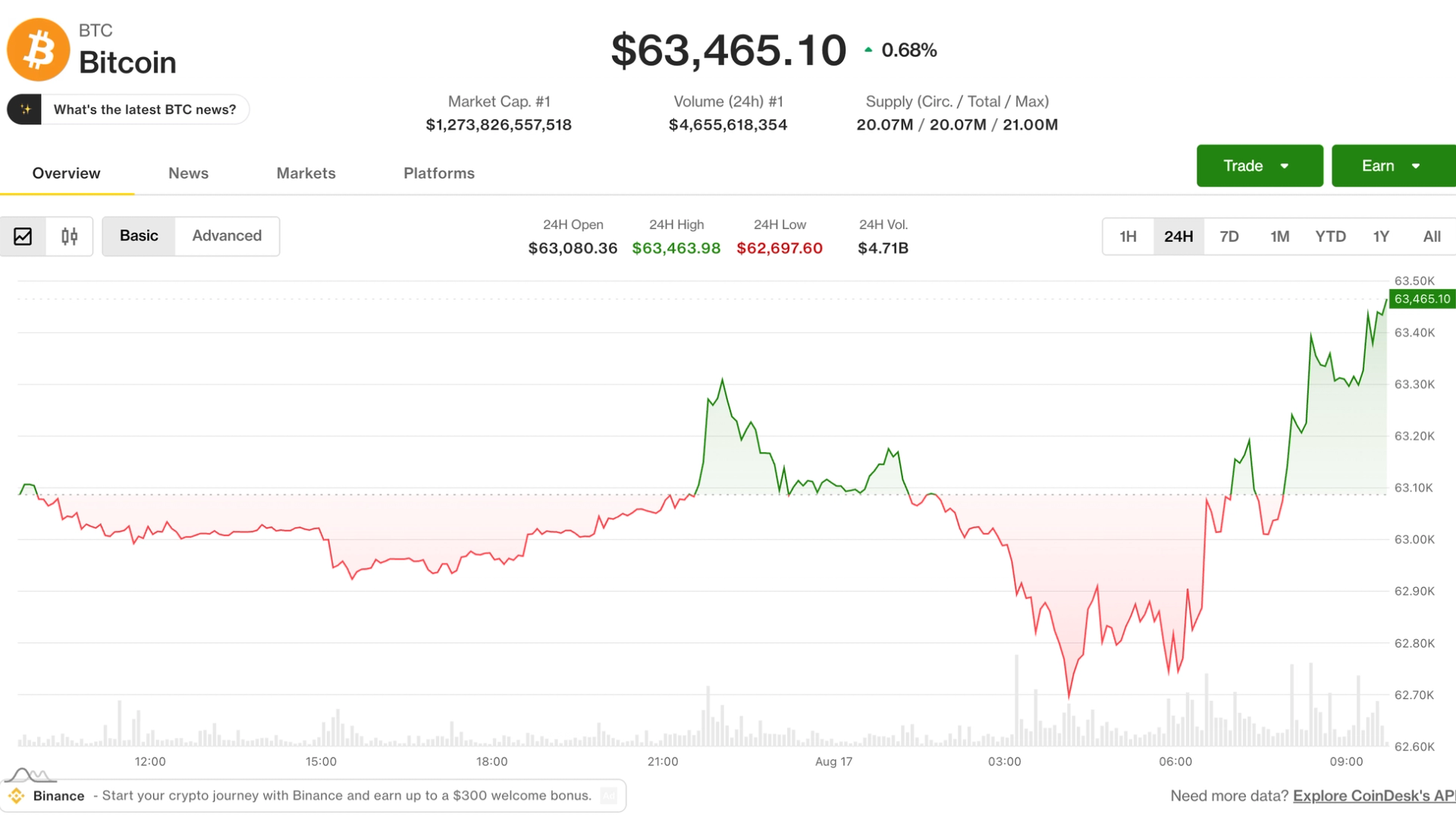
The most concrete tripwire identified in the article is the June low of $58,000. Glassnode's order-book work shows that the band of resting bids framing the summer range peaked at the start of July and has thinned by roughly a third since, leaving less support beneath any retest of those lows. Because spot volume is running at only $12.55 billion versus $25 billion in futures, the natural buyer base on the underlying market is itself half the size of the derivative book that would be selling into it. As of the article's writing, BTC was trading near $63,500, up about 1% on the day — well above the danger line but with a structurally narrow cushion. The combination of a crowded long book, a thinning bid stack, and a spot market that is half the size of the futures market is the precise configuration that history has shown produces the most violent flushes.
Key points
- Bitcoin futures open interest of $48 billion dwarfs 24-hour trading volume of $25 billion, the widest gap since September 2024.
- In 2019–2020, daily volume ran 2x to 3x larger than open interest, underscoring how the liquidity profile has shifted.
- Glassnode warns that long-heavy positioning with little resting flow can turn ordinary moves into forced liquidation cascades.
- The band of resting bids framing the summer range has thinned by roughly a third since the start of July.
- Spot volume of $12.55 billion is only about half the futures figure, amplifying the risk of exaggerated price swings on a retest of the $58,000 June low.
If BTC holds above recent support and ETF or spot demand re-emerges, the volume-to-OI gap can close organically as new participants rotate into the market. An orderly grind higher would let the crowded long book distribute without forced selling, draining the structural risk highlighted by Glassnode.
A retest of the $58,000 June low into a bid stack that has already thinned by a third could trigger cascading long liquidations, magnified by spot volume running at roughly half the futures figure. The mechanical setup Glassnode describes points to a move that extends well beyond what the underlying news would justify, with the $48 billion in open interest acting as fuel rather than a buffer.
Market signals
- BTC The article flags a structural liquidity mismatch, long-heavy positioning, and thinning bid support that raise the risk of a sharp drawdown if BTC retests the $58,000 June low.
AI-generated analysis of potential market relevance. Not financial advice.