The Quantum Issue: WTF Is Quantum Computing?
The article explains quantum computing, contrasting it with classical computers and highlighting its potential to pose an existential threat to Bitcoin's cryptographic security by efficiently breaking private keys.
Intelligence analysis by Gemini 2.5 Flash
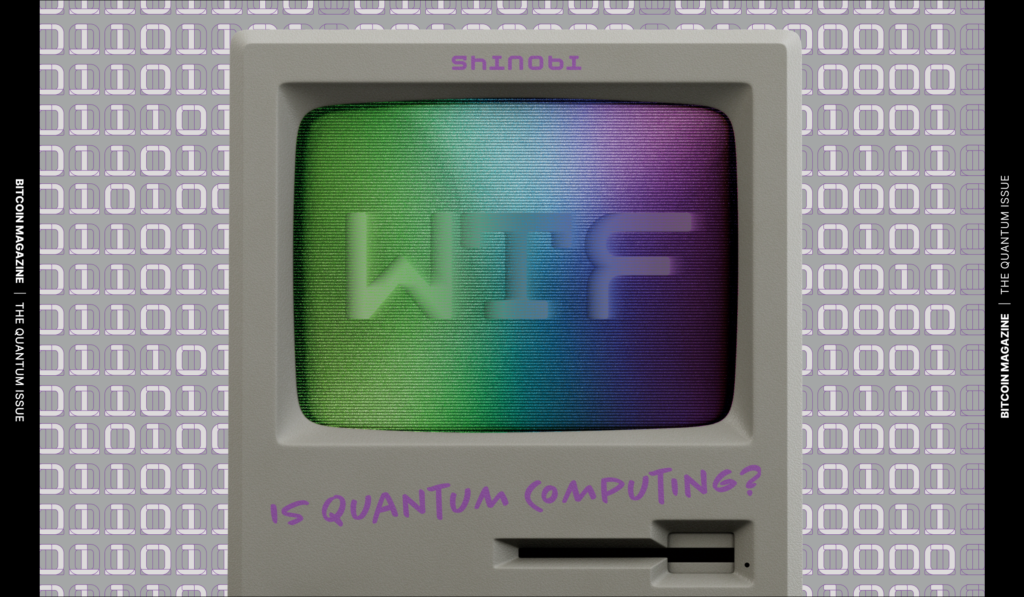
This piece delves into the fundamental differences between classical and quantum computing, emphasizing how quantum machines leverage superposition and entanglement to perform specific computations with unprecedented efficiency. It frames quantum computing as a significant, albeit future, challenge to Bitcoin's security model, which relies on the computational impossibility of guessin…
Imagine a regular computer is like a light switch that's either on or off. A quantum computer is like a dimmer switch that can be on, off, or somewhere in between all at once! This lets it try out many solutions to a puzzle at the same time, making it super good at certain tricky problems, like breaking secret codes that keep your digital money safe.
Analysis
Quantum computing represents a paradigm shift from classical computation, posing a unique challenge to the cryptographic security underpinning digital assets like Bitcoin. The article meticulously outlines the core distinctions, moving beyond the simplistic notion of "faster computers" to explain a fundamentally different operational model. This distinction is critical for understanding why quantum advancements are not merely incremental improvements but rather a potential redefinition of computational feasibility.
Qubit
The fundamental unit of information in a quantum computer is the qubit, a concept that radically departs from the classical bit. Unlike a classical bit, which must be a definite 1 or 0, a qubit exists in a state of superposition, meaning it can be both 1 and 0 simultaneously. This dual state is maintained until the qubit is observed, at which point it collapses into a discrete 1 or 0. This inherent ambiguity and potential for multiple states at once is a cornerstone of quantum computing's power, allowing for a vast increase in information density and processing capability compared to traditional binary systems. The ability of qubits to hold multiple values concurrently is what enables quantum algorithms to explore many possibilities at once, a stark contrast to the linear, step-by-step processing of classical machines.
2^256
The security of Bitcoin's private keys relies on the astronomical scale of possible combinations, specifically 2^256. This number, an incomprehensibly large figure, represents the total number of potential private keys. The article emphasizes that brute-forcing such a key with classical computers is an "impossible task," requiring computational power far exceeding anything available on Earth and timeframes longer than the age of the universe. Classical computers must check each possibility sequentially or in parallel, but even with parallel processing, the cost in terms of computing power and time remains prohibitive. This mathematical barrier is the bedrock of Bitcoin's security, ensuring that guessing a private key is practically infeasible for any classical adversary.
Entanglement
Beyond superposition, entanglement is another bizarre yet crucial phenomenon that empowers quantum computers. Entangled qubits are intrinsically linked, meaning that the state of one qubit instantaneously influences the state of another, regardless of the physical distance between them. When entangled atoms are observed and collapse into a single state, their entangled counterparts also collapse into the same state. This interconnectedness allows quantum computers to perform complex calculations by manipulating these linked states simultaneously, rather than individually. The combination of superposition and entanglement grants quantum computers the ability to explore vast computational spaces much more efficiently than classical computers, making them uniquely suited for certain types of problems, including those that could potentially compromise current cryptographic standards.
Key points
- Quantum computers differ fundamentally from classical computers, not merely in speed.
- Classical computers process discrete 1s and 0s linearly, making brute-forcing Bitcoin's 2^256 private keys impossible.
- Quantum computers utilize qubits, which can be both 1 and 0 simultaneously (superposition), and entanglement.
- These quantum properties enable highly efficient computation for specific problems, including potentially breaking current cryptographic standards.
- The development of a viable quantum computer poses an existential threat to Bitcoin's security model.
The article implicitly suggests that while quantum computing poses a threat, it also highlights the ongoing research and understanding of these complex systems. This knowledge can drive the development of quantum-resistant cryptographic solutions, ensuring the long-term security of digital assets. The very discussion of the threat can spur innovation in defensive measures.
The primary downside is the existential threat quantum computing poses to Bitcoin's security model, as a viable quantum computer could potentially break the cryptographic keys that protect users' funds. This could lead to a loss of trust in the system and compromise the fundamental assumption of private key ownership, necessitating a complete overhaul of current cryptographic standards.