The town where a vanished sea became a tourist attraction
Moynaq, Uzbekistan, once a thriving fishing port on the Aral Sea, is now a desert town where the main attraction is a "ship graveyard" left behind by the sea's retreat.
Intelligence analysis by Gemini 2.5 Flash
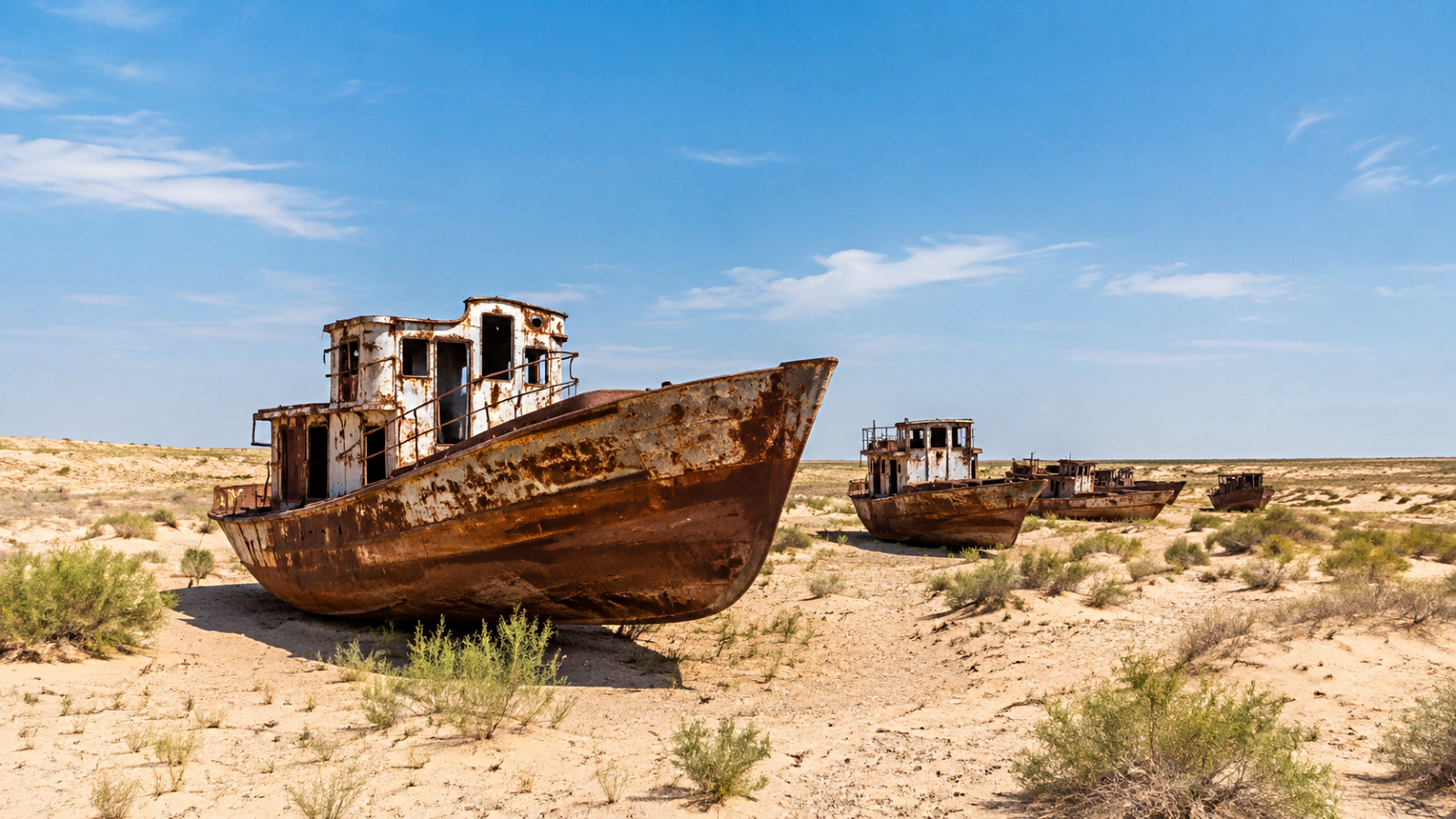
Moynaq, a former fishing hub in Uzbekistan, has transformed into a unique tourist destination. Its primary draw is the eerie sight of rusting fishing boats stranded in a vast desert, a stark reminder of the Aral Sea's dramatic environmental collapse due to Soviet-era irrigation projects.
Imagine a giant bathtub that used to be full of water, with a town right next to it where people caught fish. But then, someone kept taking water out for farms, and the bathtub slowly dried up, leaving all the boats stuck in the sand like toys in a sandbox. That's what happened in Moynaq, and now people visit to see the empty "bathtub" and the old boats.
Analysis
Moynaq, a town in Karakalpakstan, Uzbekistan, presents a stark and unusual case study in environmental disaster and subsequent adaptation. Once a bustling fishing port on the southern shore of the Aral Sea, its very existence was predicated on the vast inland body of water. The town's economy, culture, and identity were inextricably linked to its maritime activities, supporting a robust fishing industry and fish-processing facilities. The dramatic retreat of the sea, however, rendered these foundations obsolete, forcing the community to confront an entirely new reality.
Moynaq
The transformation of Moynaq from a vibrant port to a desert outpost is a poignant narrative of ecological collapse. The town's most striking feature today is the 'Moynaq Ship Graveyard,' a collection of rusting fishing vessels stranded on what was once the seabed. This eerie landscape has become the town's primary draw, attracting a unique segment of tourists interested in environmental history and the visual spectacle of decay. Visitors can literally walk on the former seabed, experiencing the vastness of the Aralkum Desert, which formed as the sea receded.
This shift has led to the emergence of what is sometimes termed 'disaster tourism' or 'extreme tourism.' People travel to Moynaq not for its natural beauty or traditional attractions, but to witness the aftermath of a profound environmental catastrophe. The town now leverages its tragic past, with museums documenting the region's former glory and the story of the Aral Sea's disappearance. This new form of tourism, while somber, provides a new economic lifeline for a community that lost its traditional livelihood.
Aral Sea
The plight of the Aral Sea is central to Moynaq's story. Once the world's fourth-largest inland body of water, its dramatic shrinkage began in the 1960s due to Soviet-era agricultural policies. Water from the Amu Darya and Syr Darya rivers, which fed the sea, was extensively diverted to irrigate vast cotton fields. This massive human intervention drastically reduced the inflow of fresh water, causing the sea's level to fall precipitously over decades.
By the 1980s and 1990s, the shoreline had retreated so significantly that Moynaq was no longer connected to the water. The fishing industry, which had sustained the town, collapsed entirely, leading to widespread economic hardship and environmental degradation. The former seabed transformed into the Aralkum Desert, a new arid landscape characterized by salt and dust storms, further impacting the region's ecology and public health. The Aral Sea's story serves as a powerful global example of the devastating long-term consequences of unsustainable resource management.
Stihia
In an unexpected modern development, Moynaq has become the host of Stihia, an electronic music, art, and science festival. This annual event is held around the dramatic backdrop of the ship graveyard, utilizing the unique and bleak setting to draw international attention to the Aral Sea's environmental catastrophe. The festival's existence highlights a creative approach to raising awareness and fostering dialogue about ecological issues in a compelling and unconventional manner.
Stihia represents an attempt to infuse new life and purpose into a landscape defined by loss. By combining cultural expression with scientific discourse, the festival aims to educate visitors about the disaster while also offering a platform for artistic engagement. This initiative demonstrates how even the most desolate and environmentally scarred locations can be repurposed to serve a greater cause, transforming a symbol of destruction into a beacon for environmental advocacy and cultural innovation.
Key points
- Moynaq, Uzbekistan, was once a thriving fishing port on the Aral Sea.
- The Aral Sea, once the world's fourth-largest inland body of water, dramatically shrank due to Soviet-era irrigation diversions.
- The town's former harbor is now a desert, featuring a "Ship Graveyard" of rusting fishing vessels.
- Moynaq has become a unique tourist destination, attracting visitors interested in environmental disaster and history.
- The Stihia electronic music festival is held there to raise awareness about the Aral Sea's ecological catastrophe.
The transformation of Moynaq into a tourist destination, even a "disaster tourism" site, demonstrates a unique form of resilience, turning an ecological tragedy into an educational and cultural attraction that draws global attention to environmental issues. The Stihia festival further leverages this unique setting to raise awareness and foster a sense of community.
The continued existence of Moynaq as a "ship graveyard" serves as a grim reminder of irreversible environmental damage, highlighting the devastating long-term consequences for local economies and ecosystems when natural resources are mismanaged. The reliance on "disaster tourism" also underscores the profound loss of a traditional way of life.