The West is debating AI’s future with half the world absent
The West is debating AI's future without considering China, where AI adoption is happening at a faster pace and scale. This omission reflects a two-level information gap in AI models and discourse.
Intelligence analysis by Llama
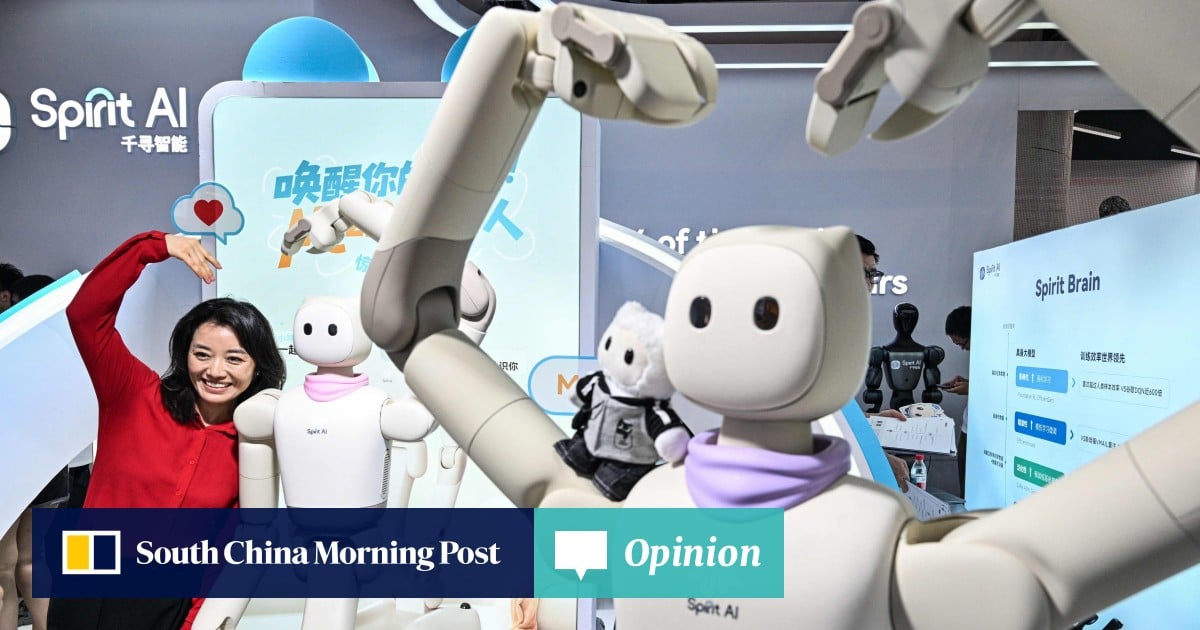
The West's debate on AI's future is incomplete without China's perspective, given its rapid AI adoption and development. This article highlights the need for a more inclusive discussion.
Imagine you're trying to learn about a new technology, but you only talk to people from one country. That's what's happening in the West's debate on AI's future. China is doing a lot of work on AI, but it's not being included in the conversation. This article says we need to listen to China's perspective to get a complete picture.
Analysis
A Global AI Debate Without China is Incomplete
The recent open letter signed by 200 leading economists and AI researchers, including 16 Nobel laureates, warns that artificial intelligence may drive an economic transformation larger than the Industrial Revolution. However, the signatory list reveals a stark omission: not a single name comes from China. This reflects a two-level information gap that runs deeper than most Western observers realize.
The first level is of the AI models themselves. Western businesses are already ahead of Western discourse here. DoorDash, Siemens, and Airbnb have adopted Chinese models from DeepSeek, Z.ai (Zhipu AI), and Moonshot AI alongside, and sometimes instead of, their American counterparts. For cost-conscious companies and governments, the sensible choice is often an open-weight model that runs cheaply on local hardware. Today, that choice is a Chinese model.
With the recent release of Moonshot AI's Kimi K3, which matches leading US models on many benchmarks, that trend will only accelerate. Investors grasped this immediately: US chip stocks fell on the news. People visit the Moonshot AI stand, featuring the Kimi K3 model, a 2.8 trillion-parameter large language model that is the world's biggest open-source AI model so far, at the World Artificial Intelligence Conference in Shanghai on July 18.
Why China Matters in the AI Debate
China is home to roughly half of all frontier model development and has arguably the world's fastest AI adoption. Trying to understand this transformation while excluding China is like studying the Industrial Revolution while ignoring the country with the most factories. No one intended the omission. It reflects a two-level information gap that runs deeper than most Western observers realize.
The Road Ahead
Any meaningful debate on AI's future must include China, where the AI experiment is also running, at greater speed and scale, and with different results. The West's debate on AI's future is incomplete without China's perspective, given its rapid AI adoption and development. This article highlights the need for a more inclusive discussion.
Key points
- The West's debate on AI's future is incomplete without China's perspective.
- China is home to roughly half of all frontier model development and has arguably the world's fastest AI adoption.
- The omission of China from the AI debate reflects a two-level information gap that runs deeper than most Western observers realize.
- Any meaningful debate on AI's future must include China, where the AI experiment is also running, at greater speed and scale, and with different results.
If the West includes China in the AI debate, it could lead to a more comprehensive understanding of AI's impact and a more collaborative approach to its development. This could result in more innovative and effective AI solutions that benefit both the West and China.
If the West continues to exclude China from the AI debate, it could lead to a lack of understanding of China's AI capabilities and a failure to address the potential risks and challenges associated with AI adoption in China.