To win the chip war, China needs a multinational strategy
China is strategically positioning itself in the global chip war, focusing on mass-market legacy integrated circuits and closing the gap in CPUs and memory chips, while the US dominates advanced AI chips.
Intelligence analysis by Gemini 2.5 Flash
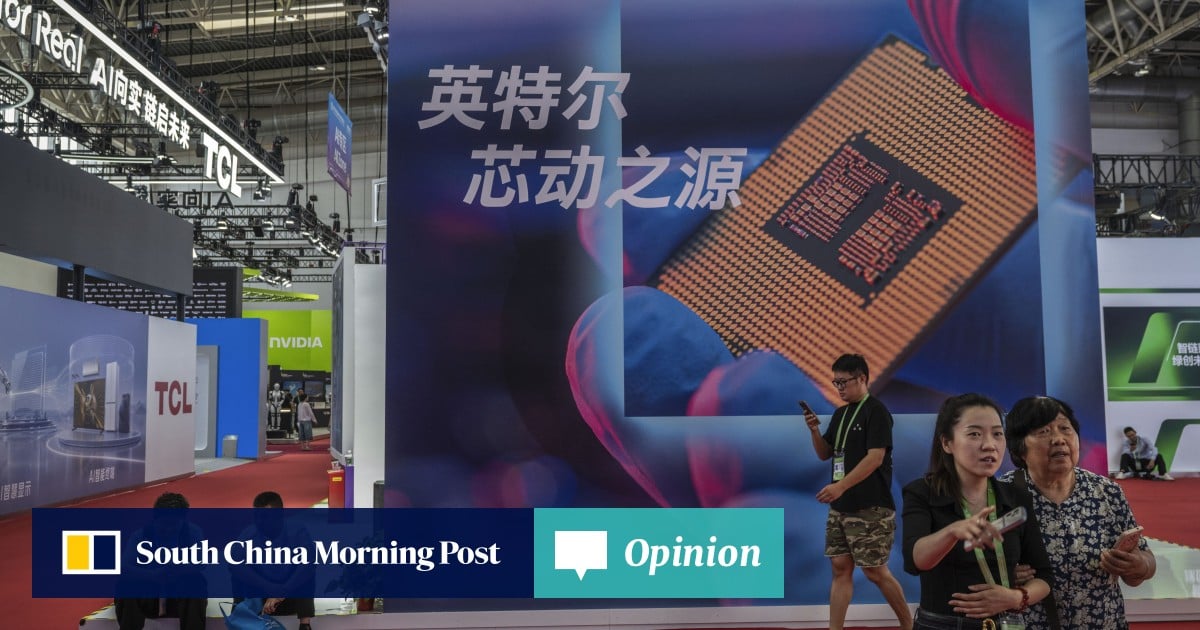
The article argues that while the US leads in cutting-edge AI chips, China is becoming a dominant force in mass-market legacy integrated circuits and is making significant strides in CPUs and memory. It suggests that China's path to winning the chip war requires a multinational strategy to counter US leverage over allied technologies.
Imagine a big race where some countries are trying to make the smartest computer brains, called 'chips.' America is really good at making the super-fast, super-smart chips for new AI robots. But China is getting really good at making the regular, everyday chips that go into things like your phone or car. They're also catching up in making the 'brains' for laptops and the 'memory' chips that help computers remember things. To win this race, China needs to work with many different countries, not just rely on itself, because other countries have important parts of the puzzle.
Analysis
China's Evolving Position in the Chip Landscape
China's role in the global semiconductor industry is undergoing a significant transformation, marked by a dual strategy that acknowledges current limitations while aggressively pursuing dominance in specific segments. While the United States maintains an undisputed lead in the most advanced artificial intelligence (AI) chips, such as Nvidia's Blackwell line, China is carving out a strong position in the mass market for legacy integrated circuits. These mature logic chips, crucial for consumer electronics and automotive applications, saw China's exports nearly double in the first half of the year, indicating a robust and growing capacity in this area. This strategic focus allows China to build foundational capabilities and market share, even as it faces restrictions on cutting-edge technologies.
The Contested Realms: CPUs and Memory
The article highlights two critical segments where China sees a more realistic path to self-sufficiency: Central Processing Units (CPUs) and memory chips. CPUs, once the symbol of American semiconductor leadership through Intel, are expected to regain significant importance in the next five years as AI applications move beyond initial model training. Although Intel and AMD have historically dominated this segment, Chinese firms are actively closing the gap, making it a highly contestable arena. Similarly, in memory chips, a segment largely ceded by the US to East Asia decades ago, China is making notable progress. While Samsung Electronics and SK Hynix hold the lion's share of the global DRAM market, China's ChangXin Memory Technologies (CXMT) is ranked fourth globally with an 8 percent market share and is poised for a significant Shanghai listing, signaling growing investor confidence and domestic capability.
The Imperative for a Multinational Strategy
The core argument of the piece is that China's success in the chip war hinges on adopting a multinational strategy. This approach is necessitated by America's significant leverage over its allies' critical technologies and capacities, which can be used to restrict China's access to essential components and expertise. To counter this, China must look beyond purely domestic efforts and engage with the global supply chain in a more diversified and strategic manner. This could involve fostering partnerships with non-US-aligned entities, investing in international collaborations, or strategically integrating its growing capabilities in legacy chips, CPUs, and memory into broader global ecosystems. By diversifying its technological dependencies and building a more resilient, globally integrated, yet domestically strong, semiconductor industry, China aims to mitigate the impact of US-led restrictions and secure its long-term technological independence.
Key points
- The US leads in advanced AI chips, but China is becoming dominant in mass-market legacy integrated circuits.
- China is closing the gap in Central Processing Units (CPUs), which are expected to regain importance as AI applications expand.
- China's ChangXin Memory Technologies (CXMT) holds 8% of the global DRAM market and is preparing for a Shanghai listing.
- The article argues that China needs a multinational strategy to counter US leverage over its allies' critical technologies and capacities.
- China's chip exports nearly doubled in the first half of the year, primarily in mature logic integrated circuits.
If China successfully implements a multinational strategy, it could accelerate its progress in key chip segments like CPUs and memory, reducing its reliance on US technology and fostering a more diversified global semiconductor supply chain. This could lead to greater technological resilience and economic stability for China.
Despite its efforts, China could face continued challenges if US leverage over allied technologies remains strong, potentially hindering its access to crucial equipment and expertise. This could slow its progress in advanced chip development and limit its ability to achieve full self-sufficiency.
Market signals
- ChangXin Memory Technologies The company's upcoming Shanghai listing signals growth and investor confidence in China's domestic memory chip sector.
AI-generated analysis of potential market relevance. Not financial advice.