University of Manchester Uses NVIDIA Earth-2 to Forecast Air Pollution Across the UK
Researchers at the University of Manchester are using NVIDIA's Earth-2 AI platform to forecast air pollution across the UK. This approach significantly reduces computational costs compared to traditional methods, enabling more detailed and frequent predictions.
Intelligence analysis by Gemini 2.5 Flash Lite
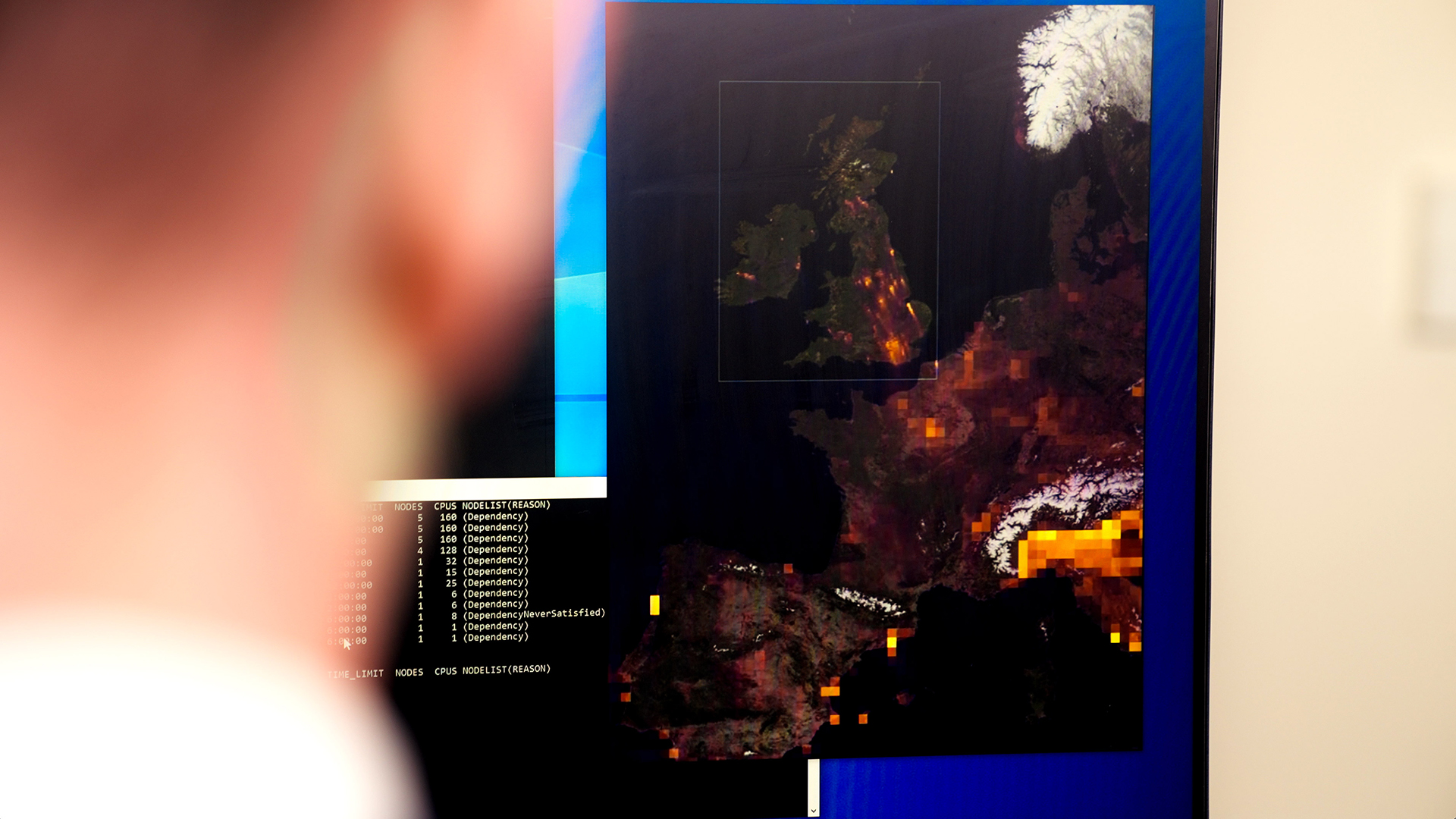
The University of Manchester is leveraging NVIDIA's Earth-2 AI framework, specifically the CorrDiff and StormCast models, to develop advanced air pollution forecasting for the UK. This initiative aims to overcome the high computational demands of traditional air quality models, making detailed, localized predictions more accessible and actionable for public health and policy-making.
Imagine air pollution is like a messy room. Old ways of cleaning it took forever and used giant machines. Now, scientists are using a smart computer helper called Earth-2, like a super-fast robot cleaner. It learns from past messes to predict where new messes will appear, helping people stay healthy by knowing when to open windows or stay inside.
Analysis
Earth-2 CorrDiff
The University of Manchester's research team, led by Professor David Topping, has successfully adapted NVIDIA's Earth-2 generative AI framework, originally designed for weather forecasting, to model air pollution across the UK. The core of this adaptation is the Earth-2 CorrDiff model, a generative downscaling tool. The team generated training data from existing chemistry-climate simulations and then trained CorrDiff on Isambard-AI, the UK's national AI supercomputer. This approach drastically reduces the computational expense and time associated with traditional chemistry-based air quality models, which are notoriously slow and resource-intensive.
The initial training of CorrDiff on Isambard-AI, which houses 5,448 NVIDIA GH200 Grace Hopper Superchips, took a mere two days. This efficiency is attributed to the model's ability to leverage NVIDIA's hardware effectively, using relatively low GPU hours and thus less power. The resulting model provides a detailed, UK-wide pollution forecast at a resolution of 2-3 square kilometers, offering a significant leap in granularity and accessibility for environmental science.
Isambard-AI and DGX Spark
The project highlights the synergy between large-scale national supercomputing resources like Isambard-AI and more accessible desktop AI systems such as the NVIDIA DGX Spark. While Isambard-AI was crucial for the initial, large-scale training of the Earth-2 models, the DGX Spark, powered by NVIDIA Grace Blackwell superchips, allows for inference and smaller training runs to be conducted on a desk. This transition from a national supercomputer to a desktop system dramatically lowers the barrier to entry for researchers, enabling them to develop and deploy powerful AI models for environmental science with an investment of a few thousand dollars.
This accessibility is a key enabler for open science initiatives. The team plans to release the open-source training data and workflows, allowing similar models to be developed for other countries and regions. This democratization of advanced modeling tools is expected to empower global communities to produce their own detailed pollution models using local data and accessible computing resources.
Agentic Future and Open Science
Looking ahead, Professor Topping envisions an 'agentic interface' where users, such as clinicians or government agencies, can pose questions about air quality, and a chain of AI models will automatically handle the complex computations to deliver an answer. This future scenario, grounded in the science represented by the Earth-2 frameworks, could involve ingesting real-time data from edge AI devices, enabling proactive decision-making in events like wildfires or providing timely health advisories.
The open-source release of training data and workflows is central to this vision. By making these tools available globally, the aim is to enable every country and major city to produce its own detailed pollution models. This collaborative approach, facilitated by accessible AI hardware and open-source frameworks, promises to accelerate scientific discovery and improve environmental monitoring worldwide.
Key points
- University of Manchester is using NVIDIA's Earth-2 AI to forecast UK air pollution.
- The AI approach is significantly faster and less computationally expensive than traditional methods.
- Models like Earth-2 CorrDiff and StormCast are being utilized for detailed, localized predictions.
- The research aims to improve public health and inform environmental policy through better forecasting.
- Open-source data and workflows are planned for release to enable global adoption.
This AI-driven approach could lead to significantly improved public health outcomes by enabling proactive interventions against air pollution. It also paves the way for more informed environmental policy-making through highly detailed, accessible pollution forecasts.
The accuracy and widespread adoption of these AI models depend on the availability and quality of local pollution data for training. Without sufficient data or computational resources in certain regions, the benefits might not be evenly distributed globally.