Volatility Exits Crypto, TradFi Markets Even as U.S.-Iran Risks Linger, Sovereign Debt Rises
Despite geopolitical tensions and rising sovereign debt, major markets including crypto, stocks, bonds, gold, and oil are experiencing a significant decline in implied volatility, suggesting a period of unusual calm.
Intelligence analysis by Gemini 2.5 Flash Lite
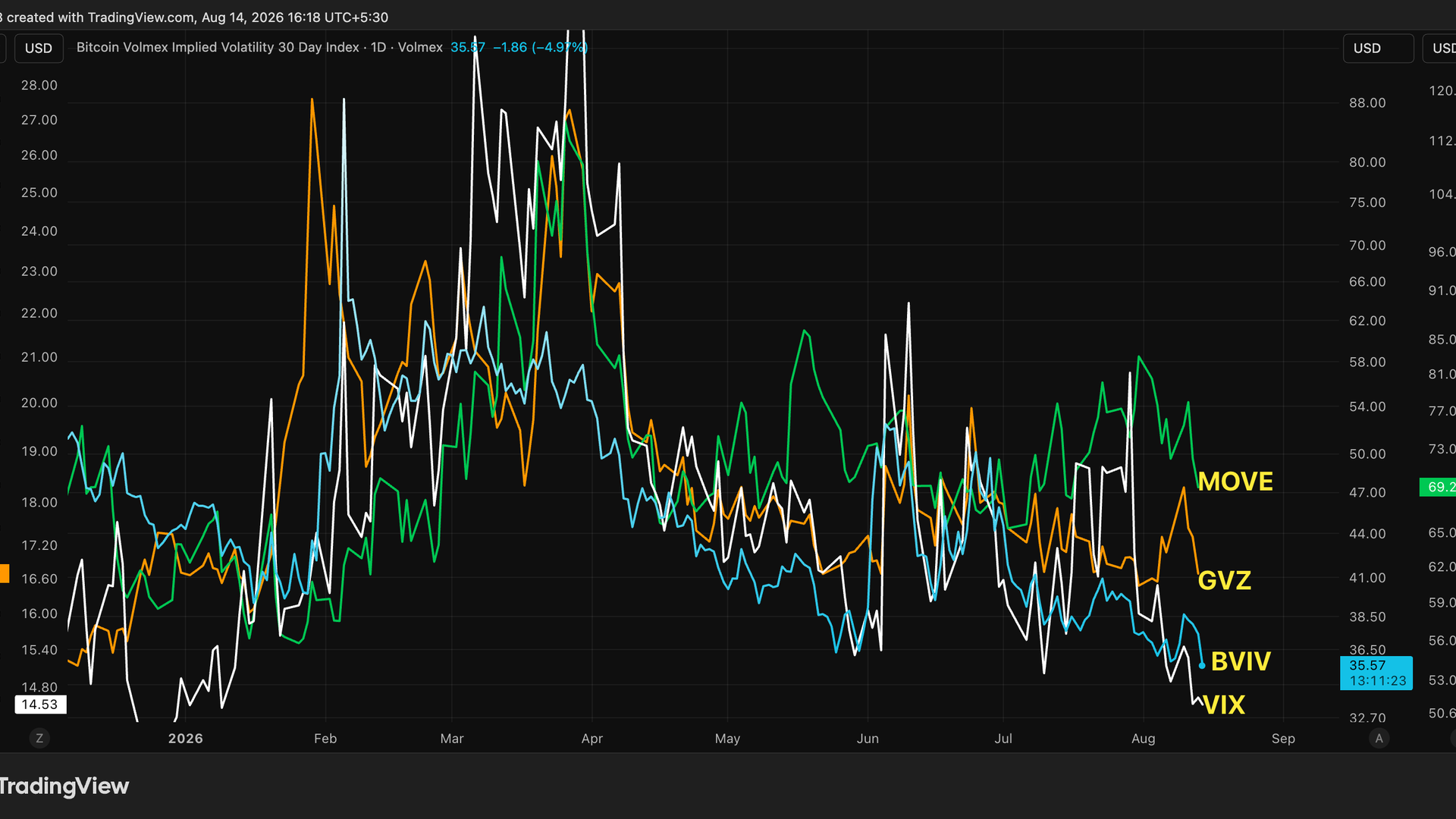
Markets across crypto, traditional finance, and commodities are exhibiting unusually low implied volatility, a measure of expected price swings. This calm persists even amidst ongoing geopolitical risks like U.S.-Iran tensions and concerns over sovereign debt, leading to a divergence between perceived risks and market behavior.
Imagine everyone is a bit worried about a storm coming (like big news about countries fighting or governments owing lots of money). But instead of getting scared and running around, people are acting very calm, like nothing is happening. This is happening in the stock market, with Bitcoin, and even with gold. It's like everyone is unusually relaxed, even though there are reasons to be nervous.
Analysis
Market Complacency Amidst Geopolitical Storms
The current market sentiment presents a curious paradox: a widespread decrease in implied volatility across major asset classes, including Bitcoin (BTC), stocks, bonds, gold, and oil, is occurring simultaneously with persistent geopolitical tensions and rising sovereign debt. Implied volatility, derived from the pricing of options and derivatives, serves as a key indicator of expected price turbulence and uncertainty. The fact that Bitcoin's 30-day implied volatility index (BVIV) has fallen to a year-to-date low, mirroring similar declines in the S&P 500's VIX, the Treasury market's MOVE index, and even volatility indexes for gold and oil, suggests a broad market-wide sense of calm. This tranquility is particularly striking given the backdrop of escalating U.S.-Iran risks and increasing sovereign debt levels, factors that historically tend to fuel market apprehension and price swings.
Bitcoin's Divergent Path
Bitcoin's implied volatility has retreated to a 2026 low, a trend that defies the typical response to the kind of regulatory setbacks and demand concerns that have been reported. The SEC's cancellation of its "Regulation Crypto" meeting, without rescheduling, adds to a cluster of unfriendly developments that have pressured Bitcoin and other digital assets like XRP. While traditional markets might be pricing in a degree of resilience or a belief that these risks are already incorporated into asset prices, the crypto market's reaction, or lack thereof in terms of volatility, is a subject of debate. Some might interpret this as a sign of growing maturity, where the asset class is becoming less sensitive to news flow. Others, however, view this synchronized low-volatility environment as a potential precursor to a significant market event, a contrarian signal that suggests preparation for an eventual disruption.
Traditional Finance's Calm
In traditional finance, the VIX, a widely watched "fear gauge" for the S&P 500, has reached its lowest point since January, indicating a significant reduction in expected stock market volatility. Similarly, the MOVE index, which tracks volatility in the U.S. Treasury market, is hovering near the lower end of its multi-month range. This calm in the bond market is particularly significant, as Treasury yields underpin global finance, and turbulence here can lead to broader financial tightening and risk aversion. The article notes that benign U.S. inflation data has tempered expectations for interest rate hikes, contributing to this stability. However, the ongoing U.S. naval blockade of Iranian ports and the potential for continued economic sanctions suggest that geopolitical risks remain elevated, creating a disconnect between the perceived safety in financial markets and the underlying global instability.
Key points
- Implied volatility has significantly decreased across crypto, stock, bond, gold, and oil markets.
- This period of low volatility persists despite ongoing U.S.-Iran geopolitical risks and rising sovereign debt.
- Bitcoin's 30-day implied volatility is at a 2026 low, while the S&P 500's VIX is at its lowest since January.
- The U.S. SEC has postponed a key 'Regulation Crypto' meeting, adding to regulatory uncertainty in the digital asset space.
- The calm market behavior contrasts with underlying geopolitical and economic concerns, raising questions about market complacency.
The current low volatility could indicate that markets have effectively priced in existing geopolitical and economic risks, suggesting a stable environment for investment. This calm might allow for sustained growth in traditional and digital asset markets, as uncertainty diminishes and investor confidence solidifies.
The synchronized decline in volatility across markets, despite lingering geopolitical tensions and rising sovereign debt, could be a sign of market complacency. This environment might be a precursor to a sharp, unexpected downturn if underlying risks materialize or if market participants are caught off guard by a sudden shift in sentiment.