What the CLARITY Act Actually Does for Bitcoin
The CLARITY Act, a bill passed by the House and awaiting Senate approval, has undergone significant changes since its introduction. The bill's impact on Bitcoin is multifaceted, with both positive and negative implications. This article delves into the specifics of the bi…
Intelligence analysis by Llama
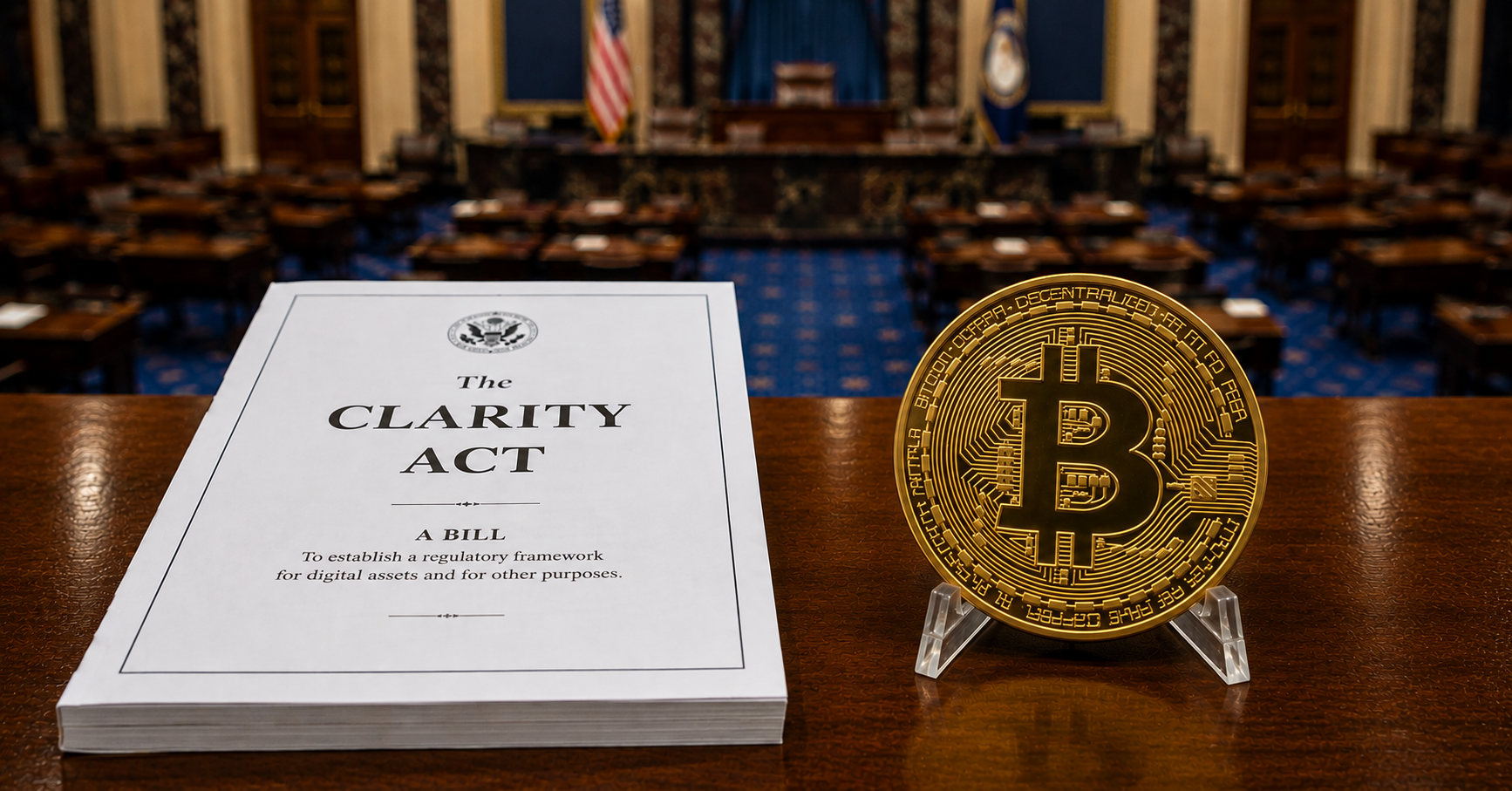
The CLARITY Act has undergone significant changes since its introduction, with the Senate rewriting the bill to include new provisions. The bill's impact on Bitcoin is complex, with both positive and negative implications. The article explores the specifics of the bill and its effects on Bitcoin, including the protection of self-custody rights, immunity from money-transmitter liabilit…
Imagine you have a special kind of money called Bitcoin that you can keep safe in your own wallet. The CLARITY Act is a law that helps protect this special money and makes it easier for banks to work with it. This can bring in new money and help the price of Bitcoin go up.
Analysis
What the CLARITY Act Actually Does for Bitcoin
The CLARITY Act, a bill passed by the House and awaiting Senate approval, has undergone significant changes since its introduction. The bill's impact on Bitcoin is multifaceted, with both positive and negative implications. This article delves into the specifics of the bill and its effects on Bitcoin, including the protection of self-custody rights, immunity from money-transmitter liability for developers, and the potential for banks to treat Bitcoin as a real asset class.
Protection of Self-Custody Rights
Section 605, the 'Keep Your Coins Act', prohibits federal regulators from restricting or impairing a person's ability to self-custody for any lawful purpose. Self-custody currently has no statutory backing, and providing direct legislation creates a defense against future tyrannical powers requiring custodial intermediaries. While people often dismiss this threat as 'fear mongering' and 'doomerism', this type of overreach does have recent historical precedent. In 2020, Treasury Secretary Steven Mnuchin directed FinCEN to propose a rule targeting 'unhosted wallets'. It would have required exchanges to collect names and home addresses for anyone moving more than $3,000/day into their private wallet, and file reports to FinCEN for anything over $10,000/day. Although the rule ultimately lost momentum, it remained on the books and un-withdrawn for almost four years . During that period, any Treasury Secretary could have revived and finalized it without any new legislation. This is the exact scenario Section 605 is written to prevent from happening again.
Immunity from Money-Transmitter Liability
Section 604, Blockchain Regulatory Certainty Act, says a 'non-controlling' developer or provider can't be classified as a money transmitting business for doing that. Prime examples are Samourai Wallet and Tornado Cash. Both were open-source, non-custodial projects whose developers were criminally prosecuted under the theory that publishing the code made them unlicensed money transmitters. Samourai's founders pleaded guilty in April 2026, and Tornado Cash's Roman Storm was convicted on the same charge in August 2025. Section 604 does not undo either case, but it does draw a line so the next open-source developer doesn't have to find out where it is in federal court.
Banks Treating Bitcoin as a Real Asset Class
Section 401, the 'Permissibility of Digital Asset Activities', is the only section of the CLARITY Act that is 'bullish' for Bitcoin's price, by my estimations. This section would finally let banks, brokerages, and institutions treat Bitcoin like a real asset class, pulling in a wave of new capital. The section lets financial holding companies, national banks, state banks, and credit unions custody digital assets, lend against them as collateral, operate nodes, provide brokerage and clearing services, and act as a market maker or dealer, all without needing extra prior approval beyond what banking law already requires. This section uses the term 'digital asset,' which is broadly defined through the already-enacted GENIUS Act. Unlike 'digital commodity' or 'ancillary asset' elsewhere in the bill, Bitcoin clearly and unambiguously qualifies here. The addressable market this opens up is enormous. US commercial banks alone hold $25.7 trillion in total assets, nearly 20 times Bitcoin's entire $1.3 trillion market cap. Custody giants like State Street and Northern Trust each sit on custody books that individually dwarf the whole Bitcoin market several times over. None of that capital needs to move far, or take much risk, to move the price of an asset this size. It just needs a legal, statutory door like Section 401 to walk through.
Key points
- The CLARITY Act has undergone significant changes since its introduction.
- The bill's impact on Bitcoin is multifaceted, with both positive and negative implications.
- Section 605 protects self-custody rights and prevents future tyrannical powers from requiring custodial intermediaries.
- Section 604 provides immunity from money-transmitter liability for developers and users of Bitcoin.
- Section 401 allows banks, brokerages, and institutions to treat Bitcoin like a real asset class, potentially bringing in new money and helping the price of Bitcoin go up.
If the CLARITY Act is passed, it could bring in new money and help the price of Bitcoin go up. This could make Bitcoin a more stable and widely accepted form of money. Additionally, the protection of self-custody rights and immunity from money-transmitter liability for developers could help to reduce the risk of regulatory overreach and promote innovation in the Bitcoin ecosystem.
However, the CLARITY Act also has some negative implications for Bitcoin. For example, the bill's changes to the definition of a digital asset could potentially limit the use of Bitcoin as a commodity. Additionally, the bill's provisions on money-transmitter liability could create uncertainty and risk for developers and users of Bitcoin. If the bill is passed, it could lead to increased regulatory scrutiny and potential restrictions on the use of Bitcoin.