What the Mecca military pact means for China
A defence pact between Saudi Arabia, Turkey, and Pakistan presents a complex strategic calculus for Beijing, demanding a masterclass in balance.
Intelligence analysis by Llama
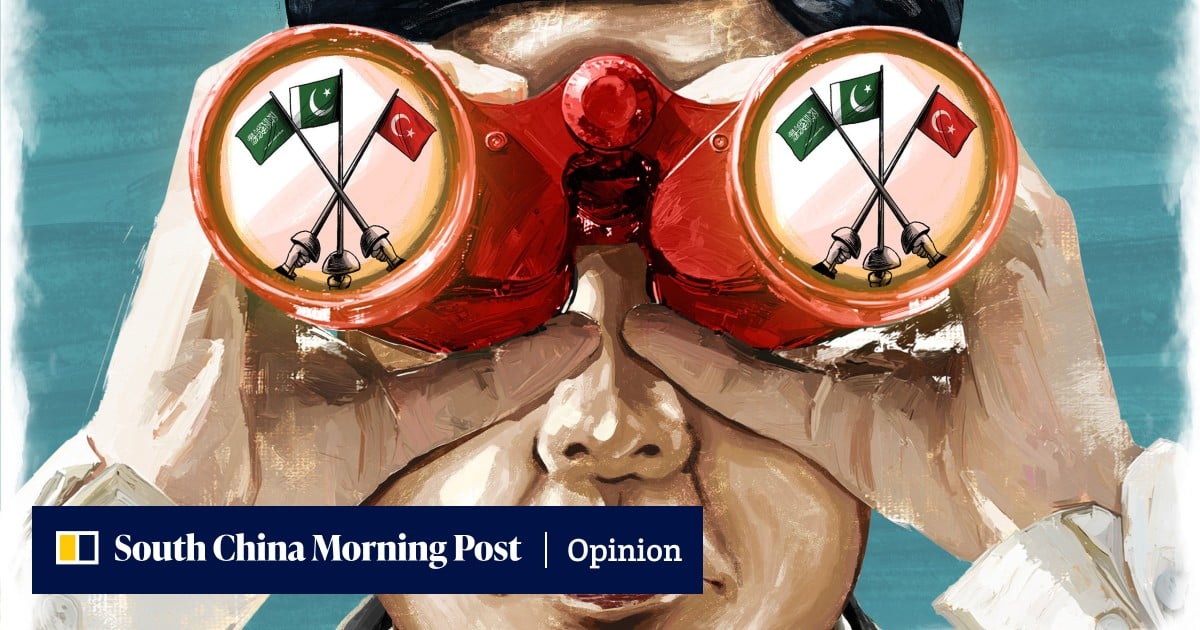
The Mecca defence agreement codifies a defence commitment, where an armed attack on one is treated as an assault on all, bridging the financial capital of the Gulf, the industrial-military muscle of a Nato member, and the operational capacity of a South Asian nuclear-armed state.
Imagine a group of countries in the Middle East forming a team to protect each other from attacks. This team, called the Mecca defence agreement, includes Saudi Arabia, Turkey, and Pakistan. They want to make sure that if one of them gets attacked, the others will come to their help. This is like having a big brother or sister who looks out for you. But, it also means that these countries might become more independent and less reliant on other countries, like the United States, for their security.
Analysis
Mecca Defence Agreement: A New Security Architecture for the Middle East
The Mecca defence agreement between Saudi Arabia, Turkey, and Pakistan marks a significant shift in the Middle East's security landscape. This pact codifies a defence commitment, where an armed attack on one is treated as an assault on all, bridging the financial capital of the Gulf, the industrial-military muscle of a Nato member, and the operational capacity of a South Asian nuclear-armed state.
This agreement was born out of acute vulnerabilities and a crisis of confidence in Western security guarantees. For Riyadh, it is an insurance policy for Vision 2030, safeguarding giga-projects and energy arteries against regional volatility, Iran-backed Houthi maritime disruptions, and unpredictable American foreign policy. For Ankara, it is the ultimate vehicle to project power across the Islamic world under its "Asia Anew Initiative", expanding its defence export footprint, anchored by Bayraktar drones and fifth-generation Kaan fighter jets. For Islamabad, it secures Gulf financial lifelines and energy supplies, while elevating its military elite to indispensable regional power brokers.
Ideologically and geopolitically, the Mecca pact represents a pragmatic realignment towards regional self-reliance. Unlike the transatlantic security alliance, which relies on a rigid, institutionalised command structure, integrated command hubs, and shared doctrine under American hegemony, the Mecca pact is seen to be operating as a flexible, transactional strategic coalition. It lacks a permanent bureaucratic headquarters, relying instead on state-to-state defence integration, intelligence sharing, and defence-industrial co-development.
Implications for China
The Mecca pact has significant implications for China's security and economic interests in the Middle East. China's Belt and Road Initiative (BRI) has invested heavily in the region, with significant infrastructure projects in Saudi Arabia, Turkey, and Pakistan. The Mecca pact's emphasis on regional self-reliance and defence cooperation may create new challenges for China's BRI ambitions, as regional states may become more inclined to pursue their own security and economic interests, potentially at the expense of Chinese investments.
Conclusion
The Mecca defence agreement represents a significant shift in the Middle East's security landscape, with implications for China's security and economic interests in the region. As regional states become more inclined to pursue their own security and economic interests, China's BRI ambitions may face new challenges. The Mecca pact's emphasis on regional self-reliance and defence cooperation may create new opportunities for China to engage with regional states, but it also poses significant risks to its investments and interests in the region.
Key points
- The Mecca defence agreement codifies a defence commitment between Saudi Arabia, Turkey, and Pakistan.
- The pact represents a pragmatic realignment towards regional self-reliance in the Middle East.
- The Mecca pact has significant implications for China's security and economic interests in the region.
- China's Belt and Road Initiative (BRI) may face new challenges due to the Mecca pact's emphasis on regional self-reliance and defence cooperation.
If the Mecca pact plays out positively, it could lead to increased stability and cooperation in the Middle East, creating new opportunities for China to engage with regional states and expand its economic interests in the region.
However, the Mecca pact also poses significant risks to China's investments and interests in the region, particularly if regional states become more inclined to pursue their own security and economic interests at the expense of Chinese investments.