Why China’s military is laser-focused on ‘disruptive’ technologies
China's military is focusing on emerging technologies such as artificial intelligence, quantum tech, and hypersonic weapons to gain an asymmetric advantage over its stronger rival, the US.
Intelligence analysis by Llama
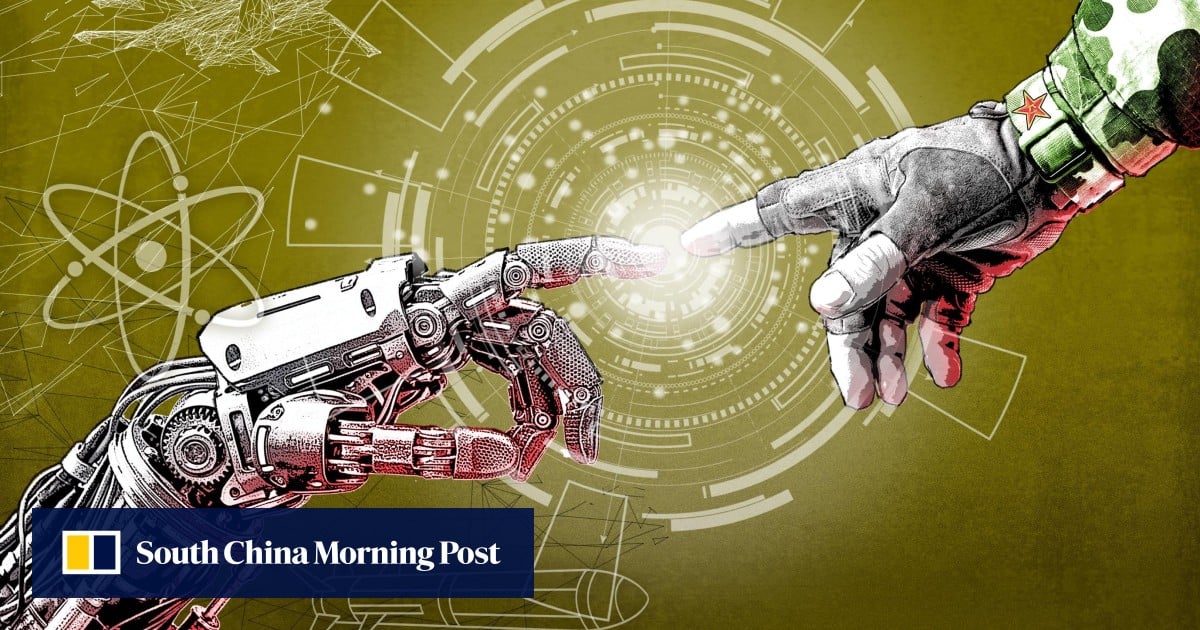
The People's Liberation Army is pursuing 'disruptive' technologies to modernise its military and gain an edge over the US, as argued in the influential book 'Unrestricted Warfare'.
China's military is trying to get better at using new technologies like artificial intelligence and hypersonic weapons to be more powerful than its rival, the US. This is because China wants to be able to compete with the US in a future war.
Analysis
A $60B Vote of Confidence
The People's Liberation Army (PLA) is marking its 99th anniversary, with its evolution highlighting the past, present, and future of China's military strategy. The PLA's pursuit of emerging technologies is a key aspect of its modernisation efforts, as it seeks to gain an asymmetric advantage over its stronger rival, the US. In the influential book 'Unrestricted Warfare', PLA military strategist Qiao Liang argued that China should not try to match the US weapon for weapon but instead develop asymmetric advantages against its stronger rival. Qiao noted that warfare was entering an informationised era and that China was clearly lagging behind the United States. He also said finance, cyberspace, and psychological operations would be important in future wars. The book has drawn significant attention in Western military circles and has been studied at the US Military Academy in West Point, New York as part of broader discussions on Chinese strategic thinking. It continues to resonate among military strategists in China, as the PLA pursues emerging and 'disruptive' technologies as part of its modernisation efforts – from artificial intelligence and quantum tech to hypersonic weapons and directed-energy systems.
Why Cursor?
The PLA's pursuit of emerging technologies is driven by a desire to gain an asymmetric advantage over the US. By developing technologies that the US does not have, the PLA can create a new balance of power in the region. This is in line with Qiao's argument in 'Unrestricted Warfare' that China should not try to match the US weapon for weapon but instead develop asymmetric advantages against its stronger rival. The PLA's focus on emerging technologies is also driven by a desire to modernise its military and gain a competitive edge over its rivals. This is reflected in the PLA's investment in artificial intelligence, quantum tech, and hypersonic weapons.
The Road Ahead
The PLA's pursuit of emerging technologies is a key aspect of its modernisation efforts, and it is likely to continue in the coming years. The PLA's focus on emerging technologies is driven by a desire to gain an asymmetric advantage over the US and to modernise its military. This is reflected in the PLA's investment in artificial intelligence, quantum tech, and hypersonic weapons. The PLA's pursuit of emerging technologies is also driven by a desire to create a new balance of power in the region. This is in line with Qiao's argument in 'Unrestricted Warfare' that China should not try to match the US weapon for weapon but instead develop asymmetric advantages against its stronger rival.
Key points
- The PLA is pursuing emerging technologies to gain an asymmetric advantage over the US.
- The PLA's focus on emerging technologies is driven by a desire to modernise its military and gain a competitive edge over its rivals.
- The PLA's pursuit of emerging technologies is a key aspect of its modernisation efforts, and it is likely to continue in the coming years.
If China's military modernisation efforts are successful, it could lead to a more stable and secure region, as China would be better equipped to defend itself and its interests.
If China's military modernisation efforts are not successful, it could lead to an arms race in the region, as other countries may feel the need to modernise their militaries to keep up with China's advancements.