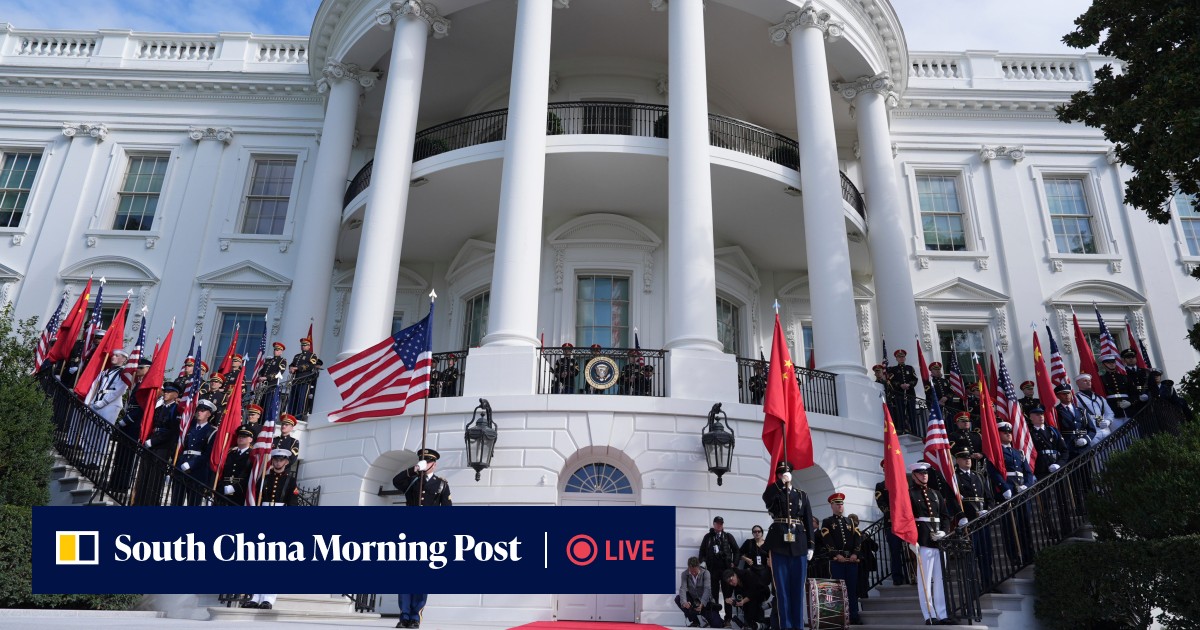
Xi begins first full day of US visit to meet Trump with White House ceremony
Chinese President Xi Jinping has commenced his first full day of a US visit, scheduled to include formal talks with US President Donald Trump and a state dinner, following an unprecedented reception upon arrival.
Intelligence analysis by Gemini 2.5 Flash
President Xi Jinping's visit to the US marks a significant diplomatic event, nearly a decade after his last trip, with a packed itinerary designed to foster a stable relationship between the two global powers. Despite a recently extended trade truce, the visit unfolds against a backdrop of fluctuating US-China relations, characterized by competition across various strategic arenas.
Imagine two big schoolyard leaders, President Xi and President Trump, who sometimes argue about toys and games. This week, President Xi is visiting President Trump's house for a big playdate. Even though they've had some disagreements, they're trying to be friendly and talk about how they can play together nicely, especially since they just agreed to share some toys for a bit longer. They'll have a fancy dinner and their wives will visit a museum, all hoping to make their friendship stronger, even if they still want to be the best at everything.
Analysis
The current visit by President Xi Jinping to the United States, nearly a decade after his last, underscores the persistent and evolving complexities of the US-China relationship. While the formal proceedings, including a White House ceremony and state dinner, project an image of diplomatic cordiality, the underlying dynamics are far more intricate. The article highlights that both nations are actively 'jockeying for position' across critical sectors such as trade, artificial intelligence, resources, and global influence, indicating that the discussions are likely to be robust and multifaceted, extending beyond mere pleasantries.
Donald Trump
The reception extended by President Donald Trump to his Chinese counterpart, described as 'unprecedented' at Joint Base Andrews, carries significant symbolic weight. Such a personal welcome by the US President himself, rather than a lower-ranking official, signals a deliberate effort to project respect and perhaps a desire to de-escalate tensions, at least publicly. This gesture could be interpreted as an attempt to set a positive tone for the high-stakes discussions ahead, particularly given Xi's statement that the two countries 'should be partners rather than adversaries.' However, the article also notes the 'fluctuating' nature of the relationship, suggesting that while the optics are positive, substantive disagreements remain a core challenge for the Trump administration.
Joint Base Andrews
The choice of Joint Base Andrews for President Xi's arrival and the 'unprecedented in-person welcome' by President Trump is a notable detail. This military facility, often used for high-profile arrivals, takes on added significance when the host president personally greets a visiting head of state, especially one from a geopolitical rival. This move could be seen as a strategic diplomatic play, aiming to convey a sense of importance and direct engagement from the highest level of the US government. It contrasts with the underlying competitive dynamic, where both Washington and Beijing are vying for supremacy in various global arenas, from economic policy to technological leadership. The initial reception thus serves as a carefully orchestrated prelude to the more challenging substantive talks.
National Museum of Asian Art
The itinerary for the first ladies, Melania Trump and Peng Liyuan, includes a visit to the National Museum of Asian Art. This cultural exchange, while seemingly a secondary event, plays an important role in soft diplomacy. Such activities often aim to build rapport and foster understanding outside the formal political negotiations, potentially creating a more conducive atmosphere for the leaders' discussions. It provides a platform for showcasing shared cultural appreciation and can subtly reinforce the idea of 'cooperation as the mainstay' of the relationship, as articulated by President Xi. These parallel engagements, though not directly addressing policy, contribute to the overall diplomatic environment, offering a counterpoint to the more contentious issues being debated by the heads of state.
Key points
- Chinese President Xi Jinping is on his first full day of a US visit, meeting President Donald Trump.
- The visit includes formal talks, a White House ceremony, and a state dinner.
- US First Lady Melania Trump and Chinese counterpart Peng Liyuan will visit the National Museum of Asian Art.
- Xi stated the countries "should be partners rather than adversaries" and foster a "stable relationship defined by cooperation."
- The visit occurs amid a "fluctuating US-China relationship" with both nations competing in trade, AI, resources, and global influence.
The extension of the trade truce and President Xi's statement about the two countries being "partners rather than adversaries" suggest a potential for de-escalation and a more stable relationship. The high-level engagement could lead to concrete agreements that foster cooperation and mitigate some of the current competitive pressures, benefiting global stability and economic growth.
Despite the diplomatic overtures, the article highlights a "fluctuating US-China relationship" and ongoing "jockeying for position" in critical areas like AI and resources. This suggests that fundamental disagreements persist, and the visit might only offer a temporary reprieve, with underlying tensions potentially resurfacing or escalating after the formal proceedings conclude.