AI Frenzy Losing Steam Leaves Bitcoin Less Volatile Than South Korean Stocks
While geopolitical tensions are pressuring bitcoin, a compelling data point has surfaced, highlighting the side effects of this year's AI frenzy. South Korea's Kospi index, a primary beneficiary of the AI boom, has slumped nearly 25% in just four weeks.
Intelligence analysis by Llama
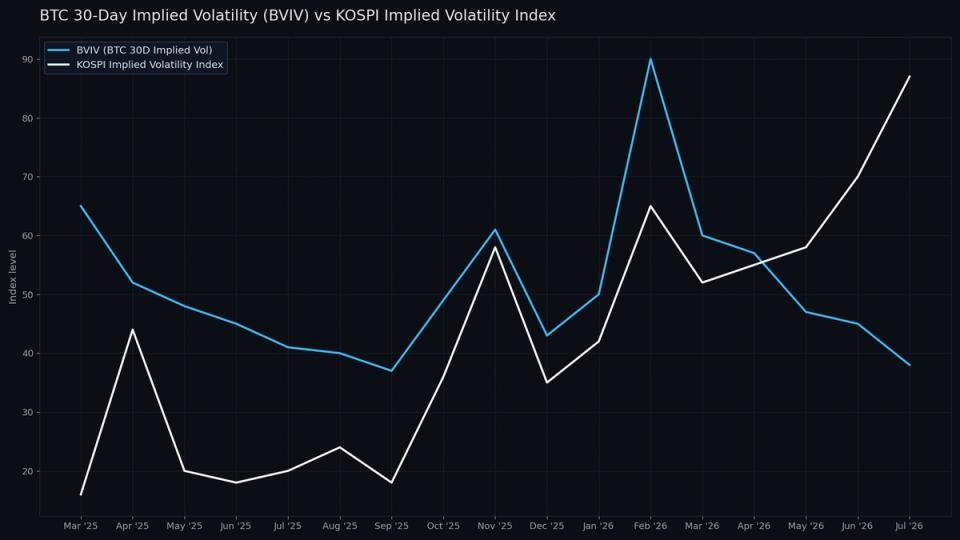
The AI frenzy is losing steam, and its impact on the market is becoming more apparent. South Korea's Kospi index, which was a major beneficiary of the AI boom, has slumped nearly 25% in just four weeks, making it less volatile than bitcoin.
Imagine you're playing a game where you can bet on how much a stock will go up or down. If many people are betting on the stock going up, it means they think it's a good bet. But if many people are betting on it going down, it means they think it's a bad bet. The AI frenzy has made many people bet on stocks going up, but now they're starting to bet on them going down. This is making the stock market more volatile, and it's affecting the price of bitcoin.
Analysis
A $60B Vote of Confidence
The AI frenzy, which has been driving unprecedented risk-taking in global markets, is losing steam. This is evident in the performance of South Korea's Kospi index, which has slumped nearly 25% in just four weeks. This decline is a significant development, as it highlights the side effects of the AI boom. The Kospi index, which was a major beneficiary of the AI boom, is now viewed as at least twice as risky as bitcoin, a decentralized cryptocurrency frequently criticized for its extreme volatility.
Why Cursor?
Kospi's options-based 30-day implied volatility (IV) index has surged to an annualized 81%, more than double BVIV, the bitcoin equivalent, at around 38%. Implied volatility is determined by demand for options, or hedging contracts; greater demand indicates a greater perceived need for protection from price swings. Many Korean retail traders chasing high returns through margin trading and leveraged ETFs have faced forced liquidations, now totaling more than $2 trillion in less than three months.
The Road Ahead
The fact that a major economy's stock index is exhibiting more volatility than bitcoin may serve as a warning to other global markets where the AI frenzy has fueled unprecedented risk-taking. For bitcoin supporters, the reality that BTC is steadier than the Kospi is a notable victory. Still, the largest cryptocurrency remains twice as volatile and risky as the S&P 500 index, whose 30-day volatility index (VIX) sits below 20%. Perhaps the true milestone for bitcoin bulls will be the day when the VIX becomes more expensive than the BVIV.
Key points
- South Korea's Kospi index has slumped nearly 25% in just four weeks.
- Kospi's options-based 30-day implied volatility (IV) index has surged to an annualized 81%, more than double BVIV, the bitcoin equivalent.
- Many Korean retail traders chasing high returns through margin trading and leveraged ETFs have faced forced liquidations, now totaling more than $2 trillion in less than three months.
- The fact that a major economy's stock index is exhibiting more volatility than bitcoin may serve as a warning to other global markets where the AI frenzy has fueled unprecedented risk-taking.
The fact that bitcoin is less volatile than the Kospi index is a notable victory for bitcoin supporters. If the AI frenzy continues to lose steam, it could lead to a decrease in volatility for bitcoin and other cryptocurrencies.
The AI frenzy has fueled unprecedented risk-taking in global markets, and its impact is still being felt. If the AI boom continues, it could lead to further volatility and risk-taking, which could negatively impact the price of bitcoin and other cryptocurrencies.