Bitcoin faces fresh headwinds as China’s Kimi beats Claude, GPT in coding benchmark
Bitcoin and other major cryptocurrencies fell after Beijing-based Moonshot AI released Kimi K3, an open-weight coding model that topped Anthropic and OpenAI on a key leaderboard.
Intelligence analysis by Llama

The release of Kimi K3, a free Chinese model that beat Anthropic and OpenAI on a coding leaderboard, has sent shockwaves through the AI and semiconductor markets, causing a selloff across Asia and impacting the price of Bitcoin and other cryptocurrencies.
Imagine you have a supercomputer that can write code faster and better than any human. That's basically what Kimi K3 is. It's a free model that can do the same thing as expensive models made by companies in the US. This has caused a big reaction in the market, and the price of Bitcoin and other cryptocurrencies has fallen.
Analysis
A $60B Vote of Confidence
The release of Kimi K3, a 2.8-trillion-parameter mixture-of-experts model with a one-million-token context window, has sent shockwaves through the AI and semiconductor markets. The model, which is set for full public release on July 27, has beaten Anthropic's Claude Fable 5 and OpenAI's GPT-5.6 on a key leaderboard, and its open-weight license has raised questions about the scarcity and expense of frontier AI capabilities.
The implications of Kimi K3's release are significant, as it challenges the assumption that frontier AI capabilities will remain scarce, expensive, and U.S.-controlled. This assumption has underwritten hundreds of billions of dollars in AI infrastructure spending, and the release of Kimi K3 has raised questions about the viability of this business model.
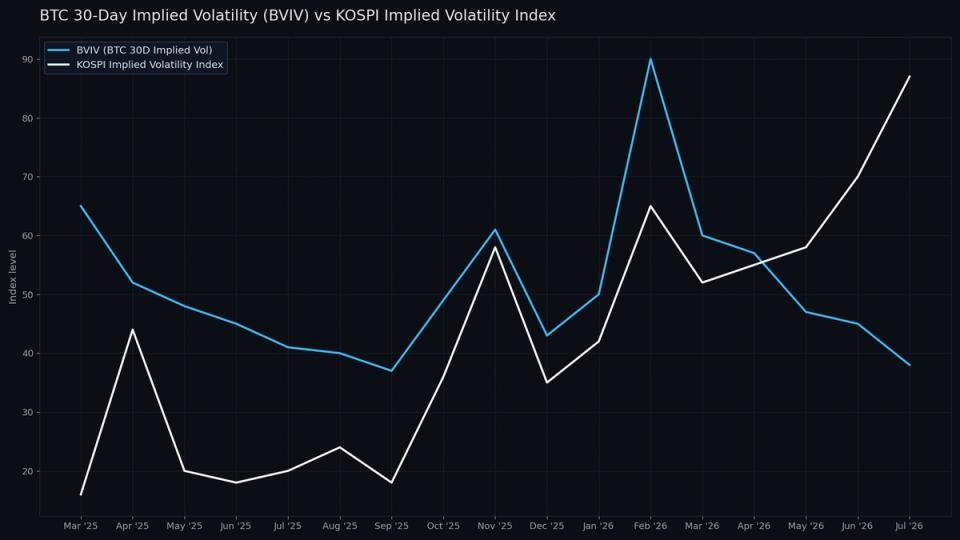
The release of Kimi K3 has also had a direct impact on the price of Bitcoin and other cryptocurrencies. Bitcoin has spent this entire week taking direction from semiconductors, and the release of Kimi K3 has caused a selloff across Asia. The headwinds for crypto run through the tape rather than through anything on-chain, and the market is increasingly trading as a leveraged bet on the AI capital cycle.
Why Cursor?
The release of Kimi K3 has also raised questions about the position of crypto in the AI capital cycle. In January 2025, bitcoin sold off with tech because it was a risk asset in a risk-off session. In July 2026, it is trading as a leveraged expression of the AI capital cycle itself, up on a Korean chip listing one week and down on a Chinese model release the next.
The weights land in ten days, and then the market will find out whether the benchmark holds. The release of Kimi K3 has raised questions about the viability of the miner-to-AI pivot that has carried several public bitcoin companies, and the market is waiting to see whether this pivot will lose its floor.
The Road Ahead
The release of Kimi K3 has significant implications for the AI capital cycle and the price of Bitcoin. The market is waiting to see whether the benchmark holds, and whether the release of Kimi K3 will have a lasting impact on the price of Bitcoin and other cryptocurrencies.
Key points
- Kimi K3 is a 2.8-trillion-parameter mixture-of-experts model with a one-million-token context window.
- The model is set for full public release on July 27 and will be available for free.
- Kimi K3 has beaten Anthropic's Claude Fable 5 and OpenAI's GPT-5.6 on a key leaderboard.
- The release of Kimi K3 has caused a selloff across Asia and has impacted the price of Bitcoin and other cryptocurrencies.
- The market is waiting to see whether the benchmark holds and whether the release of Kimi K3 will have a lasting impact on the price of Bitcoin and other cryptocurrencies.
If the release of Kimi K3 leads to a decrease in the cost of developing AI models, it could lead to a surge in innovation and adoption of AI technology, which could have a positive impact on the price of Bitcoin and other cryptocurrencies.
If the release of Kimi K3 leads to a decrease in the demand for AI models, it could lead to a decrease in the price of Bitcoin and other cryptocurrencies, as the market becomes less confident in the viability of the miner-to-AI pivot.