AI, sanctions and geopolitics: What they mean for businesses operating across borders
As cross-border business disputes grow more complex, legal experts from around the world will gather at Singapore Convention Week 2026 to explore solutions. The event will focus on emerging issues influencing dispute resolution, such as geopolitical developments and AI.
Intelligence analysis by Llama
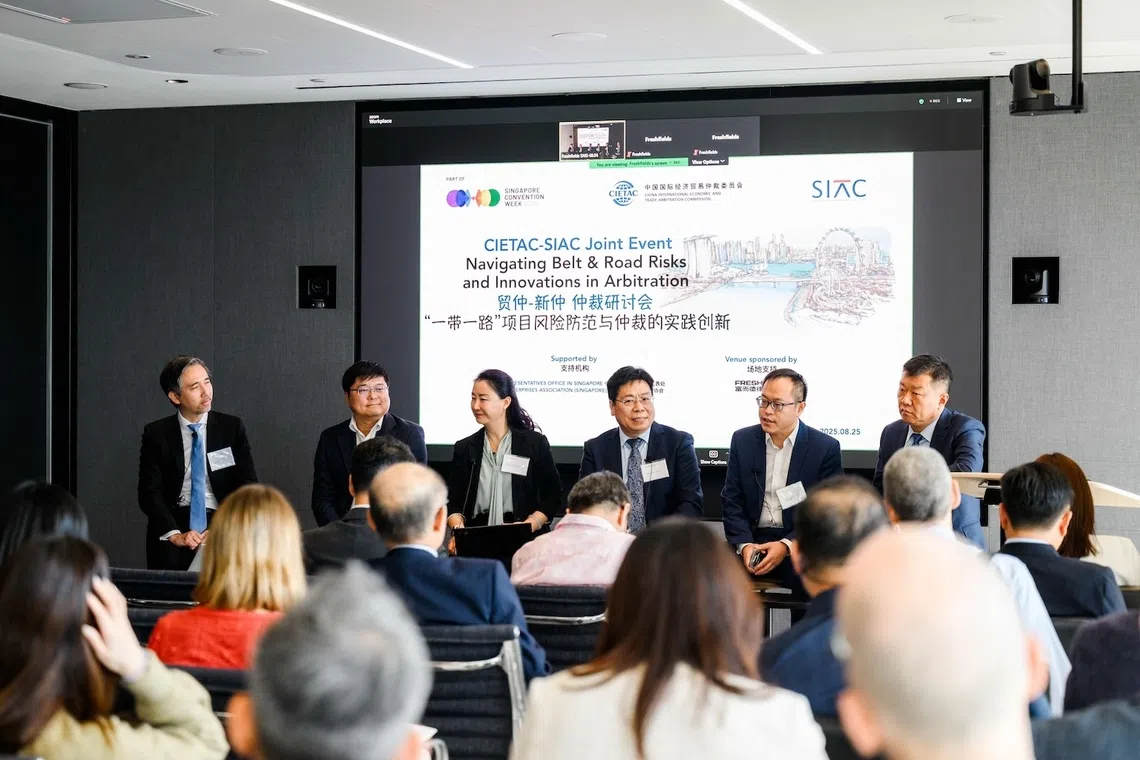
Singapore Convention Week 2026 will bring together legal experts to discuss emerging issues in dispute resolution, including AI and geopolitics. The event aims to provide a platform for the legal, business, and policy communities to explore solutions to complex cross-border disputes.
Imagine you're working on a project with someone in another country, and you both use a special tool to help you work faster. But, you start to wonder who owns the work you created together, and who is responsible if someone gets upset about it. This is a problem that's becoming more common as people use more technology to work together across borders.
Analysis
The Rise of AI-Driven Disputes in Cross-Border Business
The increasing use of artificial intelligence (AI) in business operations is creating new types of disputes over areas like data rights, model outputs, and technology transfer. This is particularly challenging when the AI provider, the user, and the data all sit in different countries. Ng Sook Zhen, director at Zenbridge Law, notes that this trend is one of three reshaping the complexity of cross-border disputes.
Geopolitical Tensions and Sanctions Exposure
Geopolitical tensions are pushing businesses to diversify where they operate, and more regulatory layers such as sanctions exposure, data localisation, and corporate governance rules are emerging. Against this backdrop, Singapore's reputation for neutrality, reliability, and the rule of law has become increasingly valuable to its competitiveness. The Ministry of Law's deputy secretary (Development) Charlene Chang notes that the rule of law is a legal principle that requires everyone, including the government, to obey the law.
Singapore Convention Week 2026
Singapore Convention Week (SC Week) 2026 will run from Aug 24 to 28, 2026, at locations including Shangri-La Singapore, Gillman Barracks, and Marina Bay Sands. The event will focus on emerging issues influencing dispute resolution, such as geopolitical developments and AI. Last year's SC Week saw over 5,600 participations across 60 partner and associated events. The Singapore Convention on Mediation (SCM) is a landmark trade law treaty that makes it easier for businesses to enforce mediated settlement agreements across borders. As of August 2026, SCM counts 60 signatories, including China, India, and the United States, and over 20 contracting parties.
The Importance of Trust in Dispute Resolution
Chuan Wee Meng, chief executive officer of Singapore International Mediation Centre (SIMC), notes that the focus of SC Week 2026 captures the key challenge in dispute resolution today: preserving fairness, integrity, and the rule of law while navigating a changing global environment. SIMC has been a partner organisation of SC Week since 2019. In 2023, SIMC organised a declaration signed by 43 international business associations and MNCs, including Meta and Microsoft, to support mediation to resolve commercial disputes.
Key points
- The increasing use of AI in business operations is creating new types of disputes over areas like data rights, model outputs, and technology transfer.
- Geopolitical tensions are pushing businesses to diversify where they operate, and more regulatory layers such as sanctions exposure, data localisation, and corporate governance rules are emerging.
- Singapore Convention Week 2026 will focus on emerging issues influencing dispute resolution, such as geopolitical developments and AI.
- The Singapore Convention on Mediation (SCM) is a landmark trade law treaty that makes it easier for businesses to enforce mediated settlement agreements across borders.
- The event aims to provide a platform for the legal, business, and policy communities to explore solutions to complex cross-border disputes.
If Singapore Convention Week 2026 is successful in bringing together legal experts and businesses to discuss emerging issues in dispute resolution, it could lead to the development of new solutions and best practices that benefit businesses operating across borders. This could, in turn, increase trust and confidence in the dispute resolution process, making it easier for businesses to resolve disputes efficiently and fairly.
However, if the event fails to address the complex issues surrounding AI-driven disputes and geopolitical tensions, it could lead to further fragmentation and mistrust in the dispute resolution process. This could, in turn, increase the risk of disputes escalating into full-blown conflicts, with negative consequences for businesses and the global economy.