Are humanoid robots the future? Chinese makers instead highlight practical design
Chinese robot manufacturers are shifting focus from flashy humanoid demonstrations to practical, wheeled, and conventional robotic designs for industrial deployment, prioritizing efficiency and return on investment.
Intelligence analysis by Gemini 2.5 Flash
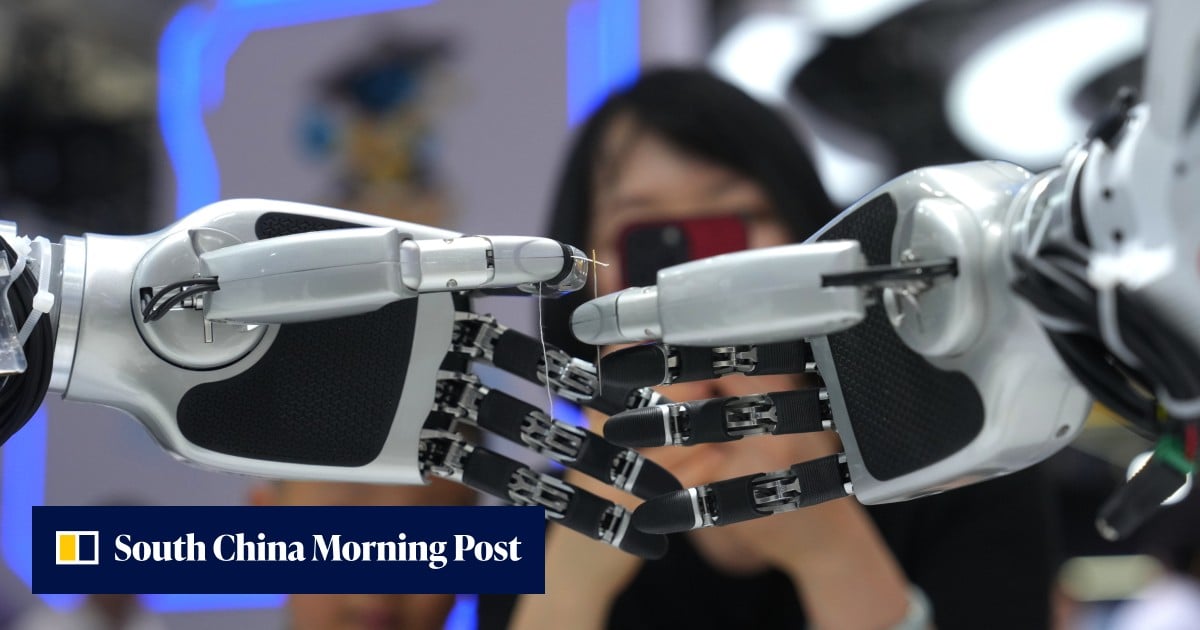
At the World Robot Conference in Beijing, while bipedal humanoids still drew crowds with their advanced movements, a growing trend among Chinese start-ups highlighted the development of more utilitarian robots. These machines, often wheeled or featuring traditional robotic arms, are designed for specific industrial tasks like sorting parcels or making coffee, emphasizing real-world ap…
Imagine robots are like toys. Some robots are super cool and can run, jump, and even play games, just like a fancy action figure. But at a big robot show in China, many companies showed off robots that weren't as flashy. Instead, these robots were really good at simple jobs, like sorting packages or making coffee, often moving on wheels instead of legs. It's like choosing a strong, reliable toy truck that can carry lots of blocks over a super-fast race car that can't carry anything, because the truck helps you get work done faster.
Analysis
The recent World Robot Conference (WRC) in Beijing served as a crucial barometer for the evolving landscape of robotics, particularly within China's burgeoning tech sector. While the allure of advanced humanoid robots, capable of complex movements like playing table tennis or engaging in mock fights, remained a significant draw for attendees, a more pragmatic trend was clearly discernible. This shift indicates a strategic pivot from showcasing technological prowess for its own sake to developing solutions that address tangible industrial needs and offer clear economic benefits. The emphasis is now firmly on deployment and integration into existing workflows, rather than merely demonstrating potential.
World Robot Conference
The WRC showcased a duality in the robotics industry's current state. On one hand, companies like Unitree Robotics captivated audiences with their bipedal models, demonstrating impressive levels of speed, balance, and coordination that have only recently become achievable. These demonstrations highlight the rapid advancements in robotic locomotion and control algorithms, pushing the boundaries of what humanoid forms can accomplish. However, these flashy displays were juxtaposed with a significant presence of robots designed for more mundane, yet critical, industrial applications.
Across the exhibition halls, numerous robots were observed performing tasks such as sorting parcels, loading production lines, and moving materials within factory settings. Many of these machines eschewed legs in favor of wheels or utilized conventional robotic arms, underscoring a preference for functional design over anthropomorphic aesthetics. This practical orientation suggests that while humanoids continue to inspire, the immediate commercial viability and scalability of robotics are found in specialized, task-oriented machines that can deliver measurable improvements in efficiency and productivity.
X Square Robot
One prominent example of this practical design philosophy was evident in the offerings from start-up X Square Robot. Yang Li, a senior engineer at the company, articulated the core question driving this shift: "If wheels can get the job done, do we really need two legs?" This query encapsulates the industry's growing focus on utility and return on investment for industrial users. While bipedal robots might be more visually impressive, factors such as payload capacity, reliability, and cost-effectiveness are paramount for businesses looking to integrate automation.
To illustrate this point, X Square Robot highlighted its two-armed WALL-B embodied model, which demonstrated superior efficiency in a controlled parcel-sorting test. The WALL-B was reported to sort 1,816 packages per hour, outperforming the bipedal Figure 03 robot from US start-up Figure AI, which managed an average of 1,248 parcels per hour. This direct comparison underscores the argument that for specific industrial tasks, a purpose-built design, even if less visually striking, can deliver significantly better performance and economic value, thereby accelerating adoption in real-world scenarios.
AI2 Robotics
Further reinforcing the trend towards practical application, another Chinese start-up, AI2 Robotics, presented a wheeled robot at the WRC that was actively making coffee and ice cream for visitors. This demonstration, while seemingly simple, showcased the versatility and adaptability of non-humanoid designs in service-oriented roles. The machine utilized different end effectors—a gripper on one arm and a dexterous hand on the other—to perform various tasks, highlighting its ability to handle diverse operational requirements.
This approach emphasizes modularity and functional specialization, allowing robots to be tailored precisely to the demands of a particular job. The ability to swap out end effectors means a single robotic platform can be reconfigured for multiple uses, enhancing its utility and justifying its investment. Such practical, adaptable designs are crucial for broader adoption in sectors beyond heavy industry, including retail, hospitality, and logistics, where specific, repeatable tasks can be efficiently automated without the complexities and costs associated with full humanoid forms.
Key points
- Chinese robot makers are prioritizing practical, industrial designs over flashy humanoid demonstrations.
- The World Robot Conference in Beijing highlighted a trend towards wheeled and conventional robotic arms for real-world deployment.
- Companies like X Square Robot are showcasing robots that are more efficient at tasks like parcel sorting than some bipedal humanoids.
- The industry is increasingly focused on factors such as payload, reliability, and return on investment for industrial users.
- AI2 Robotics demonstrated versatile wheeled robots capable of performing service tasks like making coffee and ice cream.
This shift towards practical, task-specific robots could accelerate the adoption of automation across various industries, leading to increased efficiency and productivity. By focusing on immediate utility and return on investment, Chinese manufacturers are paving the way for more accessible and economically viable robotic solutions globally.