Bitcoin Completes First Experimental Quantum-Safe Transaction, Starkware Says
Starkware announced the first experimental quantum-safe Bitcoin transaction was successfully mined on the mainnet, utilizing a method that protects against future quantum attacks without altering Bitcoin's core consensus rules.
Intelligence analysis by Gemini 2.5 Flash
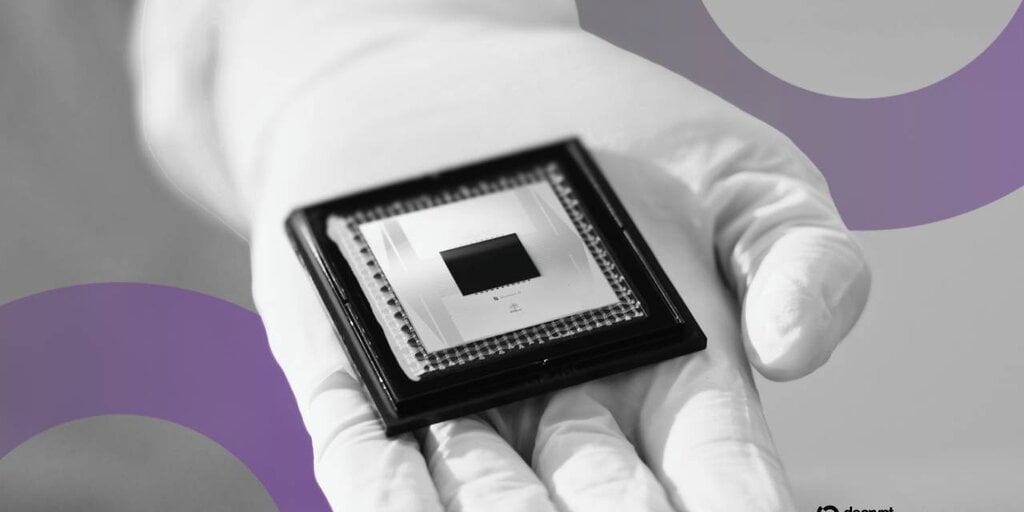
Blockchain infrastructure company Starkware has successfully conducted an experimental quantum-safe transaction on the Bitcoin mainnet. This innovative approach, developed by Starkware researcher Avihu Levy, employs hash-based security to safeguard Bitcoin funds from potential threats posed by future quantum computers, all while avoiding changes to the network's fundamental consensus …
Imagine Bitcoin is like a super-strong digital safe, but scientists are worried that super-fast future computers, called quantum computers, might learn how to pick its lock. A company called Starkware just tried a new, secret way to make a special lock for Bitcoin that even these super-fast computers can't pick, and they did it without changing the safe itself. It's like adding an extra-tough layer of protection to your piggy bank without having to buy a whole new one.
Analysis
The successful execution of a quantum-safe transaction on the Bitcoin mainnet marks a significant milestone in the ongoing effort to secure blockchain networks against emerging threats. While quantum computers capable of breaking current cryptographic algorithms are still theoretical, proactive measures are essential for the longevity and integrity of digital assets. Starkware's experimental transaction showcases a method that could provide a crucial layer of defense without necessitating disruptive changes to Bitcoin's foundational architecture, which is notoriously difficult to modify due to its decentralized nature and robust consensus mechanisms.
Starkware
Starkware, a prominent blockchain infrastructure company known for its work on the Ethereum layer-2 network Starknet, spearheaded this pioneering effort. The company's commitment to advancing cryptographic security extends beyond Ethereum, as demonstrated by this Bitcoin-focused initiative. By leveraging its research capabilities, Starkware aims to contribute to the broader blockchain ecosystem's resilience, ensuring that fundamental networks like Bitcoin remain secure against future technological advancements that could otherwise undermine their security guarantees. This positions Starkware as a key player in the ongoing evolution of blockchain security.
Their approach, dubbed Quantum-Safe Bitcoin (QSB), is a testament to innovative problem-solving within the constraints of existing blockchain protocols. The company's public announcement and detailed blog post highlight their transparency and dedication to sharing advancements with the community. While they acknowledge that a soft fork might be a more robust long-term solution, their current experimental method provides an immediate, non-invasive pathway to explore quantum resistance, offering valuable insights and practical demonstrations.
Avihu Levy
At the heart of this innovation is Starkware researcher Avihu Levy, who developed the Quantum-Safe Bitcoin (QSB) method. Levy's research, initially published in April, laid the theoretical groundwork for this practical application. His work focuses on utilizing hash-based security, a cryptographic technique that is generally considered more resistant to quantum attacks compared to the elliptic curve cryptography currently used by Bitcoin.
Levy's contribution underscores the importance of academic and research-driven efforts in anticipating and mitigating future technological risks for critical infrastructure like Bitcoin. By translating complex cryptographic theory into a demonstrable, albeit experimental, solution, he has provided a tangible step forward in the quest for quantum resistance. This highlights the collaborative nature of blockchain development, where individual researchers play a pivotal role in shaping the future security landscape of decentralized networks.
Tomer Gi
Starkware engineer Tomer Gi played a crucial role in the practical implementation of Avihu Levy's research, bringing the Quantum-Safe Bitcoin (QSB) method to life on the Bitcoin mainnet. Gi's involvement demonstrates the critical bridge between theoretical cryptographic research and its real-world application within complex blockchain systems. His engineering expertise was essential in translating the conceptual framework into a functional transaction that could be successfully mined and verified on Bitcoin's established network.
This collaboration between research and engineering within Starkware highlights an effective model for addressing advanced security challenges. Gi's work ensured that the quantum-safe transaction adhered to Bitcoin's existing operational parameters, proving that such a defense mechanism could be integrated without requiring immediate, fundamental changes to the protocol. This practical demonstration is vital for validating the feasibility and potential impact of quantum-resistant solutions for Bitcoin.
Key points
- Starkware announced the first experimental quantum-safe Bitcoin transaction was mined on the mainnet.
- The method, called Quantum-Safe Bitcoin (QSB), uses hash-based security to protect against quantum attacks.
- It was developed by Starkware researcher Avihu Levy and implemented by engineer Tomer Gi.
- The transaction was achieved without altering Bitcoin's existing consensus rules.
- Starkware still views a soft fork as a preferred long-term defense against quantum computers.
This experimental transaction offers a promising glimpse into Bitcoin's future resilience, demonstrating that quantum-safe measures can be implemented without disrupting the network's core. If further developed and adopted, this could effectively future-proof Bitcoin against theoretical quantum attacks, ensuring its long-term security and stability.
While a positive step, this remains an experimental method, and Starkware itself suggests a soft fork might be a more robust long-term solution. There's a risk that the current approach might not be fully comprehensive or scalable, potentially leaving Bitcoin vulnerable if quantum computing advances faster than these defenses can be universally adopted.