Bitcoin selloff continues as prices slide below $63,000 for the first time since February
Bitcoin fell below $63,000 for the first time since February, extending a weeklong slide and pushing volatility and ETF outflows higher.
Intelligence analysis by GPT-5.4 Mini
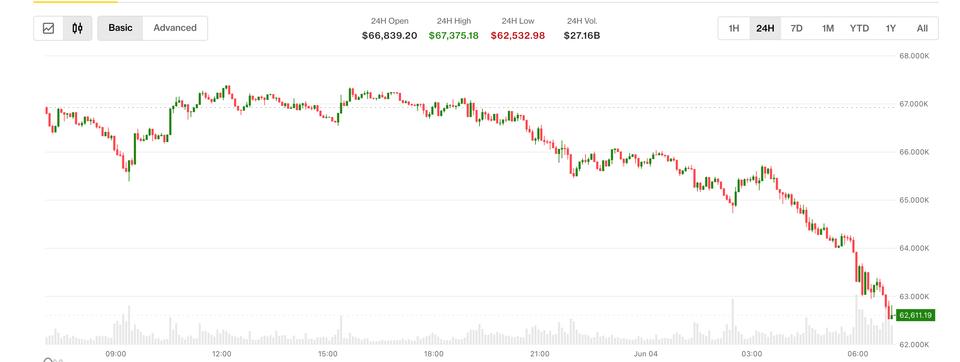
Bitcoin’s decline accelerated as it lost a key price level, with traders buying protection and U.S.-listed spot ETF outflows stretching into a 13th day. Analysts point to weak catalysts, shifting liquidity, and Mt. Gox-related selling concerns as reasons the move could continue.
Bitcoin just slipped below a line that many traders were watching, like a toy rolling off a shelf. When that happens, people get nervous, buy safety gear, and sometimes keep selling until the toy finds a new place to stop.
Analysis
What happened
Bitcoin dropped to about $63,000, its lowest level since February 24, and is down more than 14% on the week and 21% over the past four weeks, according to CoinDesk data. The move pushed the 30-day implied volatility gauge, BVIV, to 53.17, its highest level since April 2, showing that traders are paying up for protection.
Why the market is nervous
The article says U.S.-listed spot bitcoin ETFs saw another $50 million in outflows on Wednesday, extending a run of 13 straight trading days of withdrawals. That matters because those funds are widely treated as a barometer for institutional demand. Paul Howard of Wincent said the selloff began with Strategy-related transfer activity that helped trigger ETF outflows, and is now being reinforced by speculation around Mt. Gox liquidations.
Levels traders are watching
Some market participants are focusing on the low-$60,000 area as support. Material Indicators pointed to the local low near $59.9k and the 200-week moving average in the same region. Their view was not that this level guarantees a floor, but that it is a zone where the market has to make a decision.
The broader message from the piece is that bitcoin is losing momentum while liquidity rotates elsewhere, including into artificial intelligence-linked assets. With no clear fresh catalyst in sight, the article suggests volatility may stay elevated and the market may remain under pressure until buyers step back in.
Key points
- Bitcoin fell to about $63,000, its lowest level since February 24.
- The asset is down more than 14% this week and 21% over the past four weeks.
- 30-day implied volatility rose to 53.17, the highest level since early April.
- U.S.-listed spot bitcoin ETFs posted their 13th straight day of outflows.
- Traders are watching the low-$60,000 region, with some eyeing $50,000 as a possible bottom.
If the low-$60,000 area holds, the market could stabilize after the recent fast drop. That would give buyers a clear place to step back in and could ease the pressure from volatility and ETF outflows.
If ETF withdrawals keep going and no new catalyst appears, the selloff could keep spreading. The article also notes that some traders are already talking about $50,000 as a possible bottom, which implies more downside could still be on the table.