Bitcoin’s compute power dwarfs top 100 supercomputers by 600k times, says Bittensor co-founder
At a Paris summit, Bittensor co-founder Ala Shaabana argued decentralized networks can outscale corporate data centers for AI.
Intelligence analysis by GPT-5.4 Mini
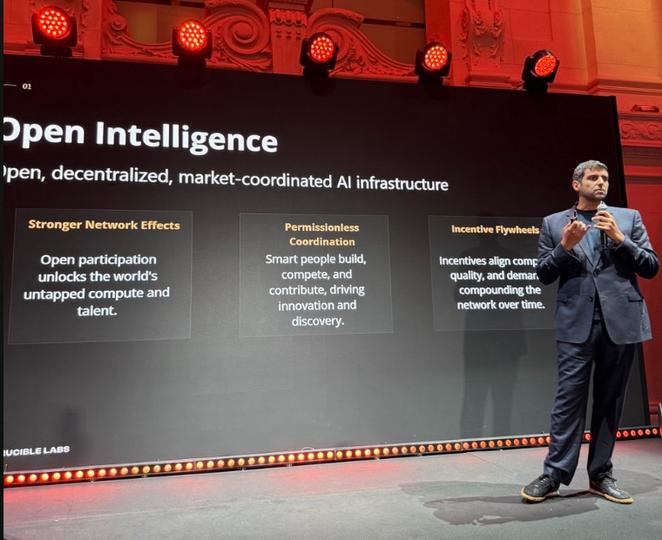
Ala Shaabana used Bitcoin’s scale as proof that incentive-driven, distributed networks can marshal massive compute without a central operator. He said Bittensor applies that same playbook to AI through subnets that reward specific tasks.
Shaabana says Bitcoin is like a giant team of computers working together, bigger than the top supercomputers by a huge amount. He thinks Bittensor uses the same team idea for AI, like giving each kid in a class a different job and a prize for doing it well.
Analysis
What Shaabana argued
At the Proof of Talk summit in Paris, Bittensor co-founder Ala Shaabana said decentralized networks are becoming the backbone of global computing power, not just corporate data centers. He pointed to Bitcoin as the clearest example, saying its hash rate is more than 600,000 times the combined power of the top 100 supercomputers.
How Bittensor fits the argument
Shaabana described Bittensor as a Layer 1 network built on a Bitcoin-like philosophy: a fixed 21 million token supply, hardcoded halvings, no pre-mine, and no venture capital. Instead of mining hashes, Bittensor uses the same style of incentives to coordinate AI work. The network is organized into 128 specialized subnets, each with its own goal, and miners earn TAO rewards by meeting the subnet’s target.
That structure is the core of his thesis. If a network rewards speed, participants optimize for speed; if it rewards storage, they optimize for storage. In his view, that means open networks can direct global hardware and talent more efficiently than centralized firms.
The larger claim
Shaabana said the long-term bull case is no longer only about technology. He framed it as being driven by debt, liquidity, and declining trust in sovereign systems. In that framing, subnets are not just technical modules; they are markets that tell participants what to optimize for, and therefore shape the network’s intelligence.
The article does not test those claims, but it does show the pitch Bittensor is making: decentralized incentives can coordinate compute and AI work at a scale that rivals or exceeds traditional corporate systems.
Key points
- Ala Shaabana made the case at Proof of Talk in Paris that decentralized networks can rival corporate compute infrastructure.
- He said Bitcoin’s hash rate is over 600,000 times the combined power of the top 100 supercomputers.
- He described Bittensor as a Bitcoin-like Layer 1 with 128 specialized subnets for AI tasks.
- Shaabana argued that incentive design determines what a decentralized network optimizes for.
- He said the long-term case for these networks is tied to debt, liquidity, and declining trust in sovereign systems.
If the incentive model works as described, Bittensor’s subnets could help direct global hardware toward useful AI tasks without relying on one big company. That would support the article’s claim that open networks can coordinate compute and intelligence at very large scale.
The argument depends on incentives producing the right behavior, and the article itself notes that what participants optimize for is determined by the reward design. If the incentives are poorly set, the network could reward the wrong outcomes or fail to compete with centralized systems.