BJP chief Nitin Nabin's Patna bastion falls, Prashant Kishor storms into House
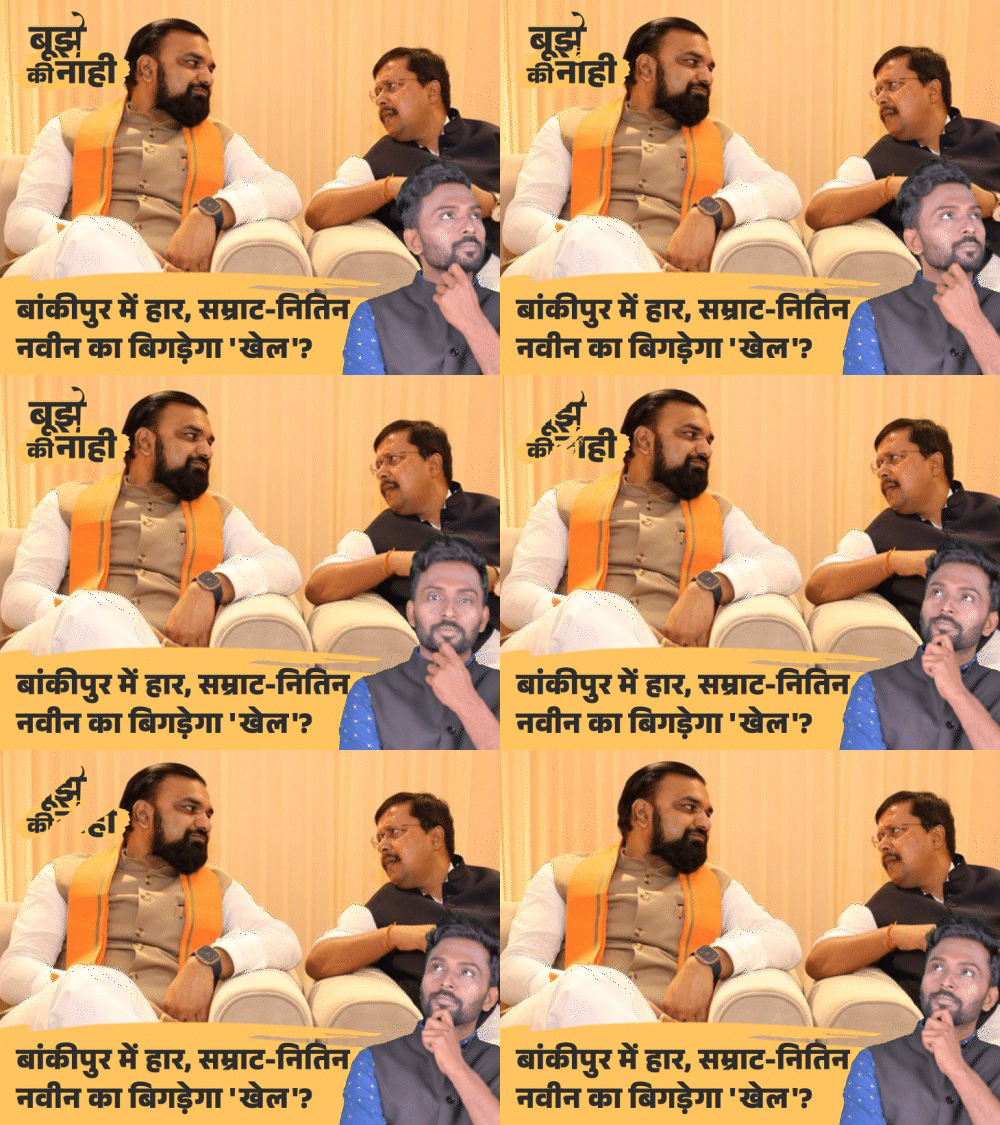
Jan Suraaj Party founder Prashant Kishor defeated BJP's Neeraj Kumar by 19,324 votes in the Bankipur Assembly bypoll, ending the BJP's 30-year hold on the Patna seat that had been the stronghold of BJP national president Nitin Nabin and his late father.
Intelligence analysis by Llama

Prashant Kishor's thumping bypoll win in Bankipur ends three decades of BJP dominance in the Patna urban seat, breathing life into his fledgling Jan Suraaj Party and exposing fault lines within the NDA over Chief Minister Samrat Choudhary's elevation.
Imagine a team that has won the same local game for 30 years in a row. A new player, Prashant Kishor, just beat them by a big score, and the team captain's own hometown watched it happen. People are upset because the team's new coach is from a different background, and they wanted more than just free snacks — they want better schools, jobs and hospitals.
Analysis
A Camel Among a Hundred Elephants
Kishor's own framing of his win captures the magnitude of the upset. He described the result as the collapse of a "30-year fortress" in "30 days," and the bypoll numbers back him up. He defeated BJP's Neeraj Kumar, a last-minute replacement candidate, by 19,324 votes in a seat that the BJP had held since 1995 through Nitin Nabin and before him his late father Nabin Kishore Prasad Sinha. The Bankipur constituency, carved out of Patna West in 2008, was vacated earlier this year when Nitin Nabin moved to the Rajya Sabha after being elected national president. That the BJP could not retain a seat so closely identified with its own top office-bearer is the central political story. As one voter quoted in the piece put it, Kishor in the Assembly could be "a camel standing out among 100 elephants," a reference to the NDA's commanding 201-seat majority.
The Choudhary Question
The bypoll exposed a fault line that the BJP will find difficult to paper over. The choice of Samrat Choudhary, an OBC Kushwaha, as Chief Minister in April to succeed Nitish Kumar appears to have cost the party upper-caste support in Bankipur, a traditionally urban, upper-caste and OBC seat. A Bihar official cited in the report identified upper-caste resentment over Choudhary's elevation as one of two decisive local factors, alongside the BJP's decision to field a relatively low-profile replacement candidate. With Nitish Kumar no longer serving as the glue between upper castes, OBCs and Extremely Backward Castes, any attempt by the BJP to pacify its upper-caste base risks alienating the OBC and EBC voters that Choudhary himself represents. That dilemma is now the defining internal challenge for the ruling alliance in Bihar.
Kishor's Second Act
The bigger political story may be Kishor himself. His Jan Suraaj Party had managed just 3.44% of the vote in its November 2025 debut, prompting questions about whether his pivot from political strategist to politician had run aground. Bankipur revives that project. The win showed that traditional caste and religious divisions softened around his candidature, with Muslim, upper-caste and other voters coalescing behind him. The RJD, which had finished second in Bankipur in 2025, slipped to a distant third, and the BJP could not leverage anti-Lalu sentiment against Kishor. The cautionary note, as the article flags, is that Kishor's party still does not pose a pan-Bihar challenge, and the upper-caste shift toward him could reverse in a general election. But as an active opposition voice in the Assembly, and with the 2029 Lok Sabha polls as a horizon, Kishor now has both a platform and a proof point.
Key points
- Prashant Kishor defeated BJP's Neeraj Kumar by 19,324 votes in the Bankipur Assembly bypoll, ending 30 years of BJP dominance in the Patna seat.
- The seat was previously held by BJP national president Nitin Nabin and before him his late father, and fell vacant when Nabin moved to the Rajya Sabha.
- Kishor framed the contest as a referendum on CM Samrat Choudhary, an OBC Kushwaha whose April elevation has drawn upper-caste resentment.
- The RJD, which finished second in Bankipur in 2025, slipped to a distant third, indicating cross-community consolidation behind Kishor rather than a Muslim-Yadav transfer to the RJD.
- JSP had won just 3.44% of votes in its November 2025 debut; Bankipur revives Kishor's position as an active opposition voice in the Bihar Assembly ahead of the 2029 Lok Sabha polls.
Kishor's victory gives the Jan Suraaj Party a credible opposition platform in the Bihar Assembly and a template for issue-based campaigning that cuts across caste lines. If the BJP's central leadership reads the result as a warning, as Kishor urged, the pressure could translate into sharper focus on jobs, education, healthcare and industry in Bihar ahead of the 2029 Lok Sabha elections.
The BJP's quandary over balancing upper-caste and OBC/EBC support has no easy resolution without Nitish Kumar as a unifying figure, and the wrong move could deepen internal coalition tensions. Kishor's win is built on a single urban seat and a Brahmin-led personal vote; the Jan Suraaj Party has not demonstrated a pan-Bihar organisation, raising the risk that the Bankipur result is an exception rather than a trend.