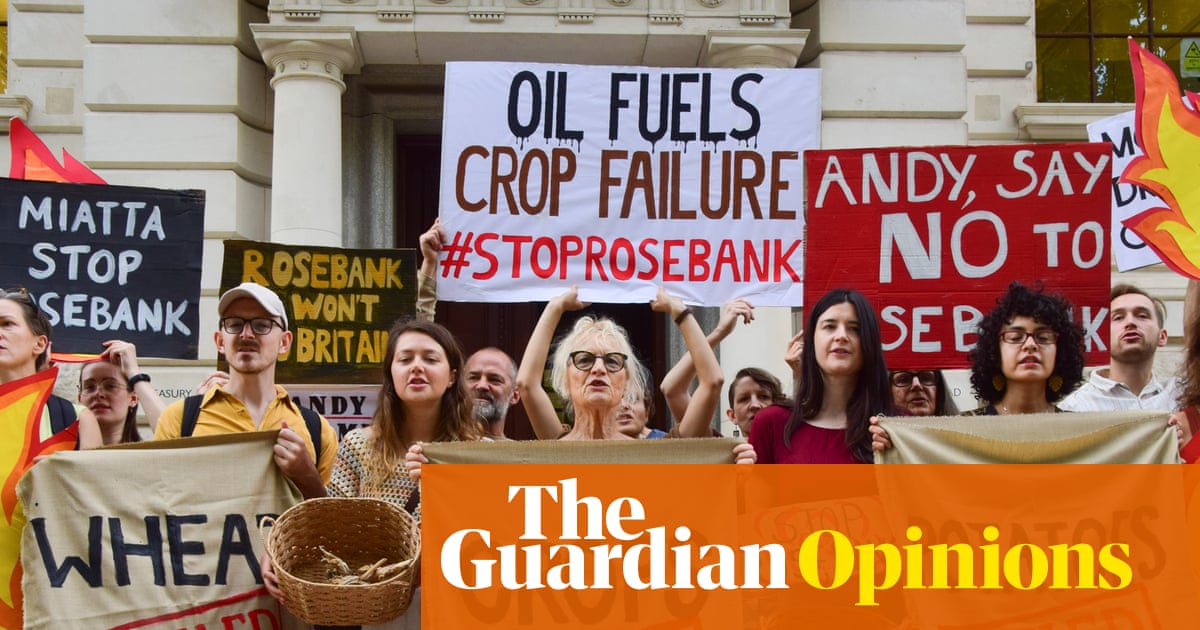
Can Burnham justify giving the go ahead to oil drilling? Yes, but these must be the conditions | Michael Jacobs
The UK government faces a critical decision on approving the Rosebank and Jackdaw oil and gas fields, balancing energy security with net-zero climate commitments.
Intelligence analysis by Gemini 2.5 Flash
Prime Minister Andy Burnham is under pressure to decide on two North Sea oil and gas fields, Rosebank and Jackdaw, following a court ruling that invalidated previous environmental assessments. The article argues that while Jackdaw might be justifiable for domestic energy security, the much larger Rosebank field requires stringent carbon capture and storage conditions to align with the…
Imagine the UK needs energy, like fuel for cars and heating homes. There are two big pockets of oil and gas under the sea, called Rosebank and Jackdaw. The government has to decide if it's okay to dig them up. Jackdaw is like a small snack that helps a little bit now, but Rosebank is a huge meal that will last a very long time, even when the UK wants to stop using so much dirty energy. To make Rosebank okay, the government might ask the companies to promise to clean up the pollution it causes, like using a special vacuum cleaner for carbon, so it doesn't harm the planet too much.
Analysis
The UK government, led by Prime Minister Andy Burnham, is at a crossroads regarding the approval of two significant North Sea energy projects: the Rosebank oilfield and the Jackdaw gasfield. This decision is complicated by a recent court ruling that found previous environmental impact assessments unlawful, necessitating a fresh review that includes the global emissions from burning the extracted fuels. The core challenge lies in reconciling the immediate demands for energy security, particularly in light of global supply uncertainties, with the UK's legally binding net-zero emissions targets under the Climate Change Act and its commitments under the Paris Agreement.
Rosebank
Rosebank stands out as a particularly contentious project due to its substantial size and projected longevity. With an estimated production life of 25 years, it is expected to generate around 250 million tonnes of carbon emissions. Crucially, its operations would extend beyond 2050, the year by which the UK is legally mandated to achieve net-zero emissions. Furthermore, the oil extracted from Rosebank would be refined in the Netherlands, meaning it would contribute little, if anything, to the UK's domestic energy security. Its significant contribution to global oil supply, especially between 2040 and 2050 when global demand is expected to decline, raises serious concerns about its impact on international climate policy and the overall trajectory of global emissions.
Jackdaw
In contrast to Rosebank, the Jackdaw gasfield presents a different set of considerations. It is a much smaller project with a shorter production life of only 11 years, ceasing operations by 2037-2038. Its total carbon emissions are estimated at a comparatively modest 24 million tonnes, equating to approximately 0.8% of the UK's total annual emissions. The gas from Jackdaw would be piped directly into the UK for domestic consumption, potentially displacing dirtier imported liquified natural gas (LNG) from the US. This aspect allows for a more plausible justification on grounds of energy security and a minor contribution to emissions reduction, making it a less problematic proposition than Rosebank.
Carbon Capture and Storage
The article proposes that carbon capture and storage (CCS) technology offers a viable pathway for Rosebank to align with the UK's net-zero commitments. By making CCS a mandatory condition for its licence, the government could require Rosebank's owners to pay for the capture and storage of an equivalent volume of emissions, primarily those generated when its oil is burned. This approach would effectively offset the project's carbon footprint. CCS is a proven technology, with examples like Equinor's Sleipner field in Norway demonstrating its long-term effectiveness in storing CO2 without leakage since 1996. The UK already has a national CCS programme with 21 licensed projects. Integrating Rosebank into this framework, potentially with government support, would test the industry's commitment to net-zero and ensure that any new fossil fuel extraction is genuinely compatible with the nation's climate goals.
Key points
- The UK government must decide on the approval of the Rosebank oilfield and Jackdaw gasfield following a court ruling on environmental assessments.
- Jackdaw is a smaller, shorter-term gasfield that could contribute to UK energy security by displacing imported LNG.
- Rosebank is a large, long-term oilfield whose production would extend beyond the UK's 2050 net-zero deadline and contribute significantly to global emissions.
- The article suggests that Rosebank's approval should be conditional on its owners paying for carbon capture and storage (CCS) of its emissions.
- CCS is presented as a proven technology that could make Rosebank compatible with the UK's domestic and international climate commitments.
If the government approves Rosebank with strict carbon capture and storage conditions, it could demonstrate a pragmatic approach to energy transition, ensuring energy security while fostering investment in crucial CCS technology. This could set a precedent for future fossil fuel projects globally, proving that extraction can be made compatible with net-zero targets.
Should Rosebank be approved without robust and enforceable carbon capture conditions, it risks undermining the UK's net-zero commitments and international climate credibility. This could lead to increased global emissions, disincentivize investment in renewable energy, and potentially lock the UK into a long-term reliance on fossil fuels that contradicts its climate goals.
Market signals
- OIL Approval of the large Rosebank oilfield could contribute materially to global oil supply for decades, potentially impacting future prices.
AI-generated analysis of potential market relevance. Not financial advice.